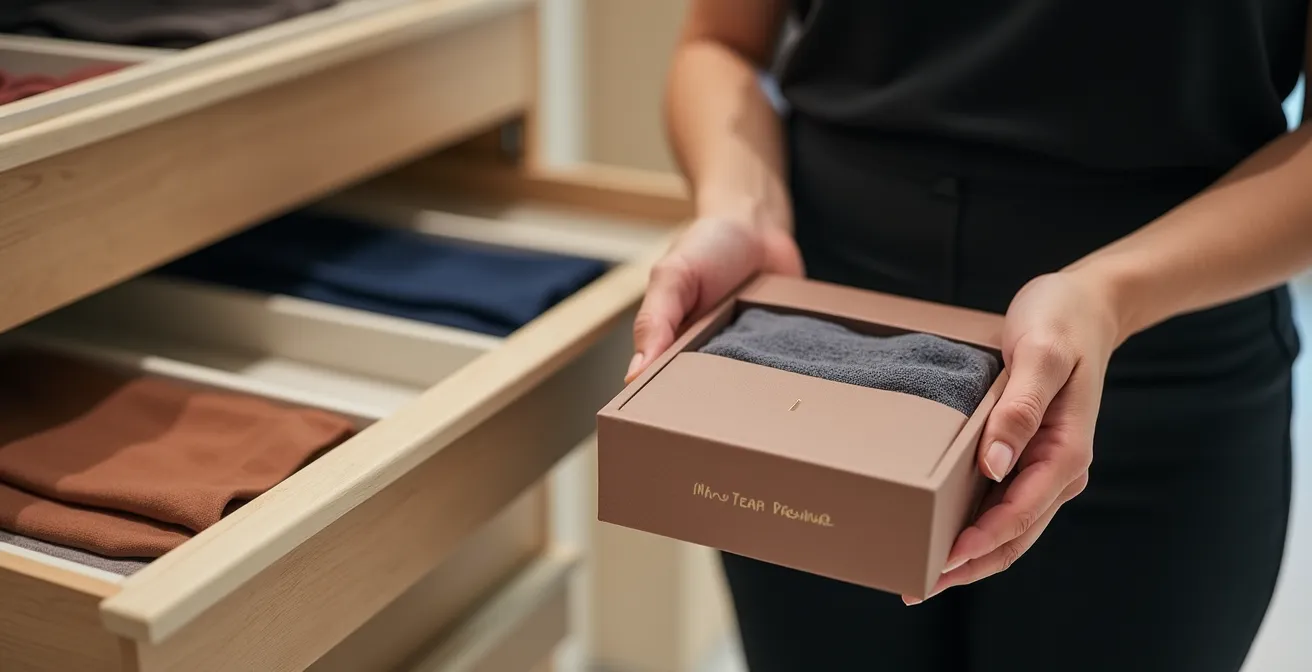
Buying underwear for your partner is fraught with risk, but the secret isn’t guessing his size—it’s approaching it as a project of ‘intimate engineering’.
- Forget his jeans size; it’s often a vanity-sizing trap. Your mission is to find his true waist measurement.
- Focus on a ‘subtle upgrade’ to premium fabrics and fits, which boosts both his comfort and his confidence.
Recommendation: Start by discreetly checking the labels on his best-fitting current pairs and invest in a single, high-quality pair in a classic style as a test case.
Let’s be honest. You’ve seen that frayed, tired-looking three-pack of boxers in his drawer. You’ve considered taking matters into your own hands, but the fear is real. Buying underwear for a man is a minefield of potential missteps. Go too bold, and you risk a gift that’s met with a forced smile and relegated to the back of the drawer. Go too safe, and you’ve just spent money on something he could have bought himself. The common advice to just “buy his jeans size” or grab some “funny” novelty pair often leads to disappointment and ill-fitting garments.
This is where most guides stop. They give you a list of brands and wish you luck. But what if the entire approach is wrong? What if the key isn’t just to replace his old underwear, but to execute a subtle, thoughtful upgrade to his daily comfort and confidence? This guide reframes the task from a risky purchase to an act of what we’ll call ‘intimate engineering’. It’s about understanding the nuances of fit, fabric, and psychology to give a gift that feels less like a suggestion and more like an indulgent discovery.
We’ll move beyond the basics and decode the real-world challenges: why his jean size is a lie, how to nudge him from sloppy boxers to sophisticated briefs without bruising his ego, and understanding the materials he’ll actually want to wear. This is your playbook for turning a potential gifting faux pas into a resounding success that benefits you both.
Summary: A Partner’s Guide to Buying Men’s Underwear
- Why is buying his “jeans size” often a mistake for underwear?
- How to encourage him to switch from loose boxers to briefs without hurting his ego?
- Cotton vs Modal: Which does he actually prefer vs what you think feels nice?
- The gift mistake of buying “funny” underwear that never gets worn
- When is matching underwear cute versus when is it cringe?
- Bold Prints vs Solid Classics: Which projects the confidence you want to feel?
- How does changing your lingerie style reactivate dopamine in long-term relationships?
- How has the UK men’s underwear market shifted from “3-pack essentials” to luxury fashion?
Why is buying his “jeans size” often a mistake for underwear?
The most common mistake in buying men’s underwear is assuming his “32-inch waist” jeans correspond to a 32-inch underwear size. This assumption is the primary source of fit issues. The fashion industry, particularly in denim, widely employs a practice known as ‘vanity sizing’, where garments are labelled with smaller sizes than their actual measurements to flatter the customer. This isn’t just a hunch; a 2011 UK study found misleading labels on over half of checked items, with some trousers understating waist circumferences by up to 2 inches. Relying on this number is a recipe for buying underwear that is too loose and unsupportive.
Underwear, unlike a pair of jeans, requires a precise fit to provide support and comfort. It sits directly against the skin, and any excess fabric or tightness is immediately noticeable and irritating. A man’s actual waist measurement—taken with a tape measure around the navel—is the only reliable data point. This is the foundation of intimate engineering: starting with accurate data, not flattering fiction. If you get the sizing right, you’ve won half the battle before he even sees the design.
Furthermore, different brands and styles have different cuts. A “Medium” in a classic brief might have a completely different fit from a “Medium” in a modern trunk style, especially when considering space for the thighs and seat. Ignoring these details and defaulting to a jean size is like trying to build a house with a metre stick that has the first ten centimetres missing. The structure is doomed from the start.
Your Undercover Sizing Mission: A 5-Step Plan
- Gather Intelligence: On your next laundry day, discreetly check the labels of his favourite, best-fitting pair of underwear. Note the brand and the size (e.g., “M” or “32-34”). This is your primary clue.
- Find the True Measurement: If you can’t find a label, the next mission is to get a true waist measurement in inches. If you can’t do it directly, find a pair of his trousers that fits well (not jeans!), lay them flat, and measure the waistband from one side to the other. Double that number to get a close approximation of his waist size.
- Consult the Brand’s Chart: Once you have a target brand, visit their website. Every reputable underwear brand has a detailed size chart. Cross-reference your intel (the “M” or the inch measurement) with their specific recommendations.
- Analyse the Cut: Read the product description. Does it mention a “slimmer fit” or “more room for larger thighs”? Brands like Real Men Real Style advise checking if pants come equipped for specific needs, which is crucial for athletic builds. Choose a style that matches his body type.
- Execute a Test Purchase: Don’t buy a multipack. Buy a single pair of the style you’ve selected. This is your low-risk test run to confirm your sizing hypothesis before committing further.
How to encourage him to switch from loose boxers to briefs without hurting his ego?
Suggesting a man change a habit as ingrained as his choice of underwear can feel like criticising his very identity. Many men have worn the same style—often loose, baggy boxers—since their teenage years. A direct, “You should wear these instead,” can easily be interpreted as, “I don’t like what you wear,” which can shut down the conversation immediately. The key is to frame the change not as a correction, but as an invitation to an upgrade. It’s not about taking away his comfortable old boxers; it’s about introducing him to a new level of comfort and support he didn’t know was possible.
The strategy is one of positive reinforcement and agency. Instead of making the choice *for* him, you empower him to make it *with* you. This could involve gifting him a premium pair of boxer briefs or trunks and framing it as a luxury item. Use language like, “I saw these and thought of you—the fabric felt incredible,” rather than, “I think you’d look better in these.” This shifts the focus from his appearance to a shared appreciation for quality. It makes the gift an indulgent treat, not a homework assignment.

Another powerful tactic is the gift card approach. Gifting him a voucher for a premium underwear brand gives him full control. You can say, “I’ve heard amazing things about this brand’s comfort, but you’re the expert on what feels right. I’d love for you to pick something out.” This respects his autonomy while gently guiding him towards higher-quality options. You are curating the shop, but he is the one making the final selection. This collaborative approach removes any perception of criticism and turns the upgrade into a shared, fun project, creating that comfort-confidence loop from a place of mutual respect.
Cotton vs Modal: Which does he actually prefer vs what you think feels nice?
When it comes to underwear fabric, there’s often a disconnect between what you might think feels luxurious and what he finds genuinely comfortable for all-day wear. Classic cotton is the dependable default for good reason: it’s breathable, durable, and familiar. However, the world of men’s underwear has evolved significantly, with modern materials like Modal and MicroModal offering a completely different experience. These semi-synthetic fabrics, made from beech tree pulp, are exceptionally soft, moisture-wicking, and resistant to shrinking and pilling. They have a silk-like feel that drapes rather than constricts.
The choice is not simply about which is “better,” but which is right for the context—both his lifestyle and even the UK climate. For a man who values classic, breathable reliability for everyday wear, a high-quality Pima or Supima cotton is an excellent choice. But for a man who commutes on a packed London Tube or is active throughout the day, the moisture-management and supreme softness of Modal can be a game-changer. The ‘intimate engineering’ approach involves matching the material’s properties to his daily life. This is where you can find a solid balance of comfort and design, as experts suggest the sweet spot for quality is often between £15–£25 per pair.
Ultimately, his preference is what matters. While the silky feel of Modal might appeal to you, he might initially prefer the familiar structure of cotton. A great strategy is to introduce a blend. Many premium brands offer cotton-Modal blends that provide the best of both worlds: the structure and breathability of cotton with the softness and moisture-wicking properties of Modal. This can be the perfect gateway fabric to help him discover new levels of comfort.
| Material | Best For | UK Context |
|---|---|---|
| Cotton | Daily wear, breathability | Marks & Spencer’s reliable Cool & Fresh line is moisture-wicking and affordable |
| Modal/MicroModal | Luxury feel, moisture management | Ideal for London Tube commuters dealing with packed carriages |
| Bamboo | Eco-conscious, antibacterial | CDLP.com & BAM.co.uk focus on sustainable, premium basics |
The gift mistake of buying “funny” underwear that never gets worn
The allure of novelty underwear—adorned with cartoon characters, silly puns, or festive themes—is a trap many well-intentioned gift-givers fall into. It seems like a fun, lighthearted present, but it almost always misses the point of what makes underwear a good gift. The goal is to enhance his daily life with comfort and confidence, not to give him a gag item that elicits a one-time chuckle before being banished to what can only be called the “drawer of shame.”
Funny underwear fails on two fundamental levels: comfort and confidence. The fabrics are often cheap polyester, which doesn’t breathe well, and the prints can be stiff and uncomfortable against the skin. More importantly, it undermines the ‘intimate engineering’ goal of making him feel good. While he might wear it once to be a good sport, he’s unlikely to reach for the “hilarious” pair when he has an important meeting or a first date. It’s a joke, and you don’t build confidence on a joke. The most successful gift is one that seamlessly integrates into his life.
The true measure of great underwear is that it becomes invisible. It’s a principle that applies perfectly to this gift-giving scenario.
The best underwear is the type you don’t consider again after you’ve put it on: those styles you’re not conscious about wearing and that are comfortable. Underwear that requires constant adjusting is a no-no.
This is the ultimate test. Does the gift add to his comfort, or does it become a source of self-consciousness and physical adjustment? Novelty underwear almost always falls into the latter category. Instead of aiming for a laugh, aim for a silent nod of appreciation every morning when he puts on a pair that feels exceptionally good. That is the true gift.
When is matching underwear cute versus when is it cringe?
The idea of matching underwear for couples can conjure images of cheesy, identical sets that feel more performative than personal. This is where the line between ‘cute’ and ‘cringe’ is drawn. The cringeworthy approach is literal, identical matching—the same pattern, the same bright colour, worn with the expectation of a social media post. It often lacks subtlety and can feel forced, especially if one partner is more reserved than the other. It puts the focus on the novelty of “twinning” rather than on shared intimacy.
The ‘cute’ and genuinely intimate approach, however, lies in subtle coordination. This isn’t about wearing identical pairs; it’s about choosing underwear in complementary colours, a shared premium fabric, or from the same sophisticated brand. Think a deep navy for him and a soft grey for you, or both of you wearing something made from ultra-soft Modal. This creates a secret, shared connection that is for you two alone. It’s a playful secret that doesn’t need an audience. It’s a way of saying “we’re a team” in a way that is personal and private.
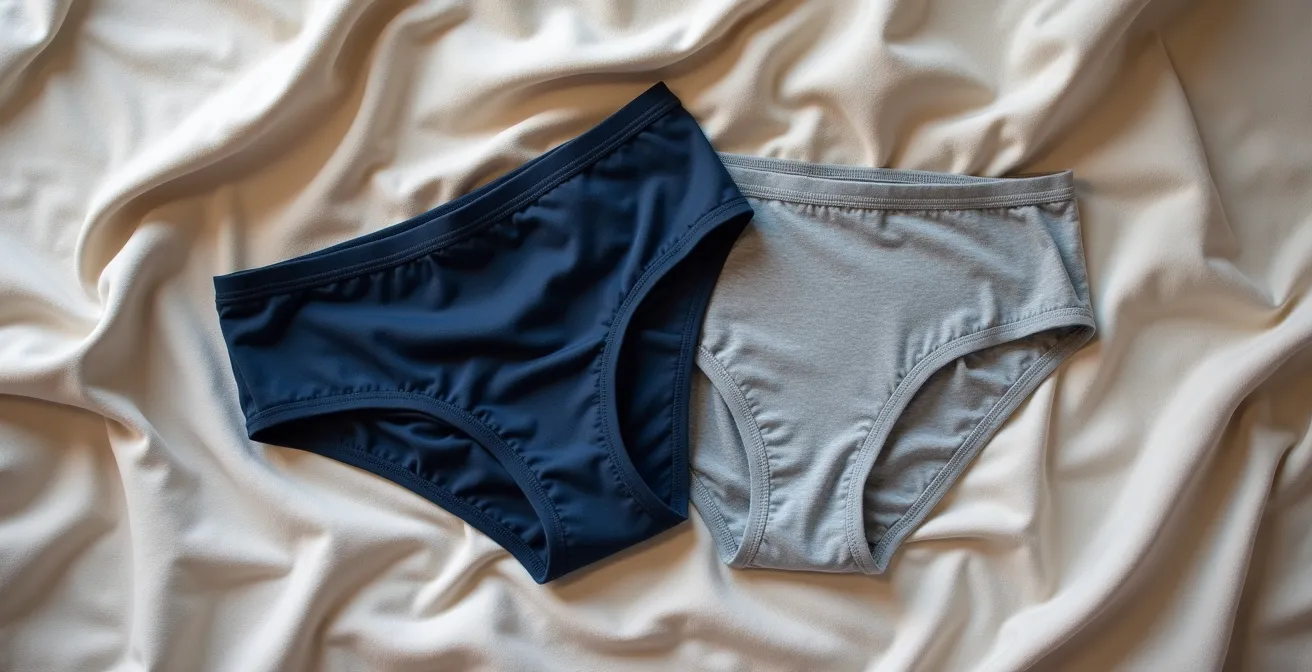
This subtle coordination can be particularly powerful in long-distance relationships. It becomes a tangible reminder of your partner. Every time you wear your coordinated set, you’re reminded of the private language you share. The key is that the underwear must stand on its own merits first. Both pairs should be stylish, comfortable, and something you would each happily wear regardless of the matching element. The coordination is the bonus layer of intimacy, not the primary reason for being. When done this way, it’s a sophisticated and modern way to feel connected.
Bold Prints vs Solid Classics: Which projects the confidence you want to feel?
The choice between a bold, expressive print and a classic, solid colour is a reflection of personal style and the type of confidence one wants to project. There isn’t a right or wrong answer, but each choice sends a different signal. Classic solids—particularly in dark tones like navy, charcoal, black, and burgundy—project a quiet, understated confidence. They operate on an “if you know, you know” basis. A man wearing a perfectly fitted pair of solid-coloured, premium briefs doesn’t need a loud pattern to make a statement. The statement is in the quality of the garment and the precision of the fit. Esteemed British brands have built their reputations on this very principle, proving that timeless style is its own form of power.
This choice taps directly into the comfort-confidence loop. A classic solid is versatile and sophisticated, suitable for any occasion, from a high-stakes business meeting to a formal event. It provides a clean, seamless foundation under any clothing, ensuring there are no distracting patterns showing through light-coloured trousers. This reliability breeds a sense of composure and control. It’s the sartorial equivalent of a firm handshake—assured and confident without needing to shout.
Bold prints, on the other hand, project a different kind of confidence: one that is more playful, creative, and expressive. A geometric pattern or an abstract design can be a form of personal expression, a flash of personality hidden beneath a professional exterior. They are best suited for more casual contexts, like weekends or creative environments. The risk with prints is that they can quickly look dated or, if the design is too loud, can veer into the “novelty” territory we’ve already discussed. The most successful prints are often subtle, geometric, or abstract, rather than pictorial or cartoony. They add a touch of individuality without sacrificing sophistication.
How does changing your lingerie style reactivate dopamine in long-term relationships?
In any long-term relationship, the initial spark of novelty inevitably fades into comfortable familiarity. Neurobiologically, this is linked to the dopamine system. Dopamine is a neurotransmitter associated with pleasure and reward, and it is potently activated by new stimuli. This is often called the “Coolidge Effect,” where a new partner can reignite desire. However, the science also shows us how to harness this effect *within* a committed relationship, and it doesn’t require new partners—it requires new experiences. Introducing novelty, even in small ways, can re-engage those same reward pathways in the brain.
Research has confirmed this link between newness and brain chemistry. In studies, dopamine neurons were activated by new smells, but not by familiar ones. This principle extends to our visual and tactile senses. When you or your partner deviates from the “usual” underwear style, you are introducing a novel stimulus. Seeing your partner in a new, sophisticated style of briefs after years of seeing loose boxers, or revealing a new lingerie set yourself, interrupts the pattern of expectation. This small “surprise” can be enough to trigger a small dopamine release, creating a moment of renewed attention and arousal.
This isn’t about a dramatic overhaul but about introducing small, exciting variables. As experts in the field note, this is a well-established strategy for maintaining desire.
Research points to several evidence-based approaches. One involves deliberately introducing novelty into the relationship. This doesn’t necessarily mean new partners—it means new experiences. Trying new activities together, especially ones involving excitement or mild risk, activates similar dopamine pathways as partner novelty. Adventure, travel, learning new skills together—these experiences can transfer arousal to your partner and relationship.
– Science Array, The Coolidge Effect: Why Novelty Drives Sexual Desire
Upgrading his underwear or your own is a low-risk, high-reward way to introduce this kind of novelty. It’s a new experience shared in an intimate context, creating a small jolt in the system that reminds both partners to pay attention again. It’s a simple but powerful tool in the long-term maintenance of desire.
Key takeaways
- Sizing is non-negotiable: Ditch the jean size and become a sizing detective to find his true waist measurement.
- It’s a comfort upgrade, not a critique: Frame the gift as an introduction to luxury and superior comfort, not as a fix for his “bad” choices.
- Subtlety trumps novelty: A classic, well-made pair that he’ll wear constantly is a far better gift than a “funny” pair that stays in the drawer.
How has the UK men’s underwear market shifted from “3-pack essentials” to luxury fashion?
For decades, the men’s underwear market in the UK was dominated by function and value. The standard purchase was a multi-pack of cotton basics from a department store, with little thought given to style, fabric, or fit. However, a quiet revolution has taken place. The UK men’s underwear market is now a robust and growing industry, estimated to exceed £1.8 billion in value, with men becoming increasingly invested in what they wear beneath their clothes. This shift has been driven by the broader “comfort-first” fashion trend, accelerated by the post-pandemic focus on loungewear and quality basics.
Men are no longer content with just the essentials; they are seeking the same level of quality and design in their underwear as they do in their outerwear. This has led to the rise of direct-to-consumer brands and established retailers expanding their premium lines. While giants like Marks & Spencer still lead the field, commanding an impressive 19.2% market share in the UK, they have adapted by heavily promoting their premium collections featuring advanced fabrics like Modal and Lyocell. The market is no longer just about replenishment; it’s about aspiration and personal style.
This evolution presents a perfect opportunity for a partner looking to gift underwear. You are not just buying a utility item; you are tapping into a genuine cultural shift towards self-care and personal refinement. Gifting a premium pair of underwear from a sophisticated brand aligns with this modern mindset. It shows that you recognise and support his investment in his own comfort and style. It positions the gift not as a mundane necessity, but as a thoughtful contribution to his evolving wardrobe. You are helping him participate in a trend he may already be curious about but hesitant to explore on his own.
By approaching this task as an ‘intimate engineer’ rather than a simple shopper, you transform a risky gift into a thoughtful, impactful gesture. You’re not just buying him underwear; you’re upgrading his daily comfort, subtly boosting his confidence, and adding a new, private layer to your shared intimacy. Now that you have the playbook, the next step is to begin your first mission. Start with the reconnaissance, and get ready to give a gift that truly keeps on giving.