
Constant desk-bound discomfort is not normal; it’s a clinical sign that conventional underwear is failing to provide essential ergonomic support for your anatomy.
- Separating skin-from-skin contact is medically crucial to prevent the heat and moisture buildup that leads to chronic fungal infections.
- Proper support actively reduces the continuous gravitational strain on testicular ligaments and cords, mitigating fatigue and long-term vascular health risks.
Recommendation: Selecting underwear based on your daily activity profile (e.g., prolonged sitting vs. high-impact sport) is as critical for your health as choosing the right ergonomic chair for your spine.
For the man who spends over eight hours a day at a desk, the frequent, almost unconscious, need to adjust his position is a familiar ritual. This physical restlessness is often dismissed as a minor annoyance. Standard advice focuses on superficial issues like chafing or sweating, suggesting that a simple change in fabric is the solution. However, from a urological standpoint, this persistent discomfort is a clinical symptom of a significant ergonomic failure: your underwear is not providing the necessary anatomical support.
The issue transcends mere comfort. It’s about mitigating the specific physiological stresses imposed by a modern, sedentary lifestyle. When the male anatomy is compressed against the thigh for extended periods, it creates a micro-environment of elevated temperature and trapped moisture—a perfect breeding ground for infection. Furthermore, inadequate support places a constant, low-grade gravitational strain on the delicate structures within the scrotum, such as the spermatic cord. This is not just about feeling better; it is about preventing long-term health complications.
This guide moves beyond the marketing claims to provide a medical and biomechanical breakdown of why anatomical pouch support is a non-negotiable tool for men’s health. We will dissect how separating the anatomy prevents infection, how to match support levels to your daily activity, the critical differences in pouch design, and how the right fit can genuinely reduce physical fatigue. This is not a matter of luxury, but of fundamental physiological necessity.
For those who prefer a visual overview, the following video offers a glimpse into the principles of modern, supportive men’s underwear, touching on the comfort and design innovations discussed in this guide.
To navigate this detailed analysis, the article is structured to address the most critical questions surrounding anatomical support. The following summary outlines the key areas we will explore, from the science of infection prevention to the ergonomics of all-day comfort.
Summary: A Clinical Look at Anatomical Pouch Underwear
- Why does separating anatomy from the thigh prevent fungal infections?
- How to choose the right level of pouch support for running vs sitting?
- Keyhole vs Contour Pouch: Which design offers better stability?
- The sizing mistake that turns “support” into dangerous restriction
- How does pouch support reduce fatigue at the end of a standing shift?
- How mesh regulates temperature when moving from a cold street to a hot tube train?
- How to measure your waist vs hips to prevent the waistband from rolling down?
- Can men’s sculpting trunks improve posture and silhouette without being uncomfortable?
Why does separating anatomy from the thigh prevent fungal infections?
The primary mechanism by which anatomical separation prevents fungal infections, such as tinea cruris (jock itch), is by disrupting the three core conditions required for fungal proliferation: heat, moisture, and darkness. When the scrotum is in direct, prolonged contact with the thigh, a warm, occluded environment is created. This skin-on-skin friction generates heat and prevents air circulation, trapping perspiration and creating the ideal incubator for dermatophytes—the fungi responsible for these common infections. This is particularly relevant in the UK, where a damp climate often means moving between cool outdoor and warm, heated indoor environments.
Anatomical pouch underwear physically lifts and separates the anatomy away from the legs, creating a barrier that allows for constant airflow. This ventilation is critical for two reasons. First, it facilitates evaporative cooling, lowering the local skin temperature. Second, it wicks moisture away from the skin surface, keeping the area dry. Research from the International Journal of Impotence Research indicates a 93% higher infection rate in scrotal environments with elevated temperatures. By maintaining a cooler, drier state, pouch underwear fundamentally alters the skin’s microclimate to one that is hostile to fungal growth.
Case Study: UK Climate and Fungal Proliferation
Analysis from the CDC highlights that the UK’s combination of a damp climate and centrally heated indoor spaces creates year-round conditions ideal for fungal growth. The agency specifically notes that ringworm transmission, a related dermatophyte infection, increases significantly in hot, humid settings with poor ventilation. These are precisely the conditions replicated by conventional underwear that forces prolonged skin-to-skin contact, making anatomically separating designs a key preventative measure for men in this climate.
Action Plan: NHS-Aligned Red Flag Checklist for Underwear Restriction
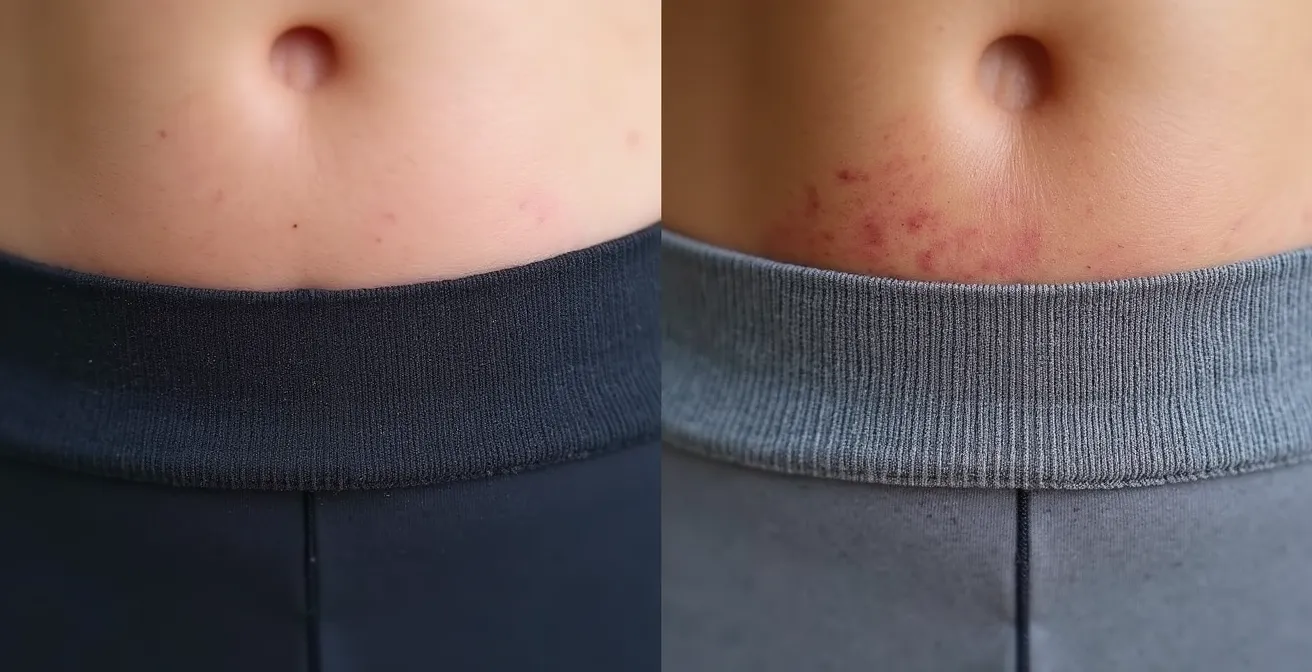
- Waistband Marks: Check for red indentations lasting more than 30 minutes after removal, which indicate excessive pressure and restriction.
- Numbness or Tingling: Monitor for any loss of sensation; this is a serious flag that requires immediate size adjustment or a change in style.
- Natural Hang: Assess elevation. The testicles should hang naturally within the pouch, not be compressed or forced upwards against the body.
- Temperature & Moisture: If the area feels consistently hot, sweaty, or damp, the fabric’s ventilation is inadequate for your body or activity level.
- Skin Condition: At the end of the day, look for any signs of redness, chafing, irritation, or the early stages of fungal growth patterns in skin folds.
How to choose the right level of pouch support for running vs sitting?
Selecting the correct level of pouch support is not a one-size-fits-all decision; it is an ergonomic choice that must be tailored to the specific biomechanical demands of an activity. The forces acting on the anatomy during a high-impact run are vastly different from the static, gravitational pull experienced during eight hours of sitting. Choosing the wrong level of support can be as detrimental as choosing no support at all, leading to either inadequate stabilisation or excessive restriction.
For high-impact activities like running or football, maximum support is required. This involves designs with more compressive fabrics and stabilising panels that minimise vertical and lateral movement. This prevents testicular torsion and reduces the repetitive strain on the spermatic cord and cremaster muscle. Conversely, for a sedentary activity like desk work or long-distance driving, the goal is gentle, non-restrictive support. The pouch should cradle the anatomy to counteract gravitational strain without compressing it. Overly-compressive support in a seated position can increase temperature and restrict blood flow, defeating the purpose. A light-to-medium support level, often achieved with softer, more flexible fabrics, is ideal.

The key is to think of your underwear as a piece of specialised equipment. Just as you would wear different footwear for a marathon versus a day in the office, your support underwear should be chosen based on the day’s activity profile. Many men in the UK, such as London commuters, experience a mix of activities—walking, standing on the Tube, and prolonged sitting—requiring a versatile medium-support design that balances breathability with stable support.
The following matrix, adapted for common UK lifestyles, provides a clinical framework for selecting the appropriate support level. This data is synthesized from an analysis published by Men’s Health UK on athletic wear.
| UK Lifestyle Profile | Activity Mix | Recommended Support Level | Key Features |
|---|---|---|---|
| London Commuter | Walking + Tube + 8hr desk | Light-Medium Support | Breathable mesh, moisture-wicking |
| Weekend Footballer | High-impact sports | Maximum Support | Compression zones, stabilization |
| M6 Driver | 4+ hours seated driving | Gentle Support | Non-restrictive, temperature regulating |
| NHS Shift Worker | 12hr standing/walking | Medium Support | Anti-fatigue design, cushioned pouch |
Keyhole vs Contour Pouch: Which design offers better stability?
The debate between keyhole and contour pouch designs is a matter of anatomical compatibility and desired function. Neither is universally superior; their effectiveness in providing stability depends on the wearer’s body type and daily activities. Understanding their distinct mechanical principles is essential for making an informed choice. A contour pouch is a single, three-dimensional compartment designed to encapsulate the entire male anatomy. Its stability comes from providing a seamless, form-fitting cup that lifts and holds everything together, preventing movement by gently conforming to the body’s shape.
A keyhole pouch, by contrast, features a system of internal compartments, typically with a horizontal or vertical fly. This design provides stability through separation, isolating the penis from the testicles in separate chambers. This prevents skin-on-skin contact and offers a different kind of stability by minimising lateral movement and allowing for easier access or adjustment if needed. For some men, this compartmentalisation offers a more secure and ‘locked-in’ feeling, particularly during dynamic movements.
Different body types require different pouch designs – for some men, a contour pouch provides superior stability by encapsulating the anatomy, while for others, the separate compartments of a keyhole design prevent lateral movement more effectively.
– Obviously Apparel Research Team, Testicle Support Underwear Study
The choice often comes down to lifestyle context. A 2025 survey of UK professionals by FashionBeans found that men wearing slim-fit trousers overwhelmingly preferred contour pouches for their smooth, seamless silhouette and “set-it-and-forget-it” stability during long office hours. In contrast, active professionals who might go from a desk to a gym often favoured the adjustability of keyhole designs. The right design ultimately provides stability by eliminating the need for conscious or unconscious micro-adjustments throughout the day.
The sizing mistake that turns “support” into dangerous restriction
The single most critical error in selecting supportive underwear is choosing a size that is too small. Men often equate “tighter” with “more supportive,” a dangerous misconception that transforms a beneficial ergonomic tool into a source of physiological harm. When underwear is too restrictive, it creates two primary medical concerns: thermal dysregulation and vascular constriction. The scrotum’s primary function is to maintain testicular temperature approximately 2-3°C below core body temperature, which is essential for healthy sperm production (spermatogenesis).
Restrictive underwear presses the testicles up against the body, eliminating the natural air gap and preventing the cremaster muscle from lowering them to cool down. As WebMD reports, this can raise scrotal temperature by several degrees, creating a state of chronic hyperthermia that can negatively impact fertility over time. Beyond temperature, excessive tightness can have direct vascular consequences. The compression can impede blood flow, particularly venous return from the testicles.
This increased pressure within the scrotal veins is a contributing factor to the development or exacerbation of varicoceles—enlarged veins within the scrotum, which are a common cause of pain and infertility. As one urologist noted, this constriction is a serious concern.
Tight pants press on the inguinal canal and may hinder venous return causing congestion. This can lead to testicular pain and potential varicocele development.
– Dr. Consultation on iCliniq, Medical consultation on testicular disorders
Properly sized supportive underwear should cradle the anatomy, not clamp it. The waistband should sit comfortably without leaving deep indentations, and the pouch should have enough volume to hold the anatomy without compression. Support comes from the design’s shape, not from sheer tightness.
How does pouch support reduce fatigue at the end of a standing shift?
For professionals who spend long hours standing, such as NHS healthcare workers or retail staff, physical fatigue is a major occupational hazard. While often attributed to foot or back pain, a significant and overlooked contributor is the low-grade, constant physical and mental energy expended on managing anatomical discomfort. Pouch support directly mitigates this by eliminating the need for constant micro-adjustments and reducing compensatory muscle strain.
Without proper support, gravity exerts a continuous downward pull on the testicles. The body unconsciously contracts pelvic and lower abdominal muscles to counteract this strain, leading to a state of low-level muscular tension throughout the day. This sustained isometric contraction contributes significantly to feelings of lower back and groin fatigue. An anatomical pouch acts like an external suspensory ligament, bearing the weight and allowing these muscles to remain relaxed. This not only prevents direct strain on the spermatic cord but also frees up muscular energy.
Furthermore, the mental fatigue from discomfort is substantial. Every time a worker needs to shift their stance, subtly adjust their position, or consciously ignore feelings of chafing or compression, it consumes a small amount of cognitive bandwidth. Over a 12-hour shift, this cumulative distraction erodes focus and mental stamina. A well-designed pouch provides a “set-it-and-forget-it” solution, removing this entire class of physical distraction.
Case Study: NHS Healthcare Worker Comfort
A collaboration between UFM Underwear and urologists studied healthcare workers on 12-hour shifts. Those wearing supportive pouch underwear reported significantly less lower back strain and overall fatigue. The study concluded that by eliminating the constant need for manual adjustments, the underwear allowed workers to maintain focus on patient care rather than being distracted by their own physical discomfort, leading to improved performance and well-being.
How mesh regulates temperature when moving from a cold street to a hot tube train?
The daily commute for many in the UK, especially in London, involves rapid and extreme temperature transitions—from a cold, damp street to a crowded, overheated Tube carriage. Technical mesh fabrics in anatomical underwear are engineered specifically to manage this thermal shock through two key properties: hydrophobic moisture wicking and convective cooling. Unlike cotton, which is hydrophilic (absorbs water), the synthetic fibres used in technical mesh (like polyester or polyamide) are hydrophobic (repel water).
When you begin to perspire in a hot train, the mesh does not absorb the sweat. Instead, it actively pulls the moisture from your skin and transports it to the outer surface of the fabric. This wicking action is critical because it keeps the skin itself dry, preventing the clammy, “swampy” feeling that leads to chilling when you eventually step back out into the cold. As Men’s Health testing found, technical mesh fabrics made from polyester-elastane blends can dry up to three times faster than traditional cotton.

The second mechanism is convective cooling, enabled by the fabric’s open-knit structure. The microscopic pores in the mesh allow air to circulate freely. As you move, this airflow passes over the moisture that has been wicked to the surface, accelerating its evaporation. This evaporative process has a powerful cooling effect, actively lowering the skin’s surface temperature and preventing overheating in the first place. This is a dynamic, responsive system that helps maintain a stable microclimate around the anatomy, regardless of the external environment.
Case Study: The London Underground Commute Test
FashionBeans tested a technical mesh fabric during a typical London commute, documenting the journey from a 5°C street to a 27°C packed Tube carriage. The mesh’s hydrophobic fibres and open-knit structure actively wicked moisture and promoted convective cooling. This prevented the significant discomfort and dampness that cotton underwear created under identical conditions, demonstrating the fabric’s superior performance in variable-temperature environments.
How to measure your waist vs hips to prevent the waistband from rolling down?
A rolling waistband is a common and frustrating issue, often caused by a mismatch between the underwear’s cut and the wearer’s body shape, or simply an incorrect size. To ensure a secure, non-rolling fit, it is crucial to take accurate measurements and understand where the waistband is designed to sit. There are two key measurements: the natural waist and the hip measurement. Which one you use depends on the rise of the underwear.
For mid-rise or high-rise briefs and trunks, you should measure at your natural waist. This is the narrowest point of your torso, typically just above your belly button. For low-rise styles, which are designed to sit on or below the hip bones, you should measure around the fullest part of your hips, ensuring the tape measure goes over the top of your glutes. Always take measurements in the morning before any meals, pull the tape snug but not tight, and keep it parallel to the floor.
However, the most critical factor is acknowledging the significant sizing inconsistencies between brands in the UK. A “Medium” from one brand can have a completely different actual waist measurement than another. This variation is the primary cause of poor fit. It is absolutely essential to ignore the S/M/L label and consult each brand’s specific size chart, comparing your personal measurements to their stated values in inches or centimetres.
This table illustrates the common discrepancies found across UK brands, highlighting why relying on a generic size label often leads to a poor fit. The data is a synthesis of market analysis, similar to that found in consumer guides.
| UK Size Label | Actual Waist Range | Brand Variation | Roll Risk Factor |
|---|---|---|---|
| Small | 28-30 inches | ±2 inches between brands | Low if measured correctly |
| Medium | 32-34 inches | ±3 inches between brands | High – most inconsistent size |
| Large | 36-38 inches | ±2 inches between brands | Moderate |
| X-Large | 40-42 inches | ±2 inches between brands | Low if measured correctly |
Key Takeaways
- Health over Habit: Anatomical separation is a medical necessity to prevent the heat and moisture buildup that leads to chronic fungal infections.
- Function Dictates Form: The required level of support is not static; it must be matched to your activity (e.g., high support for sports, gentle support for sitting) to prevent strain or restriction.
- Sizing is Clinical: Never assume your size. Measure your waist/hips and check each brand’s specific chart to avoid the dangerous mistake of turning support into harmful constriction.
Can men’s sculpting trunks improve posture and silhouette without being uncomfortable?
Modern men’s sculpting trunks are fundamentally different from traditional, highly compressive shapewear. Rather than using aggressive, uniform compression to force the body into a shape, they employ a more intelligent approach: zoned fabrics and proprioceptive feedback. The goal is not to constrict, but to guide. These garments can indeed improve both posture and silhouette without causing the discomfort associated with older-style girdles.
The postural improvement comes from the principle of proprioception—your body’s awareness of its own position in space. Sculpting trunks use strategically placed panels of slightly firmer, zoned fabric around the lower back and obliques. This gentle, targeted pressure doesn’t force you to stand straighter; it increases your sensory awareness of those muscle groups. This subtle feedback acts as a constant, subconscious reminder to engage your core and maintain a more upright posture. It’s a prompt, not a brace.
The gentle, targeted pressure of sculpting panels increases the wearer’s awareness of their own posture through proprioceptive feedback, subtly prompting them to engage their core and stand taller.
– Jack Archer Design Team, Jetsetter Boxer Briefs Engineering Study
In terms of silhouette, the improvement comes from strategic seam placement and fabric layering that smooths lines rather than squeezing them. This is particularly effective under tailored or slim-fit clothing. A study by Men’s Health UK on British men wearing suits found that 82% were satisfied with modern sculpting trunks, compared to only 31% with traditional shapewear. The key differentiator was all-day comfort. Because sculpting trunks guide rather than force, they can be worn for extended periods without restricting breathing or causing discomfort, making them a practical tool for achieving a clean, sharp silhouette for a professional or formal setting.
Investing in your foundational layer of clothing is a direct investment in your daily well-being and long-term health. By applying these clinical principles to your selection process, you can move from a state of recurring discomfort to one of effortless, ergonomic support. Evaluate your daily routine and choose the design, fabric, and size that provides the specific support your body requires.