
The search for inclusive lingerie isn’t about finding more sizes; it’s about understanding the engineering that makes them work.
- True support comes from the bra’s underband architecture, not the straps.
- A perfect fit is determined by wire geometry and cup construction, not just a tape measure.
Recommendation: Learn to assess the technical design of a bra, not just its size label, to find genuine comfort and support.
For too long, the conversation around luxury lingerie and body diversity has felt like a hollow echo. We hear promises of inclusivity and see campaigns featuring a wider range of models, yet for many women with non-standard body shapes, the reality in the fitting room remains one of frustration. The digging wires, the gaping cups, and the sense that your body is the problem, not the garment, are all too common. The standard advice—”get a professional fitting”—often falls short, especially when the underlying products are designed from a flawed, one-size-fits-all-by-scaling-up philosophy.
The issue isn’t a lack of “body positivity” in marketing; it’s a deficit of engineering in design. True inclusivity is not about simply offering a larger size tag; it’s a fundamental shift in how lingerie is constructed. The secret to a garment that feels both supportive and beautiful lies in biomechanics, material science, and a deep understanding of body architecture. It’s about creating a system of support that works with the nuances of a fuller bust, a broader back, or an asymmetrical shape, rather than fighting against them.
But what if the key to unlocking this comfort wasn’t in finding a magical brand, but in learning to see lingerie through the eyes of a designer? This guide moves beyond the platitudes. We will deconstruct the core engineering principles that separate genuinely inclusive lingerie from the pretenders. By understanding the ‘why’ behind the fit—from the geometry of an underwire to the tension architecture of a band—you gain the power to choose pieces that don’t just fit your measurements, but truly fit your form. We’ll explore the technical details that define comfort and support, giving you the vocabulary and knowledge to demand more from the luxury market.
This article provides a detailed breakdown of the critical design and fitting elements that define truly inclusive lingerie. The following sections will equip you with the expert knowledge needed to navigate the complexities of bra fitting and construction.
Summary: Beyond the Label: How UK Lingerie Engineering is Redefining “Sexy” for Every Body
- Why does your cup size change when you alter the band size?
- How to measure for a bra if you have a broad back but small cup?
- UK vs EU vs US Sizing: Which system is most consistent for curves?
- The design error that makes plus-size bras uncomfortable in the armpit
- When is it worth paying for bespoke lingerie instead of ready-to-wear?
- Why is a “high-leg” cut essential for elongating the silhouette?
- Why is wire width more important than cup depth for wide-set curves?
- How to engineer support for significant curves without relying on thick straps?
Why does your cup size change when you alter the band size?
One of the most misunderstood but fundamental principles of bra fitting is the concept of sister sizing. This is the key to understanding why your cup letter is not a fixed measurement of volume but is relative to the band size. A D cup on a 32 band holds a significantly smaller volume of breast tissue than a D cup on a 40 band. Think of the cup letter as a ratio, not an absolute size. When you go up a band size (e.g., from 34 to 36), you must go down a cup size (e.g., from a G to an FF) to maintain the same cup volume. This inverse relationship is the essence of sister sizing.
This concept is crucial because many fitting issues stem from wearing the wrong band size. With research suggesting that up to 90% of British women may be wearing the wrong bra size, understanding this relationship is the first step toward finding a better fit. Often, women who need a smaller, firmer band to get proper support compensate by choosing a smaller cup, leading to issues like spillage and discomfort. Conversely, someone in a band that is too loose may think they need a larger cup, when in fact they need to go down a band size and up a cup size to get the right support and volume.
In the UK, bra fitting philosophies can vary. A ‘technical fit’ prioritises a very snug underband for maximum support, while a ‘comfort fit’ allows for a slightly larger band. Both approaches will place you within the same sister size “family,” but the technical fit will result in a smaller band and a larger cup letter. Knowing your sister sizes gives you the flexibility to adjust your size between different brands or styles, which may fit differently. For example, if a 34F feels too tight in the band, your sister size up would be a 36E. This knowledge empowers you to make informed decisions when a fitter isn’t available.
How to measure for a bra if you have a broad back but small cup?
The “broad back, small cup” profile is one of the most underserved by traditional bra sizing methods. Standard industry grading rules often assume that as the back size increases, so does the breast volume, which leaves many women with an impossible choice between a band that fits and cups that gape, or cups that fit and a band that is painfully tight. This is where moving beyond the tape measure and focusing on fit criteria becomes essential. A professional fitter doesn’t just measure; they assess how the bra interacts with the body.
The key is to prioritise a snug band fit first, as it provides 80% of the support, and then find the cup that works for your frame. This may involve exploring brands that specialise in a wider range of cup-to-band ratios. The visual details of construction, like reinforced power mesh panels and multi-hook closures, are indicators of a well-engineered bra designed for support beyond the cup.
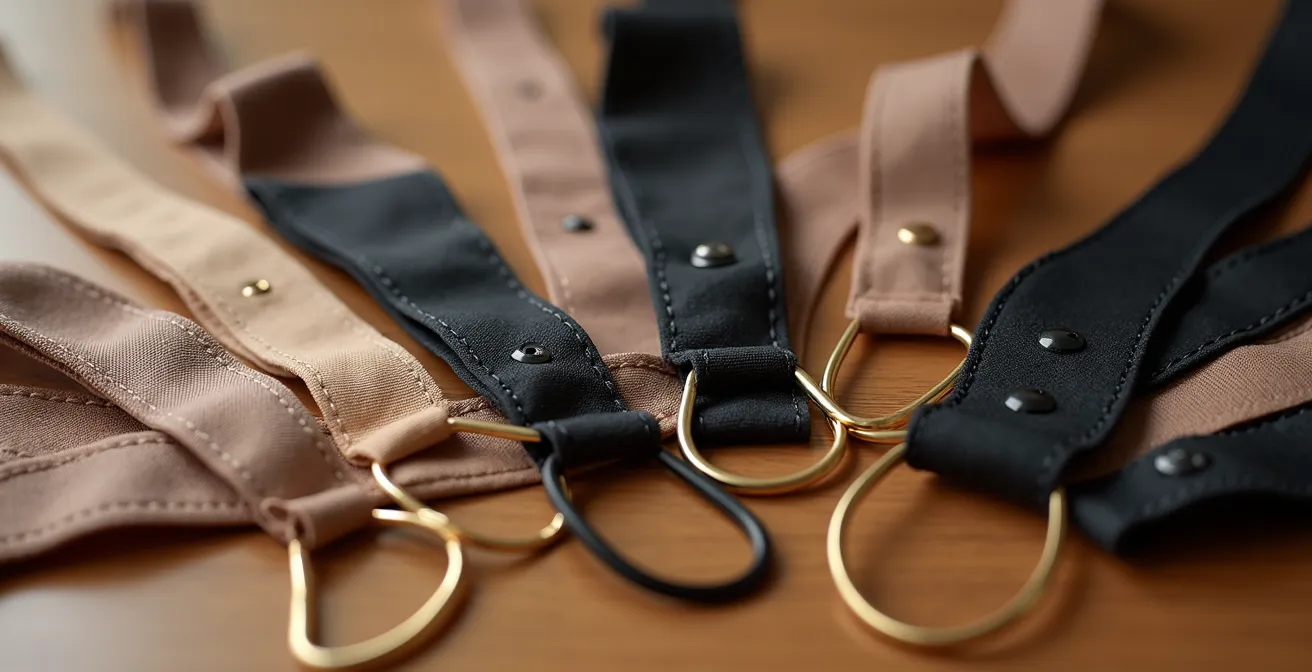
As the image above highlights, the engineering of the band—its materials, stitching, and hardware—is where true support is born. For a broad back, a wider wing and a firm, non-stretch centre panel (gore) are critical. Instead of relying on a simple measurement, use a set of professional criteria to judge the fit of any bra you try on. This allows you to diagnose problems and find solutions based on the physical evidence of the fit, not an abstract number.
Your Professional Fit Checklist: 5 Points to Verify
- The Band: Does it sit horizontally and feel snug on the loosest hook? You should only be able to fit two fingers underneath. This is the foundation of your support.
- The Cups: Is all breast tissue fully contained within the cups without any spilling over the top or sides (quad-boob) or gaping?
- The Underwire: Does the wire sit flat against your ribcage and completely encircle the breast tissue, tacking firmly against your sternum at the front? It should not sit on top of breast tissue or dig into your armpit.
- The Centre Gore: Does the panel between the cups lie completely flat against your chest bone? If it’s lifting away, the cups are likely too small or the wrong shape.
- The Straps: After adjusting, do the straps sit comfortably on your shoulders without digging in or slipping off? They should only provide about 20% of the support.
UK vs EU vs US Sizing: Which system is most consistent for curves?
Navigating international lingerie sizing can feel like learning a new language, with each system having its own logic and, frustratingly, its own inconsistencies. For women with fuller busts, the differences are not merely academic; they are the barrier between a comfortable, supportive garment and a day of discomfort. The three main systems—UK, EU, and US—approach sizing in fundamentally different ways, but one stands out for its superior consistency and detail for curves: the UK system.
The primary advantage of the UK sizing system is its granularity in larger cup sizes. After DD, it progresses through double letters (F, FF, G, GG, H, HH, etc.), with each step representing a one-inch difference in bust circumference. This allows for a much more precise fit. In contrast, the US system is notoriously inconsistent, with brands often using “DDD” or “F” interchangeably, and then jumping straight to G, leaving significant gaps in sizing. The EU system, while more logical than the US system, uses single-letter progression and centimetre-based measurements, which can result in slightly different wire shapes and less nuance between sizes.
This superior sizing structure is a direct result of the UK market’s long history of catering to the D+ customer. The commitment to this market segment is reflected in the innovation from specialist UK brands and the projected growth of the lingerie sector. For anyone with a fuller bust or non-standard proportions, prioritizing brands that use UK sizing is a strategic move towards finding a better fit. When shopping from international brands, always look for a conversion chart, but be aware that it may not account for differences in wire shape or band elasticity.
The following table breaks down the key characteristics of each system, demonstrating why the UK’s approach offers a more refined fit for a diverse range of curves. As this analysis shows, focusing on UK sizing is a practical step for anyone seeking a more precise fit, a strategy supported by a detailed comparative analysis of sizing methodologies.
| Sizing System | Cup Progression | Band Measurement | Best For |
|---|---|---|---|
| UK System | DD, E, F, FF, G, GG, H, HH | Direct measurement in inches | Fuller busts, granular sizing |
| EU System | E, F, G, H, I, J, K | Centimeters + 10cm | Wider wire shapes |
| US System | DD/E, DDD/F, G | Add 4-5 inches traditionally | Limited cup range |
The design error that makes plus-size bras uncomfortable in the armpit
One of the most common and painful complaints from women wearing plus-size bras is the underwire digging into the armpit. This is not an issue with your body; it’s a fundamental design flaw known as poor graded scaling. Many brands design a bra in a core size (e.g., a 34D) and then use software to ‘grade’ the pattern up for larger sizes. This often involves simply making every part of the bra bigger proportionally, including the height of the side wing and the length of the underwire. The result is a wire that sits far too high under the arm, causing constant chafing and discomfort.
This lazy approach to design ignores the fact that bodies do not scale proportionally. A woman who wears a 42G does not have the same torso length or arm-to-torso ratio as a woman who wears a 32C. A properly engineered plus-size bra requires a completely different pattern. It needs a lower side wing, a specifically shaped J-wire that is shorter on the armpit side, and a redistribution of support to the band and cups. This flawed methodology is rooted in an outdated understanding of sizing.
The traditional approach could leave many wearing the wrong size bra. The traditional alphabet sizing, developed in the 1930s, reached only up to a D cup and with half the women in the UK being a larger size, the accuracy of the traditional method is questionable.
– Jenny White, Department of Sport and Exercise Science, Portsmouth University
As Jenny White highlights, the very foundation of bra sizing is ill-equipped for modern bodies. Specialist D+ brands in the UK, like Panache, understand this. They re-engineer their patterns for specific size clusters, recognising that a G+ cup has different structural needs. They invest in tension architecture, using multi-part cups with side-slings and reinforced power mesh wings to pull breast tissue forward and away from the armpit, creating a more comfortable and supported profile without relying on excessively high side panels.
When is it worth paying for bespoke lingerie instead of ready-to-wear?
The ready-to-wear lingerie market has made strides in extended sizing, but for some body types, even the most inclusive brands can’t provide a perfect solution. If you consistently struggle with fit, experience chronic pain from your bras, or have specific needs due to asymmetry or post-surgical changes, investing in bespoke lingerie can be a transformative decision. While the price point is significantly higher, it reflects a process where a garment is patterned, cut, and sewn for your unique anatomy, rather than a generic size chart.
A key indicator that you might be a candidate for bespoke is persistent, unsolvable fit issues. If you’ve been professionally fitted and have tried multiple specialist brands but still face problems like a floating centre gore, wires digging in, or straps bearing too much weight, it suggests your proportions fall outside the standard ready-to-wear model. This is incredibly common, yet many women blame their bodies. The reality is that mass production simply cannot account for every variation in ribcage shape, breast position, or tissue density.
The decision to go bespoke is often prompted by a ‘tipping point’ of discomfort or frustration. With research showing that, despite recommendations, 92% of UK women don’t get fitted every six months, many people endure poor fit for years before seeking an alternative. Bespoke lingerie isn’t just a luxury; for many, it’s a functional necessity for health and well-being, alleviating back pain and improving posture. If you tick several of the boxes in the following checklist, it’s a strong sign that a bespoke investment could offer you a level of comfort and support that ready-to-wear simply cannot.
Your Bespoke Lingerie Checklist: Is It Time to Invest?
- Persistent Fit Issues: Have you tried multiple D+ brands and still experience gaping cups, digging wires, or a band that rides up, even after professional fittings?
- Significant Asymmetry: Do you have a noticeable difference in breast size or shape (more than one cup size) that ready-to-wear bras cannot accommodate?
- Post-Surgical Needs: Have you undergone a mastectomy, lumpectomy, or augmentation, resulting in a unique shape that requires specialized support or pocketing?
- Chronic Discomfort: Do you experience daily pain in your shoulders, neck, or back that you suspect is caused by an ill-fitting bra?
- Non-Standard Proportions: Do you find yourself at the extreme ends of the size chart (e.g., a very small band with a very large cup, or vice versa) where options are limited or non-existent?
Why is a “high-leg” cut essential for elongating the silhouette?
While much of the focus in lingerie is on bust support, the cut of the brief plays an equally critical role in shaping the overall silhouette. The “high-leg” or “French cut” brief, which rose to prominence in the 80s and has made a major comeback, is a masterclass in optical illusion. Its power lies in its ability to visually lengthen the leg line, creating a taller, more streamlined appearance, regardless of body type. This is not about hiding or shrinking the body, but about using lines to create a more dynamic and elegant form.
The magic happens at the hip. A traditional brief cuts horizontally across the widest part of the hip, which can visually shorten the legs and widen the frame. In contrast, a high-leg cut arches upwards, following the natural curve of the hip bone. This simple change in geometry draws the eye upward, creating an uninterrupted vertical line from the thigh to the waist. The result is that the legs appear to start higher up on the torso, giving the illusion of greater length. It’s a powerful tool for petite women wanting to add height, or for anyone looking to balance their proportions.

This design principle is intrinsically linked to the body positivity movement’s shift towards celebrating the body’s natural form rather than concealing it. As the fashion industry slowly embraces more diversity, with plus-size model representation seeing significant increases at major fashion weeks, there’s a greater appreciation for designs that enhance, rather than restrict. The high-leg cut is a perfect example: it works with the body’s curves to create a flattering and powerful silhouette, exuding a confidence that is central to the modern definition of “sexy.”
Why is wire width more important than cup depth for wide-set curves?
For individuals with wide-set breasts or a broader ribcage, the single most important factor for a comfortable bra fit is the wire geometry—specifically, its width. While cup depth accommodates projection (how much the breasts stick out), the wire width determines whether the foundation of the bra actually matches your body’s footprint. If the wire is too narrow, it will sit on top of breast tissue at the side, causing painful poking and preventing the centre gore from tacking against the sternum. This is a primary cause of discomfort and a sign of an incompatible bra shape.
Traditional fitting methods that rely solely on a tape measure are notoriously bad at diagnosing this issue. In fact, one study found that in over 77% of cases, the tape measure got it wrong when determining the best bra size. This is because a tape measure can only tell you a circumference; it tells you nothing about the shape, width, or position of your breast root (where the breast tissue begins on the chest wall). Two people can have the exact same band and cup measurements but require completely different wire shapes for a proper fit.
Recognising this, specialist UK fuller-bust brands often engineer their bras with different wire widths across their ranges. A brand like Elomi is known for its wider wires, catering to a broader frame, while other brands might offer a more average or narrower curve. This is not something you can determine from the size tag. The only way to know is to try them on and pay close attention to where the wire ends under your arm. It should fully encircle all breast tissue without extending too far back into your armpit. Finding the brand whose wire shape matches your body is a game-changer for comfort.
The table below provides a general overview of the wire characteristics of some popular UK-based fuller-bust brands, offering a starting point for your search for the right wire geometry.
| Brand | Wire Width | Available Sizes | Special Features |
|---|---|---|---|
| Elomi | Wider wires | Up to 46K | Side support panels |
| Fantasie | Medium-wide | Up to 38JJ | Mature styling |
| Freya | Variable by style | Up to 36K | Fashion-forward |
| Bravissimo | Wide options | Up to 40L | Own brand innovation |
Key Takeaways
- Fit is engineered, not just sized: Support comes from the band’s architecture and the geometry of the underwire.
- The UK sizing system’s granularity (F, FF, G, GG) offers a more precise fit for fuller busts than inconsistent US or EU systems.
- True plus-size design requires re-engineering patterns (not just scaling up) to avoid common fit issues like underwires digging into armpits.
How to engineer support for significant curves without relying on thick straps?
A common misconception in lingerie is that for a fuller bust, thick, heavy-duty straps are necessary for support. This belief leads to designs that can feel matronly and uncomfortable, with straps that dig into the shoulders. The truth, however, lies in a core principle of bra engineering: the straps should only provide around 20% of the support. The real workhorse is the underband. A well-engineered bra for significant curves is a sophisticated system of tension architecture designed to lift and contain from below and the sides, rendering thick straps obsolete.
This principle is best articulated by experts in the field. The focus must always be on the foundation of the garment. The band should be snug enough to anchor the bra to the body, creating a stable platform from which the cups can do their work. If your straps are digging in, it’s a tell-tale sign that the band is too loose and your shoulders are taking on a load they were never meant to carry.
80 per cent of support comes from the band so a bra should fit snug and still feel comfortable at the same time
– Edita Solak, Victoria’s Secret Bra Fit Expert
So how do designers achieve this support? They use a combination of materials and construction techniques. Power mesh wings provide firm but flexible lateral support, distributing tension across the back. A wider band with three or four hook-and-eye closures creates a more stable anchor. The most critical element is the multi-part cup construction. Unlike a simple moulded cup, a seamed cup can be engineered with internal “slings” or side-support panels that direct breast tissue forwards and upwards, creating lift and a rounded shape without adding bulk. Brands like Panache, Freya, and Curvy Kate are masters of this, proving that delicate straps and powerful support are not mutually exclusive.
Armed with this knowledge of lingerie engineering, your next step is to approach shopping not as a search for a size, but as an assessment of design. Demand better, choose smarter, and reclaim your comfort and confidence.