
Contrary to popular belief, the purpose of men’s sculpting trunks isn’t to unnaturally “suck you in,” but to provide a foundational structure that enhances posture and refines your silhouette.
- Light, consistent compression provides proprioceptive feedback to your core, encouraging you to stand taller naturally.
- The right garment creates a seamless transition from torso to trouser, a key detail for a sharp look in tailored clothing.
Recommendation: Focus on medium control for all-day wear and prioritise correct sizing over extreme compression to ensure both comfort and effectiveness.
The conversation around men’s style often revolves around the visible: the cut of a suit, the shine of a shoe, the knot of a tie. Yet, the foundation upon which all of this rests is frequently overlooked. For any man who has invested in fine tailoring only to feel that something is still ‘off’, or for those who find themselves slumping by midday, the issue often lies beneath the surface. It’s a matter of structure and posture, the very architecture of your presence.
For years, the solution to a less-than-perfect silhouette has been whispered about as a “secret weapon,” often associated with the restrictive girdles of a bygone era or dismissed as mere vanity. This perception has done a disservice to a category of functional apparel that has undergone a technological revolution. We’re not talking about hiding, but about enhancing. It’s less about radical transformation and more about subtle, intelligent refinement that supports both your body and your confidence throughout a demanding day.
But what if the true value of modern sculpting trunks wasn’t just about smoothing a line, but about re-engineering your posture from the ground up? The real breakthrough is the shift from passive restriction to active support. By providing gentle, consistent feedback to your core, these garments act as a constant, subconscious reminder to stand taller and engage your muscles. This is not about forcing a shape, but encouraging your body to find its own strongest, most elegant form.
This guide will demystify men’s sculpting trunks, moving beyond the platitudes to explore the science and style behind them. We will examine how they work, how to choose the right level of control for your lifestyle, and how they integrate into a sophisticated wardrobe to create a truly polished look. It’s time to view them not as a secret, but as a smart, functional component of modern menswear.
To help you navigate this topic, we’ve broken down the key questions and concepts into a clear and logical guide. The following sections will walk you through everything from the biomechanics of posture to the practicalities of daily wear.
Contents: A Guide to Core Support and Silhouette Refinement
- Why does light core compression encourage you to stand taller?
- How to smooth the hip line under a fitted dress shirt?
- Medium vs Firm Control: Which is sustainable for an 8-hour workday?
- The sizing mistake with shapewear that causes stomach pain after eating
- What design features make sculpting trunks practical for urinals?
- How does medical-grade compression in modern bodysuits differ from old-school girdles?
- Why does bad posture negate the effect of even the most expensive lingerie?
- How does wearing premium underwear influence a man’s posture and psychological state?
Why does light core compression encourage you to stand taller?
The secret to improved posture from sculpting trunks isn’t brute force; it’s subtle communication with your body. Light, consistent compression around your midsection provides what’s known as proprioceptive feedback. This is essentially a gentle, constant reminder to your brain about where your body is in space. This heightened awareness encourages the subconscious activation of your deep core muscles, particularly the transversus abdominis, which acts as your body’s natural corset.
When you slouch, the fabric provides slightly more resistance, prompting your body to correct itself back into a more upright position. It’s not about the garment holding you up, but rather training your own muscles to do the work. Over time, this can lead to improved muscle memory and better posture even when you’re not wearing the garment. This is a fundamental principle of postural engineering: using external cues to improve internal mechanics.
Scientific studies support this principle of muscle activation. For instance, research on postural muscle activation shows a significant increase in the thickness of the transversus abdominis muscle (from 3.32mm to 4.63mm) when it’s properly engaged during postural correction. While sculpting trunks don’t create this engagement on their own, the feedback they provide is a powerful catalyst for you to maintain that engagement throughout the day, providing crucial support for your lower back and helping you project an air of confidence.
How to smooth the hip line under a fitted dress shirt?
One of the most telling signs of a well-dressed man is a clean, uninterrupted line from the chest down to the trousers. However, even with the best diet and exercise regime, the area where a shirt tucks in can create a slight bulge, often referred to as a “muffin top.” This can disrupt the smooth drape of a fitted shirt and undermine the sharp silhouette of a suit. This is where the concept of silhouette architecture becomes critical.
Sculpting trunks are specifically designed to manage this transition zone. By providing smooth, even compression across the lower abdomen and hips, they eliminate the abrupt edge created by a standard underwear waistband. The goal is to create a completely seamless foundation, allowing the fabric of your dress shirt and trousers to skim over your body without catching or bunching. A quality pair of sculpting trunks will feature a high, wide waistband that stays in place without rolling down, ensuring the effect lasts all day.
Case Study: The British Tailoring Approach
Brands like The London Corset Company exemplify this philosophy. Their men’s shapewear is engineered with an understanding of British tailoring principles, focusing on the seamless transition from torso to trouser. They state that their products use “new technology compressive fabrics designed for the male body to discreetly shape and smooth your silhouette, control your abdomen and chest area, provide lower back support and improve posture.” This approach isn’t about looking thin; it’s about achieving the clean lines that high-quality tailoring demands.
This paragraph introduces the visual benefit. To truly appreciate the effect, consider the following illustration which highlights the ideal outcome.
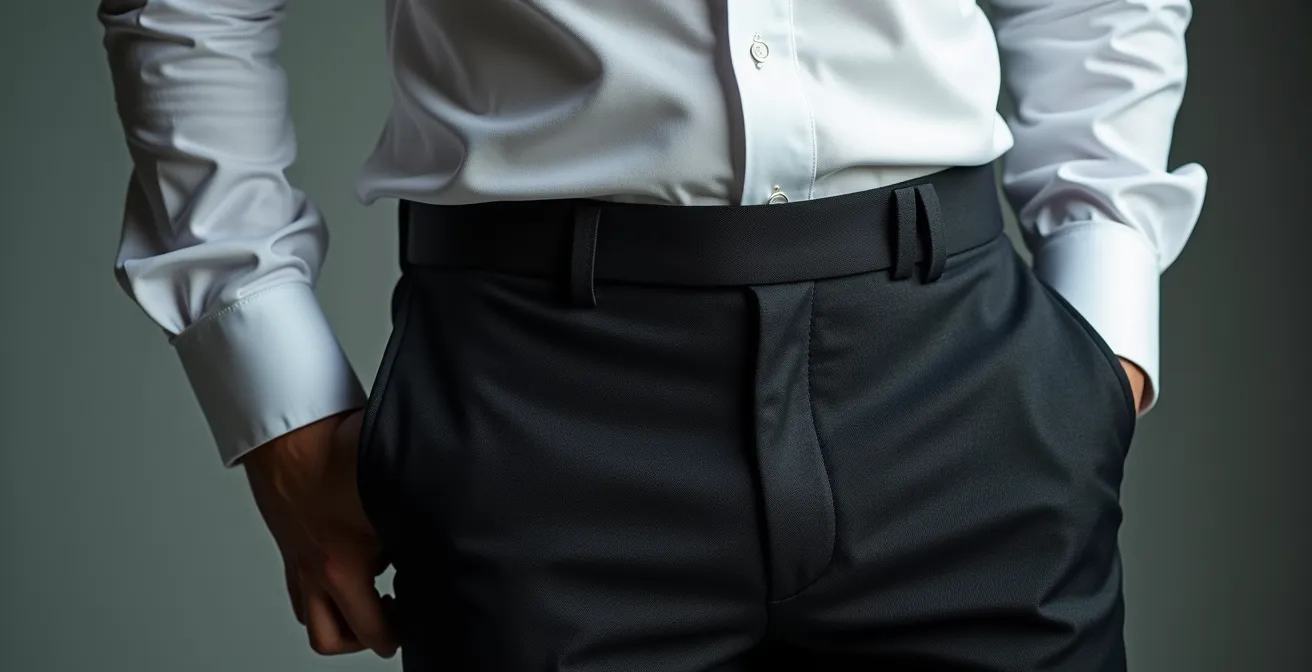
As you can see, the result is a fluid, continuous line. The sculpting trunks work *with* your clothing, serving as the invisible infrastructure that allows your tailored garments to perform as their designer intended. This small detail makes a significant difference in the overall polish and sophistication of your appearance.
Medium vs Firm Control: Which is sustainable for an 8-hour workday?
Choosing the right level of compression is perhaps the most crucial decision in selecting men’s shapewear. The temptation can be to opt for the firmest control available, assuming that tighter equals better. However, this is a common mistake that prioritises a momentary aesthetic over all-day comfort and sustainability. For daily wear, especially during an 8-hour workday that involves sitting, standing, and moving, medium control is almost always the superior choice.
Medium compression offers the ideal balance of effective smoothing and postural support without feeling restrictive. It provides enough control to smooth the silhouette and offer that valuable proprioceptive feedback, but it allows for a full range of motion and normal breathing. You can eat a meal without feeling uncomfortably constricted, and you’ll likely forget you’re even wearing it by midday. This is what we call dynamic support—it works with your body, not against it.
Firm control, on the other hand, is best reserved for specific, short-term occasions like a photoshoot, a wedding, or a formal evening event where maximum shaping is the primary goal. While highly effective for a few hours, wearing firm compression for a full workday can lead to discomfort, restricted breathing, and even digestive issues. The key to successfully integrating shapewear into your routine is sustainability; if it isn’t comfortable, you simply won’t wear it.
The following table, based on typical product specifications from specialists like The London Corset Company, breaks down the key differences to help guide your decision.
| Feature | Medium Compression | Firm Compression |
|---|---|---|
| Comfort Duration | 8-12 hours comfortable | 4-6 hours optimal |
| Breathing Impact | Minimal restriction | May restrict deep breaths |
| Waist Reduction | 1-1.5 inch reduction | 2-3 inch reduction |
| Digestive Comfort | Can eat normal meals | May cause discomfort after eating |
| Best Use Case | Daily office wear, commuting | Special events, photos |
The sizing mistake with shapewear that causes stomach pain after eating
With a growing interest in men’s grooming and presentation, the market for supportive garments is expanding. In fact, the UK shapewear market is valued at over £359 million in 2024, indicating that more men are discovering these tools. However, with this increased adoption comes the potential for error, and the most common and uncomfortable mistake is choosing the wrong size. Many men assume they should “size down” for extra compression, but this is a direct path to discomfort and negates the benefits of the garment.
Shapewear is engineered to provide its stated level of compression (medium or firm) when you wear your true size. Sizing down over-compresses the body, particularly the abdomen. While this might seem effective when you first put it on, the consequences become apparent throughout the day. The excessive pressure restricts the natural expansion and movement of your diaphragm and stomach, leading to shallow breathing and, most notably, significant discomfort or even pain after eating a meal.
This experience is a clear sign that the garment is too tight. True “sculpting” comes from a well-designed product in the correct size, not from brute-force squeezing. The goal is to smooth and support, not to constrict. A properly-sized garment should feel like a secure hug, not a vice grip. If you find yourself counting the minutes until you can take it off, you’ve made a sizing error.
This shapewear gives good control and support to hold in all those fat rolls and gives you greater confidence when wearing but at the end of the day, I can’t wait to get out of it and breathe.
– User Review, Irreverent Gent
This common sentiment perfectly highlights the trade-off made with improper sizing. True confidence comes from comfort, and that starts with honouring the size chart provided by the manufacturer.
What design features make sculpting trunks practical for urinals?
While the aesthetic and postural benefits of sculpting trunks are clear, their practicality in daily life is a non-negotiable factor. A garment that isn’t functional for basic needs will quickly be relegated to the back of the drawer. Manufacturers of quality men’s shapewear understand this, and have engineered specific design features to ensure ease of use, particularly when nature calls. The primary focus is the design of the fly opening.
Unlike standard underwear, the fly on a compression garment must provide access without compromising the structural integrity and support of the core panel. There are generally two main approaches: the traditional vertical fly and the more modern horizontal fly. A vertical fly is familiar but may require navigating through more layers of compressive fabric. A horizontal fly can offer quicker access but must be carefully designed to prevent gapping or loss of support.
Beyond the type of opening, other details matter. Reinforced edges around the fly prevent the fabric from rolling or bunching during use. A double-layer pouch can help maintain a smooth shape while still allowing for convenient access. The most sophisticated designs use strategic paneling to ensure the fly is located outside of the main high-compression zones, thus preserving the garment’s primary function of core support. When choosing a garment for daily wear, examining the fly design is as important as considering the level of compression.
Your 5-Point Audit for Practical Sculpting Trunks
- Points of Contact: Assess the access points. Check for a vertical or horizontal fly and test its ease of use before committing to a full day of wear.
- Collect Existing Elements: Inventory the seam construction. Prioritise garments with bonded or laser-cut seams over traditional stitching to ensure they remain invisible under trousers.
- Check for Coherence: Does the fly design compromise the core compression panel? The access point should not create a weak spot in the support structure.
- Memorability/Emotion: Evaluate the fabric. A modern, breathable, moisture-wicking blend is essential for all-day comfort, distinguishing it from heavy, restrictive materials.
- Integration Plan: Prioritise a design that balances easy access with seamless support. Always test-wear new trunks with your most fitted trousers to ensure function and discretion.
How does medical-grade compression in modern bodysuits differ from old-school girdles?
The image of men’s shapewear is often unfairly tainted by the memory of old-school girdles: heavy, bulky, rubberised contraptions that were notoriously restrictive and uncomfortable. Today’s sculpting garments are a world away from these predecessors, thanks to decades of innovation in fabric technology and garment construction, much of it borrowed from the medical field.
The fundamental difference lies in the material. Traditional girdles used heavy, non-breathable materials like rubberized cotton to physically constrict the body. Modern shapewear, by contrast, utilises advanced synthetic blends like Lycra, spandex, and nylon. These are lightweight, powerful, and highly elastic fabrics that provide strong compression while moving with the body. They are designed to be breathable and moisture-wicking, making them comfortable for extended wear.
Construction methods have also been revolutionized. The bulky seams, hooks, and fastenings of the past have been replaced by cutting-edge techniques that create a truly invisible foundation under clothing. This evolution is key to understanding the appeal of the modern product.
The Technological Leap in Fabric and Construction
Market analysis highlights how “bonding and laser-cut technologies have transformed body shapewear product manufacturing by eliminating seams, hems, and bulky fastenings.” This allows for garments that are exceptionally smooth and flat against the skin. In terms of fabrics, experts note that “nylon, spandex, polyester, Lycra, and elastane are widely used by manufacturers.” This represents a complete departure from the primitive materials of the past, focusing on performance, comfort, and discretion.
This technological shift means modern shapewear offers targeted, graduated compression. Different zones of the garment can have different levels of control, allowing for firm support where it’s needed (like the abdomen) and more flexibility elsewhere. It’s a far more intelligent and anatomical approach to silhouette refinement than the uniform crushing of an old-fashioned girdle.
Why does bad posture negate the effect of even the most expensive lingerie?
While the title mentions “lingerie,” the principle applies universally to all premium clothing, from a bespoke suit to a fine-gauge knit. You can invest a significant amount in beautifully crafted garments, but if your posture is poor, their intended effect will be lost. A slumped stance, rounded shoulders, and a forward-leaning head can make even the most expensive suit from Savile Row look ill-fitting and unkempt.
Posture is the frame upon which your clothes hang. Good posture—a straight spine, engaged core, and shoulders pulled back—creates a strong, elegant line. It allows fabric to drape correctly and ensures that the garment’s carefully designed structure is showcased to its full potential. When you slouch, you create folds and creases in the fabric, shorten your torso, and cause the front of a jacket or shirt to bunch up. No amount of fine tailoring can compensate for a weak foundation.
This is where the psychological and physical benefits of core support become intertwined. By encouraging a more upright stance, sculpting trunks don’t just improve your posture; they enhance the performance of your entire wardrobe. They ensure that your investment in quality clothing pays off by providing the ideal canvas. As style experts often note, confidence and stance are the most important accessories a man can have.
Good posture is a symbol of elegance, and a strong stance shows more style than any designer suit.
– The London Corset Company, Top 5 Best Men’s Shapewear of 2022
This simple truth is the cornerstone of sophisticated style. Before focusing on the clothes, you must first perfect the canvas: your own posture.
Key Takeaways
- The primary function of modern men’s shapewear is postural feedback, not just compression.
- For all-day wear, choose medium control in your true size to balance comfort and effectiveness.
- The goal is a seamless “silhouette architecture” that enhances your tailored clothes, not to radically alter your body shape.
How does wearing premium underwear influence a man’s posture and psychological state?
The decision to wear sculpting trunks is deeply personal and often rooted in a desire for increased confidence. In a world of constant visual comparison, body image is a concern for many. In fact, research indicates that nearly 28% of men struggle with body image issues. Supportive underwear can be a powerful tool in addressing this, not by creating an unrealistic ideal, but by helping a man feel more secure and put-together in his own skin.
This psychological boost has a direct physical manifestation. When you feel more confident about your appearance, you naturally carry yourself differently. Your posture becomes more open and upright, you make more direct eye contact, and your body language projects self-assurance. Wearing a garment that provides a smoother silhouette and gentle core support can trigger this positive feedback loop. You look better, so you feel better, which in turn makes you stand taller and look even better.
This is not about vanity, but about the tangible link between our internal state and our external presentation. It’s the same principle as wearing a well-tailored suit or a great pair of shoes; the right foundation makes you feel more capable and prepared. The immediate visual improvement serves as a catalyst for a more confident mindset.
The “Aerodynamic” Confidence Boost
A writer for VICE testing the products described the immediate psychological shift: “From every angle, I looked remarkably more aerodynamic… When I put on a shirt and pants over them I immediately see that my mini-muffin tops are conspicuous by their absence.” This experience perfectly captures the effect: the visible smoothing of the silhouette directly translates into an immediate confidence boost, which in turn encourages more upright posture and self-assured body language throughout the day.
Ultimately, sculpting trunks are a tool. Like any part of a well-considered wardrobe, their purpose is to support you in presenting the best version of yourself to the world, both physically and mentally.
Now that you understand the principles, the next logical step is to explore the options and find the right garment that aligns with your specific needs, whether for daily back support at the office or for creating that perfect silhouette for a special occasion.