Modern mesh underwear is not merely fabric; it’s an engineered material system designed for total environmental adaptation.
- Technical mesh excels by actively managing heat, moisture, and bacteria through its specific weave and fibre treatments.
- The blend of materials like nylon and elastane ensures structural integrity that outlasts hundreds of workouts, unlike cotton which deforms and traps moisture.
Recommendation: Stop thinking about “comfort” as a feeling and start evaluating your underwear as “gear,” based on its technical performance in managing heat, shape, and hygiene.
For the active man in the UK, the daily routine is a gauntlet of environmental shifts. It’s the brisk walk to the station, the sudden heat of a packed Tube carriage, a day under office air-conditioning, and the intense output of an after-work gym session. For years, the default choice, cotton underwear, has been a point of compromise—comfortable when static, but a damp, unsupportive liability under stress. The market responded with athletic-specific options, but this created a new problem: the need to pack a separate pair of underwear, adding another layer of friction to a busy day.
The common advice focuses on superficial features like “breathability” or “stretch.” But this misses the fundamental revolution happening at the fibre level. The true breakthrough isn’t just a new style of underwear; it’s the development of a cohesive material system. This system is engineered to provide not just athletic performance or everyday comfort, but both simultaneously, without compromise. The secret lies in understanding that modern mesh is not just one material, but a carefully calibrated blend of fibres, weaves, and treatments designed to work in synergy.
This article moves beyond the marketing claims to deconstruct the science. As a fabric technologist, we will analyse the specific mechanisms that allow these blends to manage odour, retain their shape, regulate temperature, and provide functional aesthetics. We’ll explore why certain materials are chosen, how they interact, and what it means for you, the end-user. This is your guide to understanding the engineering that powers the perfect all-day, all-activity underwear.
To fully grasp how these garments deliver on their promise, we will break down the core technologies and practical considerations. This structured overview will guide you through the science of performance, from the microscopic action of silver ions to the macro-level tests you can perform yourself.
Summary: Deconstructing the Engineering of Performance Mesh
- Why do silver-infused mesh blends prevent smell better than cotton?
- How to check if your mesh underwear becomes transparent when stretched?
- Spandex vs Elastane in mesh: Which holds its shape after 100 gym sessions?
- The washing habit that destroys the smooth finish of technical mesh
- How mesh regulates temperature when moving from a cold street to a hot tube train?
- Power Mesh vs Tulle: Which offers more “blurring” effect?
- Why does sheer mesh reduce groin temperature by up to 2 degrees?
- Why are sheer mesh fabrics becoming a functional favorite for men’s intimate apparel?
Why do silver-infused mesh blends prevent smell better than cotton?
The fundamental flaw of cotton in an active context is its hydrophilic nature: it absorbs moisture and holds it close to the skin. This warm, damp environment is the perfect breeding ground for odour-causing bacteria like Staphylococcus aureus. A silver-infused mesh blend tackles this problem at its source through hygienic engineering. Rather than just wicking moisture away, it actively neutralizes the threat. Silver ions (Ag+) embedded within the fabric fibres are released when they come into contact with moisture (sweat). These ions physically puncture the cell walls of bacteria, disrupting their metabolism and preventing them from multiplying.
The effectiveness of this technology is not just a marginal improvement; it’s a complete paradigm shift in fabric hygiene. In fact, dedicated research from AUTEX demonstrates that silver-infused fabrics achieve 100% inhibition rates against common bacteria like E. coli and S. aureus. This means from the moment you start your morning commute, the fabric is working to maintain a neutral scent, giving you the confidence to transition from an 8-hour office day directly to social plans without a second thought. As an added benefit, the conductive properties of silver also provide a shield against low-frequency electromagnetic fields (EMFs), offering a layer of protection often overlooked in men’s health.
How to check if your mesh underwear becomes transparent when stretched?
One of the primary concerns when choosing mesh underwear, especially for dual office-and-gym use, is opacity. A fabric that appears opaque on the hanger can become unintentionally transparent when stretched during a squat or a yoga pose. This property, known as “grin-through,” is a sign of poor material selection or a weave not designed for high-stretch applications. The optical properties of the mesh are determined by the size of the perforations (the “holes”), the denier (thickness) of the yarn, and the finish of the fabric. High-quality micro mesh, for instance, uses tiny, densely packed perforations that maintain coverage even at full extension.
You don’t need a lab to test for this. You can perform a simple, effective audit in a retail environment. The key is to simulate real-world stress under harsh lighting conditions, which are surprisingly common in most UK department store changing rooms. This practical test will immediately reveal the fabric’s true character.
Your 5-Step UK Changing Room Transparency Audit
- Target the right environment: Use the harsh, top-down fluorescent lighting found in changing rooms at retailers like John Lewis or Sports Direct.
- Select your garment: Understand that quality micro mesh is designed to be non-see-through; the holes are engineered to be too small for transparency.
- Perform a stress test: Execute a full, deep squat while facing away from the mirror. This action maximally stretches the fabric across the glutes.
- Check for “grin-through”: In the mirror, check for any unintentional transparency or visible skin through the stretched fabric.
- Simulate gym conditions: If possible, slightly dampen a small, inconspicuous area to see how moisture affects the fabric’s opacity, replicating a post-workout scenario.
Understanding the different types of mesh can also guide your purchase, ensuring you select the right tool for the right job, from daily wear to more intimate occasions.
| Mesh Type | Hole Size | Transparency Level | Best Use |
|---|---|---|---|
| Micro Mesh | Tiny punch holes | Non-transparent | Athletic/Daily wear |
| Sheer Mesh | Small weave | Semi-transparent | Aesthetic appeal |
| Fishnet | Large weave | Fully transparent | Intimate occasions |
Spandex vs Elastane in mesh: Which holds its shape after 100 gym sessions?
First, let’s clarify a common point of confusion: Spandex and Elastane are not competitors. They are simply regional names for the same synthetic polymer, prized for its exceptional elasticity. Spandex is the common term in North America, while Elastane is used throughout Europe, including the UK. So, the question isn’t which is better, but rather, what role does this fibre play in the long-term structural integrity of a mesh garment? Its job is to provide stretch and recovery. When you squat, lunge, or cycle, the fabric deforms. The elastane fibres act like microscopic rubber bands, pulling the fabric back to its original shape the moment the tension is released. Without it, the mesh would progressively “bag out,” losing its supportive fit.
As the Skiviez Technical Team notes in their guide, “Male mesh underwear usually consists of several basic fabrics of spandex or elastane.” The percentage is critical. While it’s often a small component of the overall blend, its impact is enormous. For context, even in robust fabrics, the elastane content is carefully calibrated. Testing on different blends shows that WAMA’s testing shows optimal shape retention requires a precise 3% Spandex with only a ±3% variation allowed. In performance mesh, this percentage might be higher to allow for greater freedom of movement, but the principle is the same: it’s the engine of shape retention. The difference between a premium garment that looks new after 100 washes and a budget one that sags after 10 is the quality and integration of its elastane fibres.
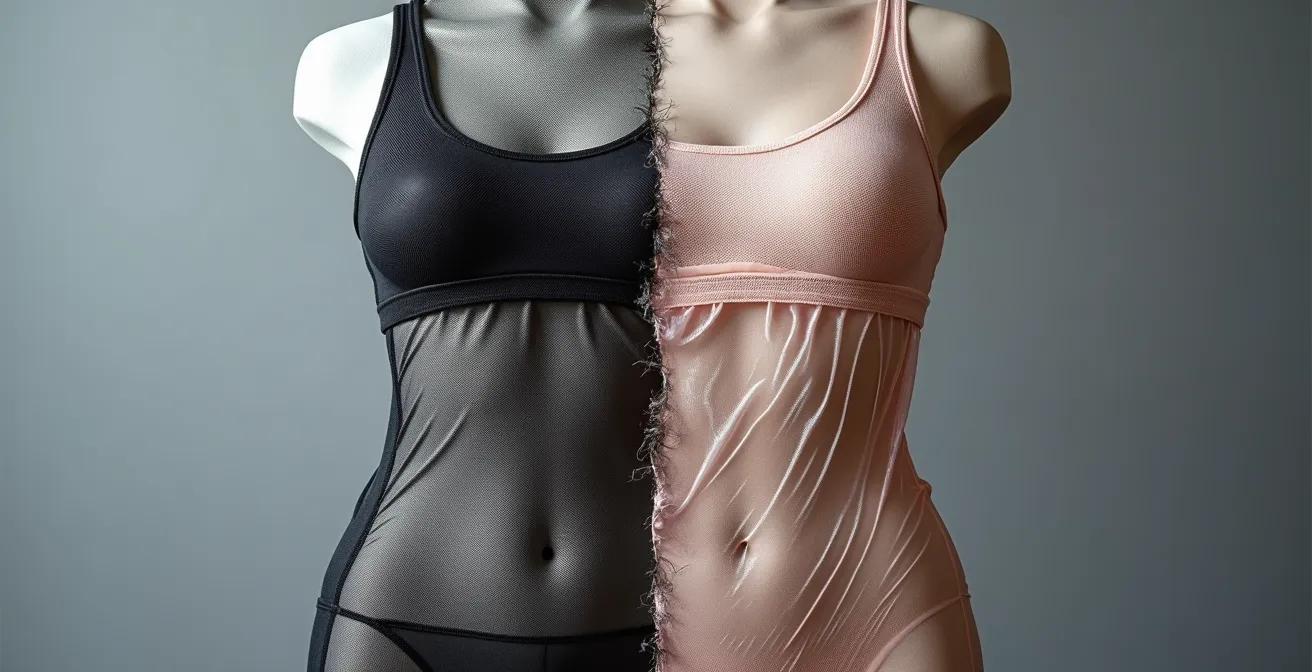
This visual contrast highlights the investment proposition. A premium nylon/elastane blend maintains its engineered shape, providing consistent support and fit. A cheaper polyester-based mesh quickly loses its structure, becoming less comfortable and less effective. The elastane is what guarantees the garment’s performance longevity.
The washing habit that destroys the smooth finish of technical mesh
Investing in technically advanced underwear is only half the battle; preserving its engineered qualities is the other. The single most destructive habit for performance mesh is improper washing, specifically the use of common fabric softeners. In the UK, popular brands like Comfort and Lenor use silicone-based formulas. While these make cotton feel soft, they are ruinous to technical fabrics. The silicone coats the fibres and clogs the micropores of the mesh, effectively suffocating the fabric. This destroys its moisture-wicking ability and traps bacteria, negating the benefits of the breathable design and any antimicrobial treatments.
Furthermore, washing technical gear with abrasive items like jeans or towels causes micro-damage to the delicate yarn, leading to pilling and a loss of the smooth finish. Protecting the fabric’s performance requires a dedicated care protocol. The longevity of a garment’s technical features is directly tied to its maintenance. Impressively, Qingdao University research confirms that with proper care, some performance fabrics can achieve 97% temperature regulation retention even after 500 wash cycles. This proves that longevity is an engineered and maintained property.
To maintain the peak performance of your mesh underwear, adopt the following UK-specific care protocol:
- Avoid Fabric Softeners: Never use UK fabric softeners like Comfort or Lenor. Their silicone-based formulas will clog the mesh’s micropores.
- Create Dedicated Loads: Wash your technical wear in a separate load from heavy or abrasive items like denim and towels.
- Use a Technical Wash: Opt for a specialised cleaner like Nikwax BaseWash or Grangers Active Wash, both readily available at UK retailers like Sports Direct.
- Wash Cool and Air-Dry: Use a cool wash cycle and always air-dry. The high heat of a tumble dryer can damage the delicate elastane fibres, destroying the fabric’s stretch and recovery.
- Consider Hard Water: If you live in London or the South East, the hard water can leave mineral deposits. Using an extra rinse cycle can help maintain fabric softness and breathability.
How mesh regulates temperature when moving from a cold street to a hot tube train?
The daily commute for many in London is a perfect case study in dynamic thermal regulation. You experience a rapid temperature swing, moving from a cold, windy street to the sudden, radiant heat of a packed London Underground carriage. A cotton garment will absorb the initial sweat from this thermal shock and hold it, leaving you feeling damp and clammy for the rest of your journey. A technical mesh garment, however, is an active system designed to manage this exact scenario.

The process works on two levels. First, the open-weave structure of the mesh allows for constant convective cooling. Air is able to circulate freely through the fabric, carrying heat and moisture vapour away from the skin’s surface before it can accumulate. Second, the synthetic fibres themselves are hydrophobic, meaning they do not absorb water. Instead, they actively pull moisture from the skin to the outer surface of the fabric, where it can evaporate quickly. This dual-action mechanism prevents the “greenhouse effect” that occurs with damp cotton, keeping your skin drier and more comfortable.
The science behind this is evolving rapidly. Advanced research into thermally adaptive smart textiles (TAST) is creating fabrics that can passively cool the wearer. As detailed in a study on radiative cooling performance, next-generation materials using scalable extrusion methods can enable a passive outdoor radiative cooling effect of 6–10 °C compared to normal fabrics. While not yet in mainstream underwear, this demonstrates the direction of fabric technology: creating materials that actively and intelligently manage your microclimate.
Power Mesh vs Tulle: Which offers more “blurring” effect?
As men’s underwear design incorporates more aesthetic elements, understanding the different types of mesh becomes crucial. The “blurring” effect is an optical illusion created by the fabric that suggests shape and contour without full transparency. It’s about creating shadow and depth, playing with light to enhance the perception of what lies beneath. As one Fashion Design Expert puts it in the Modern Men’s Aesthetic Guide:
The ‘blurring’ effect is about creating suggestive contouring and shadow, enhancing perception of muscle definition without full exposure.
– Fashion Design Expert, Modern Men’s Aesthetic Guide
Two common fabrics used to achieve this are Power Mesh and Tulle, but they function very differently. Power Mesh is an athletic, functional fabric. It has a high elastane content, offering significant compression and support. Its dense weave absorbs more light, creating strong shadows that are excellent for contouring and enhancing muscle definition. It’s the choice for garments that need to provide both aesthetic shaping and athletic support. Tulle, on the other hand, is a very fine, lightweight netting with minimal stretch or compression. Its primary purpose is decorative. It allows more light to pass through, creating a soft, ethereal haze rather than sharp, defining shadows. It offers a gentle blurring effect but provides no functional support, making it suitable purely for intimate apparel.
This comparative table breaks down their distinct optical and functional properties, clarifying their ideal applications.
| Property | Power Mesh | Tulle |
|---|---|---|
| Compression Level | High – provides shaping | Minimal – delicate drape |
| Light Absorption | Higher – creates shadow/depth | Lower – allows light through |
| Blurring Effect | Strong contouring shadows | Soft ethereal haze |
| Best Application | Athletic support with aesthetic | Pure intimate appeal |
Why does sheer mesh reduce groin temperature by up to 2 degrees?
The ability of sheer mesh to reduce groin temperature is more than a simple comfort feature; it’s a critical functional benefit with significant health implications. The human body is designed to keep the testicles cooler than the core body temperature for optimal sperm production. Modern lifestyles, tight clothing, and prolonged sitting work against this. This environmental pressure is a contributing factor in a worrying trend: research shows human sperm counts have fallen by 50% over the past 50 years. According to Harvard Medical School, sperm quality can be an indicator of overall health, making thermal regulation a key concern.
Sheer mesh directly addresses this by facilitating aggressive heat and moisture transfer. The mechanism is simple but highly effective: maximized air permeability. A typical sheer performance mesh is an open-weave structure engineered with over 900 tiny air holes per square inch. This design allows for constant, micro-level air circulation directly against the skin. Unlike cotton, which traps a layer of warm, humid air, the mesh structure ensures that heat and moisture are actively carried away from the body through convection. This process can lead to a measurable temperature reduction of up to 2°C in the groin area compared to traditional fabrics.
This isn’t just about feeling cooler. It’s about creating an environment that is closer to the body’s natural requirements. By eliminating the “greenhouse effect” caused by trapped heat and moisture, sheer mesh provides a functional advantage that directly supports a healthier microclimate, making it a conscious choice for long-term well-being.
Key Takeaways
- Material science is key: Silver ions for hygiene and elastane for structural integrity are non-negotiable features for high-performance underwear.
- Performance requires maintenance: Using technical washes and avoiding fabric softeners and high heat is essential to preserve the fabric’s engineered benefits.
- Function meets aesthetic: The rise of mesh is driven by its ability to deliver measurable benefits like thermal regulation alongside modern, stylish design.
Why are sheer mesh fabrics becoming a functional favorite for men’s intimate apparel?
The growing popularity of sheer mesh fabrics in men’s underwear is not just a fleeting fashion trend; it represents the ultimate convergence of function and form. For decades, men’s choices were binary: supportive but stuffy cotton briefs for daily wear, or flimsy, non-functional “sexy” options for intimate moments. Mesh has shattered this dichotomy. It has become a favourite because it delivers the technical performance demanded by an active lifestyle while also offering the modern, aesthetic appeal that men now expect from their garments. As the HisRoom Editorial Team notes, there’s a look for every mood, blending style with substance.
This collection of men’s mesh underwear is breathable, sexy, and stylish — perfect for anyone who wants to show a little more without giving it all away. From see-through fabrics to athletic-inspired mesh panels, there’s a look for every mood and every moment.
– HisRoom Editorial Team, Men’s Mesh Underwear Guide
The “function” is no longer just about basic support. It’s about the advanced material systems we’ve explored: the antimicrobial properties of silver, the superior thermal regulation that keeps you cooler, the moisture-wicking that keeps you dry, and the shape retention that provides consistent support from the office to the gym floor. These are tangible, measurable benefits. Consumers are no longer just buying a piece of clothing; they are investing in gear that enhances their comfort, confidence, and even their health. This shift in consumer mindset is reflected in market trends, where performance-oriented apparel is seeing significant growth. In a related sector, the global thermal underwear market is expected to reach USD 0.38 billion by 2033, showing a clear demand for functional base layers.
Ultimately, sheer mesh has become a favourite because it respects the modern man’s multifaceted life. It acknowledges that he can be professional, athletic, and stylish all in the same day, and it provides a single, high-performance solution that doesn’t force him to compromise.
Now equipped with a technologist’s understanding of how modern mesh blends work, you can make an informed choice. Evaluate your daily needs and select the material system that provides the right balance of thermal regulation, structural integrity, and hygiene to power your day, from start to finish.