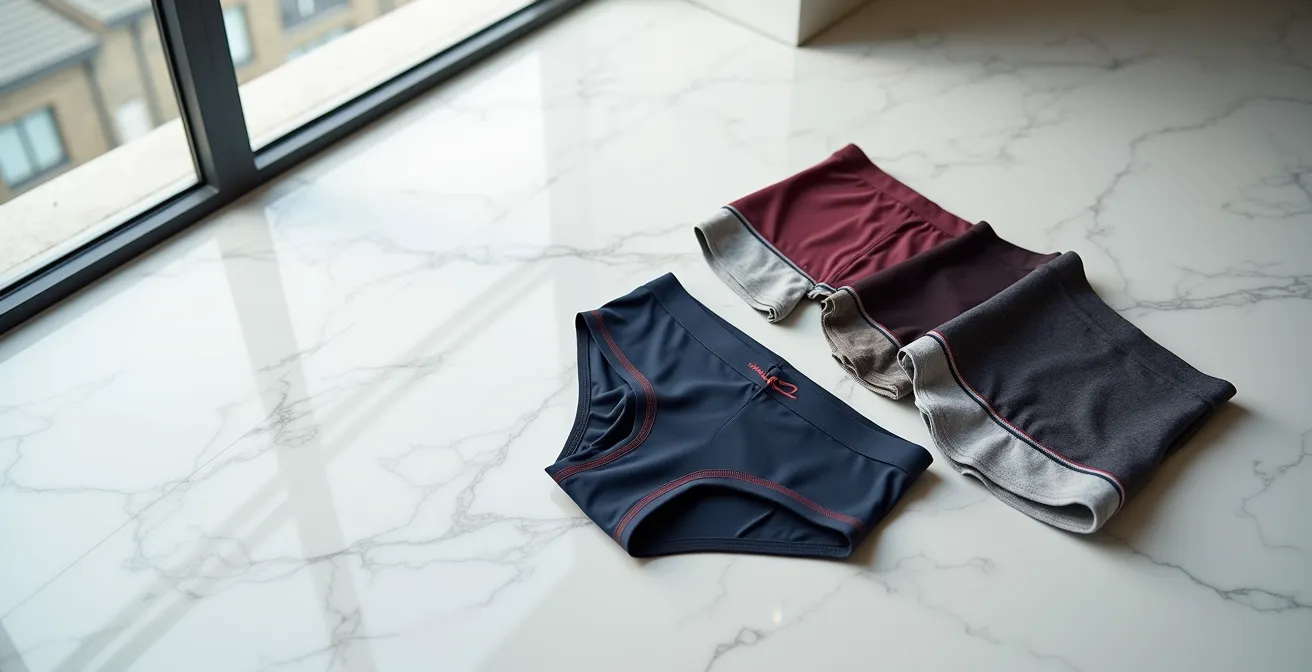
Upgrading your underwear is the most impactful style decision you’re not making, with premium pairs often proving more economical per wear than budget options.
- True fit is an exact science based on body measurement, not the vanity sizing of your jeans.
- Fabric quality and the specific cut (trunk vs. boxer brief) are engineered to prevent common issues like chafing, sagging, and waistband roll.
Recommendation: Begin by replacing your four most-worn pairs with technically superior options to immediately feel the dividend in comfort and confidence.
There’s a moment every man recognises. You’re dressed to impress—the tailored suit, the polished Oxfords, the statement watch. Yet, beneath it all lies a forgotten compromise: underwear that has lost its shape, its support, and its self-respect. For too long, men’s underwear has been an afterthought, a bulk-buy commodity grabbed from a supermarket aisle. But a quiet revolution is taking place in the UK, a shift in mindset that redefines underwear not as a disposable basic, but as the most critical foundation of a modern man’s wardrobe.
The conversation is moving beyond the simple multipack. We see men experimenting with fit, exploring advanced materials like MicroModal, and considering the ethics of the brands they wear. This isn’t about vanity; it’s about performance, comfort, and the quiet confidence that comes from getting the fundamentals right. The old advice to simply “buy your size” or “stick to cotton” is no longer sufficient. If the true key to upgrading this essential layer wasn’t just about the brand on the waistband, but the engineering underneath it?
This guide deconstructs the new rules of men’s underwear. We will move past the superficial and into the science of a perfect fit, the economics of long-term value, and the strategy for curating a collection that works as hard as you do. It’s time to treat your first layer with the same respect you give your outerwear. The evolution from a basic essential to a piece of luxury fashion is not just a market trend; it’s a fundamental upgrade to your daily life.
For those who prefer a visual take, the following video offers a glimpse into how modern brands are approaching the engineering of comfort and design, right here on the streets of London.
To navigate this evolution, we’ve structured this guide to address the most critical questions a man faces when rebuilding his underwear drawer from the ground up. This is your roadmap to a superior foundation.
In This Guide: Remastering Your Underwear Drawer
- Why should you spend £30 on boxers when a supermarket pack costs £10?
- How to measure your waist vs hips to prevent the waistband from rolling down?
- Trunk vs Boxer Brief: Which cut prevents thigh chafing for your body type?
- The cotton-quality mistake that leads to “diaper butt” after 3 washes
- In what order should you replace your underwear drawer to spread the cost?
- What defines “luxury” in men’s underwear beyond just a designer logo?
- Why is buying his “jeans size” often a mistake for underwear?
- What defines “luxury” in men’s underwear beyond just a designer logo?
Why should you spend £30 on boxers when a supermarket pack costs £10?
The initial price tag is the first hurdle for most men. Why invest in a single pair what you could spend on a multi-pack? The answer lies in shifting your mindset from purchase price to long-term value, a concept we call the cost-per-wear calculus. A cheap multi-pack feels like a win at the till, but its value diminishes rapidly. Poor quality cotton loses its shape, elastic gives way, and they are often relegated to the back of the drawer within months. This is a false economy.
Consider the maths. A premium £30 pair, engineered with durable fabrics and superior construction, can easily withstand 150 wears over two to three years. That works out to 20p per wear. A £10 three-pack, where each pair might last for only 50 wears before becoming misshapen, also costs you roughly 20p per wear. The price, over time, is identical. However, the premium pair delivers a significant “comfort dividend” on every single one of those wears: superior support, no sagging, and a boost in confidence that a worn-out pair simply cannot provide.
The market reflects this growing understanding. The UK men’s underwear market is no longer a niche concern; it’s a burgeoning industry. Projections show that the UK men’s underwear market is expected to reach £2,455.0 million by 2030, a clear indicator that men are increasingly willing to invest in quality. This isn’t about extravagance; it’s a strategic investment in the most-worn item in your wardrobe.
How to measure your waist vs hips to prevent the waistband from rolling down?
The single greatest cause of discomfort—the dreaded waistband roll—isn’t a flaw in the underwear, but a flaw in the selection process. It’s the direct result of a poor fit, and the solution begins with a measuring tape. Relying on your jeans size is the first mistake; the key is to capture your true waist measurement where the underwear will actually sit.
To do this correctly, stand relaxed and use a soft measuring tape. Don’t suck in your stomach. Find the top of your hip bone and the bottom of your ribs. Your natural waistline is the soft, fleshy part in between, usually level with or just above your navel. Wrap the tape around this point. It should be snug but not tight. As the experts at Pants & Socks UK advise, you should be able to slip a finger in the waistband comfortably without the elastic squeezing. This is your definitive waist size for underwear.
The next crucial measurement is your hip, or more accurately, your ‘seat’. Wrap the tape measure around the fullest part of your hips and buttocks. This measurement is critical for men with more athletic builds (larger glutes and thighs from squatting, for example), as it determines whether the underwear will provide enough room without stretching and pulling the waistband down. Knowing both your waist and seat measurement is the first step in the engineering of a perfect fit.
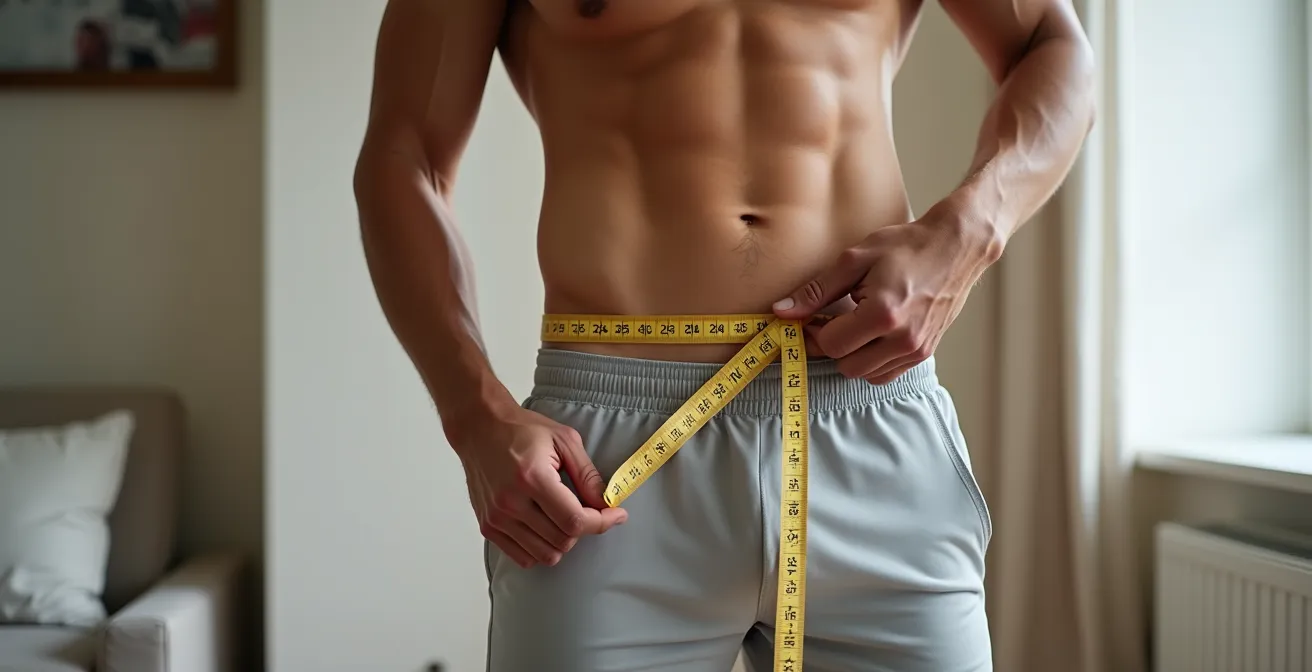
With these two numbers, you can now confidently compare your personal specs against a brand’s specific size chart, ignoring the generic S, M, L labels and focusing on the precise inch-based fit guide. This is the difference between buying clothes and commissioning a foundation.
Trunk vs Boxer Brief: Which cut prevents thigh chafing for your body type?
With your true measurements in hand, you can now select the right architecture for your frame. The choice between a trunk and a boxer brief is not merely stylistic; it’s a functional decision that directly impacts comfort, especially when it comes to preventing thigh chafing. The key difference is the inseam length: trunks typically have a shorter 3-4 inch inseam, while boxer briefs offer more coverage with a 5-6 inch inseam.
Your body type dictates the superior choice:
- Athletic/Rugby Build: If you have muscular thighs, the longer inseam of a boxer brief is essential. It provides a protective barrier of fabric that stays in place, preventing skin-on-skin friction during movement.
- Slim/Lean Build: For slimmer legs, a trunk is often the better option. It provides a streamlined, sharp silhouette without the excess fabric of a longer leg that can bunch up.
- Cyclist/Runner: Athletes in these disciplines should opt for a compression-style boxer brief. The snug fit and longer leg are specifically designed to stay put during repetitive motion, eliminating any chance of riding up.
Performance tests confirm this logic. In a review by Men’s Health UK, testers noted that performance trunks and boxer briefs with technical fabrics delivered a close fit that didn’t stick to the skin when sweating, remaining comfortable and supportive without bunching during intense workouts. The right cut, made from the right material, works with your body, not against it.
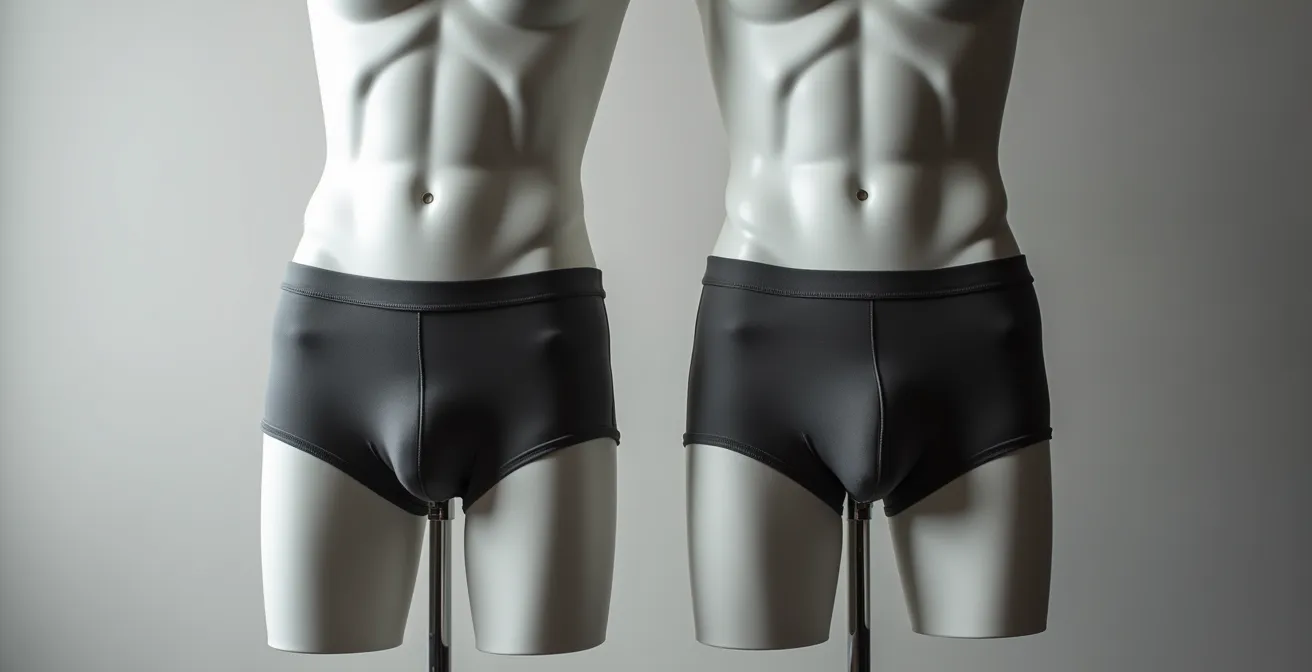
Ultimately, a trunk is ideal for a streamlined look under slim-fit trousers for men with leaner legs, while a boxer brief is the workhorse for preventing chafing and providing support for those with more substantial thighs. Choosing correctly is an act of anatomical engineering.
The cotton-quality mistake that leads to “diaper butt” after 3 washes
We need to talk about “fabric fatigue.” It’s that familiar and frustrating phenomenon where your once-snug boxers lose all semblance of shape, sagging at the seat in a way that’s unflatteringly termed “diaper butt.” The culprit is almost always low-grade cotton. While cotton remains the dominant fabric, accounting for over 40% of the men’s underwear market, not all cotton is created equal. The difference between a premium pair and a budget one often comes down to the staple length of the cotton fibre.
Budget underwear uses short-staple cotton. These short fibres break and fray easily when washed, causing the fabric to lose its structural integrity and stretch out permanently. Premium brands, by contrast, use long-staple cottons like Pima or Egyptian cotton. The longer, stronger fibres create a much more durable and softer yarn that resists pilling, holds its shape after countless washes, and maintains that day-one fit.
The ideal properties of cotton—breathability, softness, and moisture-wicking ability—are only truly present in these higher-grade materials. To this, luxury brands add a precise percentage of elastane (typically 5-10%). This isn’t just for stretch; it’s for recovery. The elastane acts like a memory foam for the fabric, allowing it to move with you and then snap back to its original shape. Cheap underwear often skimps on high-quality elastane, which is why it bags out so quickly. Investing in a superior cotton-elastane blend is the only way to defeat fabric fatigue for good.
In what order should you replace your underwear drawer to spread the cost?
A complete overhaul of your underwear drawer can feel financially daunting. The solution is not to buy another cheap multi-pack, but to implement a strategic, phased replacement plan. This allows you to upgrade your collection methodically, spreading the cost while immediately elevating your most frequent experiences. Forget a total clear-out; think surgical strike.
The goal is to build a core collection of high-performance foundation pieces that can handle 90% of your life. This isn’t about dozens of pairs; it’s about having the *right* pairs. The “Foundation Four” strategy is the most effective starting point: begin by investing in four exceptional pairs in versatile, classic colours. These will become your new daily drivers, proving their worth from day one.
From there, you can execute a phased replacement that aligns with your lifestyle and budget. By focusing your investment on high-impact areas first, you get the maximum return in comfort and confidence without the upfront financial hit. This turns a daunting expense into a manageable and rewarding project.
Your Phased Replacement Plan: A 5-Step Audit
- Build the Foundation: Start with four core pairs (e.g., two black, one navy, one grey) to create a versatile and reliable rotation for daily wear.
- Apply the ‘One In, Two Out’ Rule: For every new premium pair you purchase, identify and discard the two worst, most worn-out pairs from your existing collection.
- Phase 1 – The Daily Grind: Focus your initial investment on replacing the underwear you wear most often for work and social occasions. This is where you’ll feel the biggest immediate upgrade.
- Phase 2 – The Performance Upgrade: Next, turn your attention to your gym and sport-specific underwear. Technical fabrics and a secure fit will make a noticeable difference to your workouts.
- Phase 3 – The Comfort Zone: Finally, upgrade the pairs you wear for lounging at home. Prioritise softness and a relaxed fit for ultimate comfort.
What defines “luxury” in men’s underwear beyond just a designer logo?
For decades, “luxury” in men’s underwear was simply a status signifier—a prominent designer logo on the waistband. Today, that definition feels outdated and hollow. True luxury is no longer just about what a brand projects, but what it stands for. The modern man, particularly in the UK and Europe, is looking for substance behind the style, and the market is responding.
As noted in a recent report on the European market, a key driver of growth is the consumer’s prioritisation of both quality and sustainability. The new definition of luxury is multifaceted, encompassing ethical production, innovative and sustainable materials, and a genuine commitment to comfort engineering. It’s less about the logo and more about the philosophy. A brand that invests in a transparent supply chain or uses FSC-certified fabrics is making a statement of quality that resonates more deeply than a flashy name.
The European underwear market is expanding as consumers prioritize both quality and sustainability. The men’s underwear segment is particularly notable, reflecting growing interest in comfort and innovative fabrics.
– Cognitive Market Research, Europe Underwear Market Report 2024
A powerful, UK-relevant example of this shift is the Australian brand Step One. Their focus on using sustainable bamboo viscose has struck a chord with conscious consumers.
Case Study: Step One’s Sustainable Market Entry
In February 2024, Step One became the first clothing brand to receive Forest Stewardship Council (FSC) accreditation in the UK for their use of responsibly sourced bamboo. This wasn’t just an internal achievement; it was a core part of their market strategy. They complemented this ethical credential with a strategic retail partnership with John Lewis, a trusted British retailer. This move brilliantly communicated their brand values: sustainability, quality, and accessibility, defining them as a modern luxury player without relying on a traditional high-fashion logo. It demonstrated that for today’s consumer, proof of ethical practice is the ultimate luxury.
Why is buying his “jeans size” often a mistake for underwear?
It’s the most common sizing mistake in the male wardrobe: assuming your 34″ jeans size translates to a 34″ underwear waist. This single error is a primary source of poor fit, leading to waistbands that dig, pinch, or roll. The disconnect stems from a practice known as “vanity sizing,” which is rampant in casualwear but rare in performance-oriented garments like quality underwear.
For years, denim and trouser brands have been quietly adding extra inches to the waistband. A pair of jeans labelled “34 waist” might actually measure 36 or even 37 inches. It’s a marketing trick designed to make the customer feel slimmer. Underwear brands, especially those focused on a technical fit, can’t afford this dishonesty. Their sizing is, by necessity, true to measurement. A “Medium (32-34″)” is designed to fit a man whose physical waist actually measures within that range.
This fundamental difference, which we call the “Sizing Delta,” is why you must abandon your jeans size as a reference. The purpose of the two garments is entirely different: jeans are about silhouette and style, while underwear is about support and comfort against the skin. The reliance on different measurement points and the varying use of stretch fabrics make a direct comparison impossible.
| Measurement Type | Jeans Sizing | Underwear Sizing |
|---|---|---|
| Vanity Sizing | Common (2-3 inches added) | Rare (true to measurement) |
| Stretch Factor | 1-2% elastane typical | 5-10% elastane typical |
| Measurement Point | Low hip/below waist | Natural waistline |
| Fit Purpose | Style/silhouette | Support/comfort |
Key Takeaways
- True value is measured in cost-per-wear and comfort, not the initial price tag.
- Your underwear size is your physical waist measurement in inches, not your jeans size.
- The right cut (trunk vs. boxer brief) is an engineering choice dictated by your body type to prevent chafing and bunching.
What defines “luxury” in men’s underwear beyond just a designer logo?
Now that you understand the macro trends of sustainability and the pitfalls of sizing, we can focus on the tangible, tactile hallmarks of a truly luxurious garment. This is the “micro-luxury”—the details of foundation engineering that you can see and feel, which separate a premium piece from a disposable one. Once you know what to look for, you’ll never see underwear the same way again.
First, examine the seams. A budget pair uses overlocked seams that are bulky and can chafe. A luxury pair employs flatlock stitching, where the seams are flat against the fabric. Run your finger over them; they should feel almost non-existent. This detail is crucial for all-day comfort, eliminating potential irritation points. Next, look at the waistband. Is it a simple piece of printed elastic, or is it a soft-backed, jacquard-woven band? A premium waistband is engineered to distribute pressure evenly without digging in, maintaining its elasticity for years.
The most advanced brands now focus on the pouch construction. A simple, flat-front design is a relic. Modern luxury underwear features a contoured or 3D-pouch, often constructed from multiple panels. This anatomical design provides superior support and separation, reducing the need for readjustment and increasing breathability. Finally, consider the fabric itself. Beyond the type of cotton, feel the “hand” of the material. Is it silky smooth? Does it have a slight, reassuring weight? This tactile quality is the result of superior raw materials and finishing processes that cheap production simply cannot replicate. These details collectively define the new luxury: a garment engineered for an unparalleled experience.
Your style evolution begins from the foundation up. It is an investment in your daily comfort, performance, and self-assurance. Armed with this knowledge, you are now equipped to curate an underwear collection that is not an afterthought, but a statement of intent. The next logical step is to begin your own phased replacement and experience the difference for yourself.