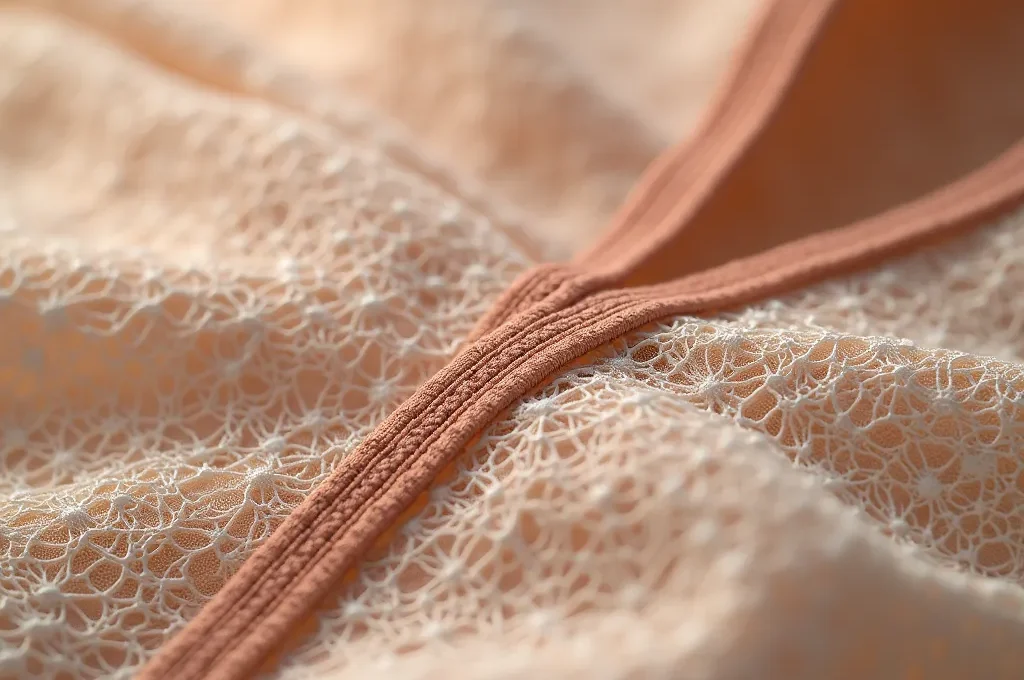
The secret to daring lingerie isn’t magic or body tape; it’s a precise system of soft-body engineering designed for complete security.
- Garments rely on calculated tension vectors and structural anchors to distribute load, preventing slippage and discomfort.
- Material science, including fabric friction and hypoallergenic hardware, is critical for long-term comfort and skin safety.
Recommendation: Shift your focus from just ‘fit’ to understanding the underlying structural principles of a garment to choose daring pieces with total confidence.
The hesitation is a familiar feeling. You see an exquisitely crafted piece of provocative lingerie—a bodysuit with daring cut-outs, a bra with a complex web of straps—and while you admire its beauty, a practical question immediately arises: “Will that actually stay in place?” For many women, the fear of a wardrobe malfunction, of straps digging in or a key component shifting, is enough to steer them towards safer, less expressive designs. This concern is valid, but it’s often rooted in a misunderstanding of what makes these garments work.
Common advice often misses the point, suggesting surface-level fixes like body tape or simply “finding the right size.” While important, these tips overlook the core truth: well-designed lingerie is a feat of soft-body engineering. The confidence it inspires comes not from adhesives, but from a calculated interplay of forces. The UK lingerie market is a testament to this innovation, with a projected rapid growth of 7.3% CAGR from 2024 to 2030, driven by designs that are both adventurous and technically sound.
But if the real solution isn’t tape, what is it? The key lies in understanding the garment as a structural system. Provocative lingerie relies on a sophisticated balance of tension vectors, frictional integrity, and secure structural anchors. These are not merely fashion terms; they are engineering principles that ensure every strap, panel, and piece of hardware serves a purpose. It’s a science dedicated to working with the body’s form and movement, not against it.
This article will deconstruct that science. We will move beyond aesthetics to explore the technical mechanics that provide security and comfort. By examining the engineering behind the elegance, you will gain the knowledge to assess a garment’s stability and choose even the most daring pieces with the assurance of a technologist.
To help you navigate these technical concepts, this guide breaks down the core engineering principles that ensure daring lingerie performs flawlessly. Explore the science behind the art, from the physics of suspension to the subtleties of material choice.
Summary: The Unseen Engineering of Provocative Lingerie
- Why do suspension straps require precise tensioning to avoid skin indentation?
- How to adjust multi-way bondages straps without tangling the set?
- Metal hardware vs Plastic adjusters: Which is safer for sensitive skin?
- The friction error that causes irritation in open-cup styles after 2 hours
- When should you switch from a structural corset to a soft chemise during an evening?
- Why does the ‘shelf’ effect of a balconette create a rounder shape?
- How to measure your torso length for a bodysuit accurately?
- How does a push-up balconette differ from a standard plunge in creating cleavage?
Why do suspension straps require precise tensioning to avoid skin indentation?
Suspension straps, whether on a garter belt or a complex harness, operate on the principle of distributed load. A common misconception is that a tighter strap is a more secure strap. In reality, excessive tension on a single point creates a high-pressure “hotspot,” leading to the dreaded skin indentation and discomfort. The engineering goal is to convert a single gravitational pull into a series of lower-intensity tension vectors spread across a wider surface area. This ensures the garment is held up by a balanced system, not by brute force.
Effective design achieves this by carefully positioning the anchor points—where the straps connect to the main body of the garment. For a strap to be effective without digging in, the tension must be just enough to counteract the weight it supports (like a stocking) and no more. The angle of the strap is also critical; a more vertical strap carries weight directly, while angled straps help stabilize the garment against lateral movement. A well-engineered piece uses a combination of these to create a stable, multi-directional support grid.
This approach mirrors advancements seen in performance wear, where comfort is paramount. As seen in Lindex’s Female Engineering brand, sophisticated material science and patented technologies can deliver function without compromising on feel. Their work in developing fabrics with custom elasticity proves that tensioning systems can be engineered for ultimate comfort. The principle is the same: the material and design must work together to distribute forces evenly, whether for menstrual protection or supporting a silk stocking. The result is a garment that feels almost weightless because no single point is bearing an undue burden.
How to adjust multi-way bondages straps without tangling the set?
The elegant complexity of a multi-way strap system can quickly become a frustrating puzzle. The key to mastering adjustment without creating a tangled mess is to approach it systematically, just as a pattern cutter would assemble a prototype. Instead of trying to adjust the garment while wearing it, begin by laying it perfectly flat on a surface. This allows you to see the entire “map” of the design in two dimensions and understand the intended path of each strap.
Before you touch a single adjuster, identify the garment’s structural anchors. These are the primary, non-adjustable parts of the garment, such as the bra band or the main waistband of a body harness. These elements provide the foundational stability from which all other straps derive their tension. Secure this foundation first. Once the core of the garment is in place, you can then begin adjusting the secondary, often decorative or lighter-tension, straps one by one. This ‘foundation-first’ principle prevents the entire system from becoming a confusing, twisted mess.

Many high-end designers embed subtle cues into their creations to guide the user. Look for differentiated hardware (e.g., one O-ring is gold while others are silver), unique textures on certain loops, or even colour-coded stitching on primary connection points. These are not just aesthetic choices; they are a functional roadmap. Following these cues simplifies the process and ensures you are configuring the piece as the designer intended, maintaining its structural and visual integrity.
Your Action Plan: Untangling Complex Straps
- Identify Anchor Points: Start by mapping all fixed connection points on the garment before attempting any adjustments.
- Adopt a Systematic Approach: Lay the garment flat to visualize the complete strap configuration in 2D before you begin to wear it.
- Follow Design Cues: Look for differentiated hardware, unique textures, or color-coded stitching that indicates the primary connections.
- Apply the ‘Foundation First’ Principle: Always secure the main structural elements (like the chest band or waist strap) before adjusting any decorative straps.
- Use Temporary Markers: For very complex pieces, use small, non-damaging clips or colored threads to label matching strap-and-loop pairs during the initial setup.
Metal hardware vs Plastic adjusters: Which is safer for sensitive skin?
The choice between metal and plastic hardware on lingerie is a critical engineering decision that balances durability, aesthetics, and biocompatibility. For individuals with sensitive skin, the primary concern with metal is often a nickel allergy, a common cause of contact dermatitis. However, not all metals are created equal. High-end lingerie increasingly uses nickel-free Zamak alloy or even surgical stainless steel. These materials offer the strength and longevity required for structural components while being significantly safer for the skin. Zamak, when properly coated, and medical-grade steel are generally considered hypoallergenic.
Plastic adjusters, particularly those certified by OEKO-TEX, represent the safest option for highly sensitive skin. The OEKO-TEX Standard 100 certification guarantees that every component of the product has been tested for harmful substances and is therefore harmless to human health. While plastic may not have the same perceived luxury or long-term durability as metal, its inert nature makes it an excellent choice for sleepwear or items intended for prolonged, direct skin contact. The trade-off is a shorter lifespan, as plastic can become brittle over time compared to a robust metal alloy.
For the UK market, compliance with REACH regulations is a legal requirement. This European Union regulation restricts many harmful chemicals, including certain metals in products that come into contact with the skin. As a lingerie technologist, my advice is firm, echoed by industry reports. As stated by the Leeline Sports Industry Report in their “Top 9 Lingerie Manufacturers In UK Guide”:
When scouting lingerie manufacturers, focus on those with OEKO-TEX or GOTS certifications for quality and eco-friendliness.
– Leeline Sports Industry Report, Top 9 Lingerie Manufacturers In UK Guide
This table from an analysis of UK manufacturing standards breaks down the safety profiles of common hardware materials.
| Material Type | Safety Rating | UK/EU Compliance | Durability | Best Use Case |
|---|---|---|---|---|
| OEKO-TEX Certified Plastic | Excellent | Full REACH compliance | Moderate (2-3 years) | Sleepwear, sensitive skin |
| Nickel-free Zamak Alloy | Very Good | REACH compliant when coated | Excellent (5+ years) | Structural designs |
| Surgical Stainless Steel | Good | Medical grade certified | Excellent (10+ years) | High-end pieces |
| Unregulated Import Metals | Poor | Often non-compliant | Variable | Not recommended |
The friction error that causes irritation in open-cup styles after 2 hours
The alluring design of an open-cup or “cupless” bra relies on a precise frame to shape and support. However, this is also where a common engineering flaw, the “friction error,” can occur. Irritation that appears after a couple of hours of wear is rarely due to the fabric itself, but rather to the edge finishing of the frame. The edge of the cup opening is a point of constant, micro-movement against the skin. If this edge is finished with a stiff, coarse, or sharp binding, it acts like a fine-grit sandpaper, slowly abrading the skin with every breath and movement, leading to redness and chafing.
A well-engineered open-cup style mitigates this through superior material choice and construction techniques. The solution lies in creating the softest possible transition from fabric to skin. This can be achieved in several ways: using a plush-back elastic, where the side touching the skin is soft and fleecy; employing a soft-fold elastic binding, where the fabric is folded over the elastic to encase it completely; or laser-cutting and bonding the edges to create a seamless, “knife-edge” finish with no stitching or ridges whatsoever. This obsession with comfortable edges is a hallmark of quality design.
Case Study: Lounge Underwear’s ‘Comfort Made Sexy’ Engineering
The rapid success of UK-based brand Lounge Underwear is built on their mission to fuse comfort with style. Their flagship Triangle Set, celebrated for its everyday wearability, is a prime example of eliminating friction issues at the design stage. Instead of relying on stiff components, the brand focuses on friction-reducing fabric treatments and meticulous edge finishing. By investing in techniques like soft-fold elastic binding, they ensure that every seam and edge that comes into contact with the skin is smooth and supple. This focus on the tactile experience demonstrates that proper material selection and finishing are not just details, but the core of creating lingerie that remains comfortable for hours, preventing the very friction errors that plague lesser designs.
This principle of “frictional integrity” is about acknowledging that lingerie is not static. It lives and moves with the body. The most beautiful design is a failure if its edges create friction hotspots. Therefore, when assessing an open-cup style, pay less attention to the main fabric and more to the finish of the edges. Run your finger along the inside of the cup frame. Is it smooth and soft, or can you feel a ridge? That small detail is the difference between hours of comfort and an evening cut short by irritation.
When should you switch from a structural corset to a soft chemise during an evening?
The transition from a highly structured garment like a corset to a soft, unstructured piece like a chemise is a key part of managing comfort throughout an extended evening. This switch isn’t dictated by a specific time on the clock, but by listening to your body’s physiological cues and aligning with the phases of the event. A corset is a piece of “performance wear”; it creates a specific silhouette and posture, ideal for the more public, formal parts of an evening, such as a reception or dinner. However, its very nature involves compression, which your body can only tolerate for so long.
The ideal time to transition is when you begin to experience compression fatigue. This manifests in several ways. The most common signal is post-meal abdominal expansion; the rigid structure of a corset does not accommodate this natural change, leading to discomfort. Another cue is a rising body temperature or a feeling of being restricted in your breathing. After approximately 3-4 hours, the diaphragm and intercostal muscles need relief from the constant pressure of boning and rigid fabrics. A change in venue, such as moving from a formal dining room to a relaxed lounge area, also provides a natural and socially seamless moment to make the switch.

A graceful transition can be planned. One elegant method is to use a third, transitional garment, like a silk robe. You can begin the evening with the robe worn open over the corset. Later, you can retreat to a powder room, remove the corset, slip on the chemise, and reappear with the robe now closed and belted. This provides continuous coverage and style, making the switch discreet and sophisticated. Here are some key guidelines for timing your transition:
- Monitor Physiological Cues: Switch when you experience post-meal abdominal expansion or a noticeable rise in body temperature.
- Follow Event Phases: Keep the corset for the formal dinner or reception (the “public performance”) and switch to the chemise for the after-party or relaxation phase.
- Use Transitional Garments: Layer a silk robe over the corset initially, then close it over the chemise later for a seamless transition.
- Watch for Compression Fatigue: After 3-4 hours of wear, your body’s core muscles need relief from the structural pressure.
- Consider Venue Changes: Moving from a standing reception to a seated, informal lounge area signals an ideal time to change.
Why does the ‘shelf’ effect of a balconette create a rounder shape?
The signature “shelf” effect of a balconette bra, which provides a full, rounded lift, is a direct result of its unique structural geometry. Unlike a plunge or full-cup bra, a balconette features a shorter, more horizontal cup cut and wide-set straps. This design fundamentally changes the direction of the supportive forces acting on the breast tissue. It’s a masterful piece of engineering that prioritizes upward lift over inward push. The importance of getting this engineering right is reflected in the market, where in the UK the bra segment alone is set to generate $1.45 billion between 2024-2028.
The physics behind it is clear. As a technical fitting analysis in the UK Lingerie Engineering Standards guide explains, the design applies a specific force.
A balconette’s design, with its horizontal cup cut and wide-set straps, applies a primarily ‘vertical lift’ vector from the base of the breast.
– Technical fitting analysis, UK Lingerie Engineering Standards
This vertical lift vector is the key. The underwire and the bottom half of the cup act as a solid platform, pushing the breast tissue directly upwards from below. Because the top of the cup is open and the straps pull from the outer edges, there is very little force compressing the tissue inwards or downwards. The result is that the volume of the breast is pushed up into the upper half, creating a prominent, rounded swell that sits “on the shelf” of the cup’s edge. This makes the balconette an ideal choice for creating a fuller, more uplifted silhouette, particularly under square or wide necklines where cleavage is less of a focus than overall shape.
Essentially, the balconette doesn’t try to create cleavage by squeezing the breasts together. Instead, it lifts them from their base, presenting their natural volume in a higher, rounder profile. It is a celebration of shape, achieved through the precise application of upward force, making it one of the most effective tools in a lingerie wardrobe for sculptural shaping.
How to measure your torso length for a bodysuit accurately?
Measuring for a bodysuit is one of the most commonly misunderstood processes, as it requires accounting for a three-dimensional loop, not a simple two-dimensional length. A tape measure held from shoulder to crotch in a straight line will always result in an incorrect, too-short measurement. This is because it fails to account for the volume of the bust and the curve of the body. An ill-fitting bodysuit will make itself known immediately through tell-tale signs: the underwire digging painfully into the ribs, straps gouging into the shoulders, or uncomfortable pulling in the crotch area. This is why a functional fit is so important, especially as women now make up approximately 47% of the UK workforce, driving demand for garments that can be worn comfortably all day.
The correct, professional technique is known as the vertical torso loop measurement. This method captures both length and volume simultaneously, ensuring the garment has enough fabric to accommodate your unique shape. It provides a far more accurate figure for designers and manufacturers to work with. Following this method is crucial for achieving a fit that feels like a second skin rather than a restraint.
To perform this measurement correctly, follow these precise steps:
- Start at the Shoulder Hollow: Place the end of a soft tape measure at the natural hollow at the front of your shoulder, where a bra strap would typically sit.
- Follow the Vertical Torso Loop: Guide the tape measure down over the fullest part of your bust, continuing down between your legs.
- Complete the Loop: Bring the tape measure up your back, aiming for it to meet the starting point at the shoulder. For accuracy, it helps to have someone assist in reading the number where the tape meets the starting point.
- Check Brand-Specific Charts: Torso measurements can vary significantly between brands. A “Medium” in one UK brand can have a torso loop measurement that differs by up to 2 inches from another. Always cross-reference your measurement with the specific brand’s size chart.
- Test the Fit Markers: When trying on the bodysuit, check for the tell-tale signs of a poor fit. Proper length will prevent crotch pulling, shoulder indentation, and underwire digging.
This single measurement is the most critical piece of data for ensuring a bodysuit fits not just in length, but in overall volume. It is the technical secret to all-day comfort in one of the most elegant and versatile lingerie garments.
Key Takeaways
- Structure over Squeezing: Secure lingerie relies on distributing force through tension vectors and structural anchors, not just tightness.
- Friction is the Enemy: Comfort in daring styles comes from superior edge finishing (like soft-fold binding) that eliminates skin abrasion.
- Material is a Technical Choice: The safety and performance of hardware (e.g., nickel-free Zamak vs. OEKO-TEX plastic) is as important as the fabric.
How does a push-up balconette differ from a standard plunge in creating cleavage?
While both a push-up balconette and a standard plunge bra are designed to enhance the bust, they are engineered to achieve different outcomes using distinct mechanical principles. The visual difference in the cleavage they create—one offering rounded volume, the other a deep “V”—stems entirely from the shape and placement of their internal padding and the direction of the forces they apply. It is a classic case of form following function, with each style being a specialized tool for a specific neckline and desired effect.
A standard plunge bra is engineered for one primary purpose: to create central cleavage. It achieves this by using angled padding located on the outer bottom quadrant of the cups. This padding applies an inward and upward force vector, essentially pushing the breast tissue from the sides towards the center. Combined with a very low central gore (the piece connecting the cups), this creates the deep, narrow “V” shape ideal for low-cut tops. The focus is entirely on horizontal compression.
Case Study: Panache Lingerie’s D+ Engineering
Sheffield-based Panache Lingerie, a specialist in D+ cups since 1982, offers a clear example of this divergent engineering. Their design teams, which have propelled the brand into 53 countries, understand that fuller busts require precise structural solutions. Their popular Jasmine collection showcases the push-up balconette principle: it features soft, crescent-shaped padding along the very base of the cup. This creates a uniform upward lift across the entire breast, resulting in a full, rounded swell. This contrasts sharply with their plunge designs, which use strategically angled outer padding to push breast tissue inwards, demonstrating a mastery of applying different force vectors to achieve distinct aesthetic results.
Conversely, a push-up balconette, as detailed in the previous section, is engineered for vertical lift. Its padding is typically a ‘crescent’ shape positioned along the bottom of the cup. This structure applies a uniform upward force across the entire base of the breast. The result is not a squeezed-together cleavage, but an overall lift that enhances the upper volume of the bust, creating a rounded, “on a shelf” appearance. The balconette is less about creating a deep central line and more about generating a fuller, higher silhouette. The choice between the two is therefore not a matter of which is “better,” but which engineering tool is correct for the desired structural outcome.
Apply this engineering mindset to your next lingerie purchase. By assessing a garment’s structural anchors, tension vectors, and material choices, you can move beyond simply hoping for a good fit. You can choose daring, provocative, and beautiful designs with the technical confidence that they are built to perform, allowing you to wear them with the poise and security they were designed to inspire.