
The secret to a supportive bralette for D+ cups isn’t wider straps; it’s a complete engineered support system that works without wires.
- The band provides 80% of the support, and its structural integrity is more critical than the straps.
- Fabric choice is key: durable Guipure lace outperforms delicate Chantilly for daily wear, especially in UK hard water areas.
- Strategic design, like panelled cups and thermal linings, transforms a sheer bralette from a style piece into a functional garment.
Recommendation: Focus on bralettes designed with structural components like power mesh panels and multi-part cups, rather than simply scaled-up versions of smaller designs.
For any woman with a D+ cup size, the world of lingerie can feel like a paradox. You see delicate, sheer lace bralettes styled as the pinnacle of effortless chic, yet the immediate thought is often, “That would never work for me.” The fear of inadequate support, sagging, and discomfort is real. The common advice—to just look for wider straps or accept that bralettes are purely for lounging—misses the point and underestimates the sophistication of modern lingerie design. This advice keeps fuller-busted women from a category of lingerie that is as much about confidence and personal style as it is about comfort.
The conversation around unstructured support has evolved. While traditional underwired bras have their place, the lingerie industry is undergoing a significant shift. The focus is moving towards innovative, wire-free solutions that provide genuine support through clever engineering rather than brute force. The assumption that support must equal rigidity and bulk is being challenged by brands that specialise in the fuller bust market, proving that aesthetics and function can coexist beautifully.
But if the secret isn’t the wire, what is it? The true key lies in understanding the bralette as an engineered support system. It’s a synergy of components where the band, the fabric’s properties, the cut’s geometry, and strategic reinforcements work in concert to lift, shape, and hold. It’s not about finding a bralette that simply *fits*; it’s about finding one that is architecturally designed for your body, turning a piece of delicate lace into a feat of soft engineering.
This guide will deconstruct the elements that create a truly supportive sheer bralette for larger cup sizes. We will move beyond the superficial advice and delve into the structural mechanics, fabric science, and styling strategies that empower you to embrace this trend with confidence. From the foundational importance of the band to choosing the right lace for longevity and styling it for any occasion, you’ll gain the expert knowledge to make the sheer bralette a staple in your wardrobe.
This article provides a detailed roadmap to navigating the world of sheer bralettes for fuller busts. The following sections break down everything you need to know, from the technical aspects of fit to confident styling.
Summary: Finding Your Perfect Wire-Free Support System
- Why is the band more important than the wire in a lace bralette?
- How to style a sheer bralette for a UK festival look?
- Chantilly vs Guipure: Which lace is durable enough for daily wear?
- The lining error that makes sheer bralettes unwearable in cold weather
- How to wear a bralette under a blazer for a professional yet edgy look?
- The sign that a “trendy” cut is actually distorting your natural shape
- Why is showing skin through sheer fabric a power move, not a weakness?
- How to embrace the “naked look” trend with grace and confidence?
Why is the band more important than the wire in a lace bralette?
The single biggest misconception in bra fitting is that the shoulder straps do the heavy lifting. In reality, the band is the architectural foundation of any bra, providing up to 80% of the total support. In a wire-free bralette, this principle is even more critical. Without an underwire to create a rigid anchor point, the band becomes the primary structure responsible for lifting and securing the bust. A well-designed band distributes weight evenly around the torso, preventing the strain on your shoulders and back that leads to discomfort. This is the core of the engineered support system that makes a bralette viable for a D+ cup.
Brands specialising in fuller busts, like Tutti Rouge, have perfected this. Their approach focuses on creating a perfect balance between a natural silhouette and robust support. In designs like their Frankie bralette, they use soft, lightweight mesh and lace but integrate key structural elements. This includes wider bands with firm but breathable power mesh side panels, more side coverage to prevent spillage, and a secure hook-and-eye closure with at least three rows to allow for precise pressure adjustments. The goal is to make the band feel like a secure, comfortable hug, not a restrictive cage.
The effectiveness of this system is driving significant growth in the intimate apparel sector, as consumers seek both comfort and style. In fact, research projects that the UK lingerie market is expected to grow at a 7.3% CAGR from 2024 to 2030, partly fuelled by these innovations in wire-free technology. To ensure you’re getting the support you need, you must learn to assess the band’s quality yourself.
Your Action Plan: Testing Band Support in the Fitting Room
- Check the Level: The band must sit perfectly horizontal across your back, parallel to the floor. If it rides up, it’s too loose and won’t provide support.
- Lift Your Arms: Raise your arms above your head. The band should stay firmly in place without shifting. Your breasts should remain securely within the cups.
- Assess the Side Panels: Feel the fabric on the side panels. It should be a firm, resilient ‘power mesh’ that offers containment without digging in.
- Verify the Closure: Look for a hook-and-eye closure with at least 3 rows. You should fasten it on the loosest hook when new, allowing you to tighten it as the band naturally stretches over time.
- The Strap Test: Slip the shoulder straps off. A truly supportive band will hold the bralette in place for a few moments without any help from the straps.
Ultimately, a supportive band is what elevates a bralette from a simple triangle of fabric to a piece of functional engineering. It’s the silent workhorse that allows the delicate lace to take centre stage.
How to style a sheer bralette for a UK festival look?
The British festival scene, epitomised by Glastonbury, has a unique style code: a high-low mix of glamour and rugged practicality. It’s here that the sheer bralette finds its perfect expression, not as a delicate undergarment, but as a deliberate and edgy layering piece. The key is to balance its inherent fragility and sensuality with durable, weatherproof outerwear. This juxtaposition creates a look that is both visually interesting and perfectly adapted to the unpredictable UK climate.
The quintessential pairing involves layering a sheer lace bralette under a classic, open waxed jacket. This look was seen across Glastonbury in 2024, where style icons expertly blended practicality and high fashion. As detailed in Cosmopolitan UK’s coverage, celebrities like Maya Jama paired a bra top with Hunter wellies, while Sienna Miller opted for a Barbour jacket. This trend isn’t just about showing skin; it’s about a controlled reveal, where the lace peeks out from beneath the utilitarian jacket, creating an intriguing contrast in textures.
This styling transforms the bralette into a focal point of the outfit. It’s a confident choice that plays with the duality of being covered and exposed, protected from the elements yet embracing a free-spirited aesthetic. Paired with denim shorts or a mini skirt and the all-important wellington boots, it’s a look that is quintessentially British and effortlessly cool.

As this image captures, the magic is in the mix. The toughness of the waxed cotton and muddy boots grounds the delicate nature of the lace, making the entire ensemble feel intentional and fashion-forward rather than out of place. This is how you wear lingerie as outerwear in a way that feels powerful and perfectly suited to the environment.
This approach allows you to participate in the sheer trend without feeling overly exposed, using layers to frame the bralette as a statement piece within a practical, weather-ready outfit.
Chantilly vs Guipure: Which lace is durable enough for daily wear?
When investing in a sheer bralette for a fuller bust, the type of lace used is not just an aesthetic choice—it’s a crucial factor for durability, support, and longevity. While both Chantilly and Guipure lace are beautiful, their structural properties are vastly different. Understanding this difference is key to choosing a piece that will withstand regular wear and washing, especially given the challenges of hard water common in many parts of the UK. This practical consideration is vital, as a bralette that loses its shape or integrity after a few washes offers poor value, no matter how beautiful it is initially.
Chantilly lace is known for its fine, delicate appearance, often featuring intricate floral patterns on a lightweight net background. It is exceptionally soft and drapes beautifully, making it feel luxurious against the skin. However, its delicacy is also its weakness. It is prone to snagging and can be damaged by the mineral deposits in hard water, requiring careful hand-washing and special detergents. For a D+ bralette that relies on the fabric’s tensional strength for some of its support, the fragility of Chantilly makes it less suitable for everyday use.
Guipure lace, on the other hand, is a much more robust option. It is a heavier, more textured lace made by embroidering a motif onto a chemical fabric that is later dissolved, leaving behind interconnected motifs without a net background. This “bobbin lace” construction gives it a superior structural integrity. It is far more resistant to the rigours of daily wear and machine washing (on a delicate cycle), and it holds up better against the mineral deposits in hard water. This makes it the clear winner for a functional, long-lasting bralette.
This table breaks down the key differences, helping you make an informed choice based on durability and cost-per-wear in the UK market. The data is based on an analysis of material lifespans and care requirements, relevant for a market where, according to Statista’s lingerie market analysis, consumers are increasingly balancing premium feel with practical longevity.
| Feature | Chantilly Lace | Guipure Lace |
|---|---|---|
| Durability | Delicate, requires careful handling | Robust, withstands regular wear |
| Hard Water Resistance | Prone to damage from UK water | Better resistance to mineral deposits |
| Cost per Wear | Higher due to special care needs | Lower due to increased durability |
| Washing Requirements | Hand wash only, special detergents | Machine washable on delicate cycle |
| Typical Lifespan | 6-12 months with careful use | 18-24 months with regular use |
While Chantilly is perfect for special occasion pieces, for a daily-wear sheer bralette that needs to provide consistent support, the robust and resilient nature of Guipure is the smarter, more practical choice.
The lining error that makes sheer bralettes unwearable in cold weather
One of the biggest functional failures of mass-market sheer bralettes is the all-or-nothing approach to lining. They are either fully sheer, offering no modesty or warmth, or fully lined with a synthetic foam that defeats the “naked look” and often adds unflattering bulk. This binary choice makes them impractical for the damp, chilly British climate. The true innovation for fuller-bust bralettes lies not in adding a full lining, but in strategic, partial lining with advanced technical fabrics that provide thermal regulation and support without sacrificing the sheer aesthetic.
The common lining error is using cheap, non-breathable polyester. This material traps moisture and feels cold and clammy against the skin. A far superior solution, adopted by forward-thinking UK brands, is to use natural, thermo-regulating fibres. A micro-modal or fine merino wool blend lining feels incredibly soft and warm, wicks moisture away from the body, and provides opacity only where needed. These materials are so fine that they don’t create bulk under clothing, maintaining a smooth silhouette.
This focus on climate-adapted apparel is a growing segment in the UK lingerie market. According to market research, which projects the UK lingerie market to reach USD 2481 Million by 2028, investment in R&D for innovative materials is a key driver. This includes the development of bralettes with partial linings like a “sling” or side-support panel. A sling is an internal panel that cradles the bottom and side of the bust, providing lift and forward projection while the rest of the cup remains sheer. This targeted support offers both function and the desired visual effect.
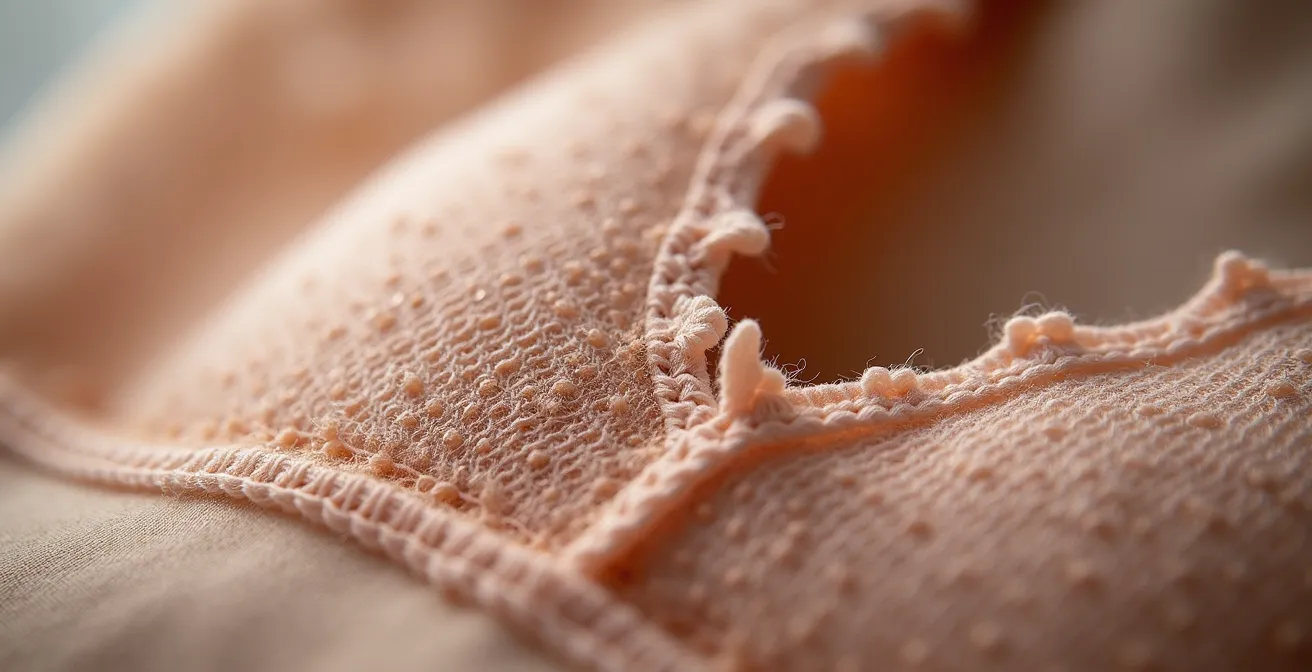
This close-up view shows the genius of the design: the delicate lace overlay provides the aesthetic, while the high-performance merino blend lining underneath does the functional work of providing warmth and a soft touch. It’s this combination of textiles that transforms the bralette into a year-round garment, perfectly suited for the British climate.
When shopping, look for descriptions like “internal sling,” “side support panel,” or “modal-lined cups.” These are the hallmarks of a thoughtfully designed bralette that offers both the beauty of sheer lace and the practical comfort you need.
How to wear a bralette under a blazer for a professional yet edgy look?
Wearing a bralette under a blazer is a power-styling move that bridges the gap between professional attire and personal expression. It’s a look that has moved from the runway to the street, and even into more creative office environments. For a woman with a D+ bust, this style can be particularly empowering, as it showcases a beautifully fitting piece of lingerie as a deliberate fashion choice. The key to executing this look with sophistication is to focus on structure, coverage, and balance. It’s not about overt exposure, but about creating a sharp, intriguing silhouette.
The foundation of the look is a well-tailored, single-button blazer. The single button creates a deep ‘V’ neckline that elegantly frames the bralette, allowing the lace to peek through without revealing too much. Paired with high-waisted trousers, the overall look remains professional and polished, as the high waistline provides coverage and elongates the legs, balancing the hint of skin at the neckline. As the Victoria’s Secret Style Guide notes, this is a way to wear a bralette for a “bold, chic look.”
Bralettes can be worn as a peek-a-boo element under sheer tops or under blazers and jackets for a bold, chic look.
– Victoria’s Secret Style Guide, Victoria’s Secret Bralette Collection Guide
For more conservative UK office environments, like those in the City, a softer approach can be taken. Layering the bralette under a sheer silk blouse first, and then adding the blazer, provides an extra layer of modesty while still playing with the concept of sheerness. Opting for tonal colours—such as a black bralette under a charcoal blazer, or a nude lace piece under a cream blazer—adds a level of subtlety and sophistication. The look can then transition from day to night: keep the blazer buttoned for important meetings and open it for after-work drinks. Here are some key tips for perfecting the style:
- Choose a well-tailored, single-button blazer for a sharp, deep ‘V’ that frames the bralette elegantly.
- For more conservative settings, layer the bralette under a sheer blouse first before adding the blazer.
- Opt for tonal colours (nude under cream, black under charcoal) for subtle sophistication.
- Keep the blazer buttoned for meetings, then unbutton for a seamless transition to an evening look.
- Pair with high-waisted trousers or a skirt to maintain a professional level of coverage and create a balanced silhouette.
By following these principles, the bralette-blazer combination becomes a powerful statement of confidence, proving that professional wear can be both sharp and stylishly edgy.
The sign that a “trendy” cut is actually distorting your natural shape
In the world of fast fashion, bralette trends often prioritise aesthetics over anatomy, especially for smaller cup sizes. Designs like the minimalist triangle or the high-apex cut look stunning on models but can be disastrous for a D+ bust when not properly engineered. The most telling sign that a trendy cut is wrong for you is the dreaded “four-boob effect” or unilateral spillage. This happens when the cup is too small, too shallow, or cut in a way that compresses your breast tissue, causing it to bulge over the top or sides of the lace edge. It’s an instant indicator of a poor fit that not only looks unflattering but also feels uncomfortable.
This issue often arises from brands simply scaling up a small-cup pattern without re-engineering the geometry for a fuller bust. A D+ cup has more volume and projection and requires a different structural approach. An effective bralette for a larger bust will feature panelled or multi-part cups. Instead of being a single piece of fabric, the cup is constructed from two, three, or even four separate pieces of lace stitched together. This allows designers to create a deeper, more projected cup shape that encapsulates the breast tissue rather than flattening it. The seams, far from being a flaw, are a mark of superior design and function.
Marks & Spencer, a staple of the UK high street, addressed this problem directly with their innovative DD+ bralette. As noted during testing by model Emma Breschi, “Bralets usually cut into me, creating a four-boob effect, but this one has a fuller cup and so creates a lovely shape.” The M&S design incorporated concealed panelling and a high-stretch lace fabric specifically engineered to prevent the compression issues common in trend-led styles. This highlights the importance of seeking out brands that invest in proper R&D for the fuller-bust market, rather than opting for cheaper, poorly constructed alternatives where, with bras averaging around £15 in the UK, design is often sacrificed for price.
When trying on a bralette, stand sideways and look in the mirror. Your bust should have a smooth, rounded silhouette. If you see any sharp angles, flattening, or bulging, it’s a clear sign the cut is distorting your natural shape, regardless of how trendy it is.
True style complements your form, it doesn’t fight against it. Choosing a bralette with an engineered, panelled cup is the best way to ensure you get a beautiful shape and all-day comfort.
Why is showing skin through sheer fabric a power move, not a weakness?
In a culture that has often scrutinised and objectified the female body, the act of deliberately revealing skin through sheer fabric is a profound statement of agency. It is a conscious, controlled choice that reclaims ownership of one’s body and image. For decades, particularly within the context of British tabloid culture, a “wardrobe malfunction” involving sheer fabric was portrayed as a moment of vulnerability or embarrassment. The modern sheer bralette trend completely subverts this narrative. It reframes the act of showing skin not as an accident to be ashamed of, but as an intentional and powerful style decision.
This shift in perspective is about moving from being the object of the gaze to being the author of one’s own presentation. When you choose to wear a sheer bralette under a blazer or as a festival top, you are curating exactly what is seen and how it is seen. The lace acts as a veil—it simultaneously conceals and reveals, creating a dynamic tension that is both alluring and assertive. You are not “exposed”; you are showcasing a piece of wearable art and, by extension, your confidence in your own body.
This idea is perfectly captured by a recent analysis of fashion evolution, which highlights how this trend reclaims power from outdated cultural narratives.
The sheer bralette trend challenges the history of British tabloid culture’s objectification, turning a potential ‘wardrobe malfunction’ into a deliberate, controlled style choice.
– Fashion Culture Analysis, British Fashion Evolution Study
For a woman with a fuller bust, this power move can be even more significant. Society has often dictated that larger breasts should be minimised or strictly contained. Embracing a sheer style that celebrates your natural shape is a direct challenge to this outdated notion. It is a declaration that comfort, sensuality, and confidence are not mutually exclusive and are not limited by cup size. It is a choice to be seen on your own terms.
Ultimately, the power lies in the intention. By consciously choosing to incorporate sheer elements into your wardrobe, you transform a simple piece of fabric into a symbol of self-assurance and control.
Key Takeaways
- True support for D+ cups comes from an engineered system (band, fabric, cut), not from an underwire.
- The band provides 80% of the support; its fit and structural integrity are paramount.
- For daily wear in the UK, durable Guipure lace is superior to delicate Chantilly, and strategic thermal linings make bralettes a year-round option.
How to embrace the “naked look” trend with grace and confidence?
Embracing the “naked look” or sheer trend is less about the garment itself and more about a mindset. For many, especially those with fuller busts who have been conditioned to prioritise full coverage, the idea can be intimidating. The journey to wearing sheer styles with confidence is a gradual one, built on strategic styling choices and a conscious effort to reframe your perspective. It’s not about jumping straight into a fully transparent outfit; it’s about starting with small, controlled steps that allow you to grow comfortable in your own skin and style.
A great starting point is tonal dressing. Layering a skin-toned or monochrome sheer piece under clothing of a similar colour creates a subtle, sophisticated effect. Think of a black lace bralette peeking out from the V-neck of a black cashmere sweater, or a nude one subtly visible through a white linen shirt. This approach feels less like a bold statement and more like an elegant textural detail. It allows you to play with the trend in low-risk scenarios before graduating to more visible styling, like the blazer combination.
Building confidence is a process. It can be helpful to start in safe spaces, wearing a new sheer look at home or with close friends first. This allows you to get used to the feeling and appearance without the pressure of public opinion. As your comfort level grows, you can progress from partial reveals—like letting the lace edge of a bralette show above a crew-neck top—to bolder combinations. The goal is to move at your own pace, celebrating each small step as a win. This incremental approach is key to making the trend feel authentic to you. The UK women’s underwear market, which was valued at over £1.9 billion, is increasingly catering to this desire for expressive, confidence-building lingerie.
The final, most crucial step is a mental one: reframe how you see the garment. Instead of focusing on the skin that is visible, focus on the craftsmanship of the lace you are showcasing. See it as wearable art. You are not just ‘showing skin’; you are displaying an intricate pattern, a beautiful texture, a piece of design that you have chosen to highlight. This mental shift transforms an act of potential vulnerability into one of curated self-expression and appreciation for beauty.
- Start with tonal dressing: layer skin-toned or monochrome sheer pieces for subtle sophistication.
- Begin in low-risk scenarios: wear a new style at home or with close friends first to build comfort.
- Try safer styling options first, like letting a bralette peek above a crew-neck sweater.
- Progress gradually from partial reveals to bolder blazer or open-shirt combinations.
- Reframe the mindset: focus on showcasing the lace craftsmanship as wearable art, not just revealing skin.
By combining a gradual approach with a powerful mindset shift, you can embrace the sheer trend not with trepidation, but with the grace and confidence you deserve.