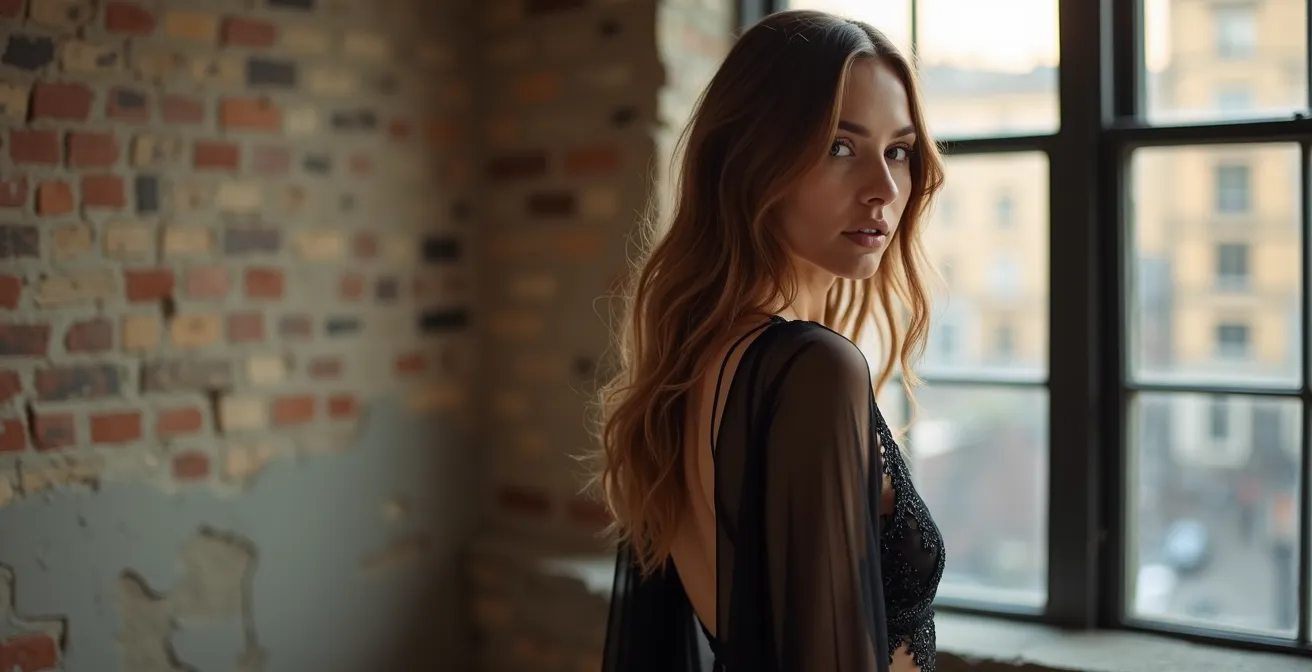
Wearing sheer clothing isn’t about being exposed; it’s about taking control of transparency to celebrate your body on your own terms.
- Technical fabric choices, like Power Mesh, offer a superior ‘blurring’ effect compared to standard Tulle, giving you more control over the final look.
- Strategic tools, from custom embroidery to supportive underpinnings, are instruments for framing and sculpting, not just for hiding.
Recommendation: Before you even consider the outer layer, master your foundation. Finding a bralette with a perfectly fitted band is the first and most crucial step to feeling powerful and secure in any sheer garment.
You see it on the red carpet, on your Instagram feed, and in the windows of high-street shops from King’s Road to Manchester’s Northern Quarter. The “naked look”—garments crafted from sheer, diaphanous fabrics that play with transparency. For many women, the immediate reaction is a mix of admiration and apprehension: “I love that, but I could never wear it.” It’s a feeling rooted in the idea that showing skin is an act of vulnerability, something to be anxious about or to ‘earn’ with a certain body type.
The conventional advice often reinforces this fear. You’re told to “layer strategically” under a blazer, to stick to dark colours, or to start with a tiny sheer panel on a sleeve, as if you must apologise for the fabric’s very nature. These tips, while well-intentioned, treat transparency as a problem to be solved or minimised. They are rooted in the concept of hiding.
But what if we reframed the entire conversation? What if embracing sheer fabrics wasn’t about revealing, but about curating? This guide rejects the notion that sheer is about exposure. Instead, it presents it as a powerful act of self-authorship. It’s about understanding the technical tools at your disposal—from the physics of fabric weave to the art of skin preparation—to consciously decide what you show, what you blur, and what you celebrate. This is not about being naked; it’s about wielding transparency with intention and power.
This article will provide you with a complete toolkit to master this trend with confidence. We will explore the mindset behind the power move, delve into the specifics of fabrics and fit, uncover the lighting mistakes to avoid, and detail how to achieve a supportive and stylish look, no matter your body shape or cup size. Get ready to transform your perspective and your wardrobe.
Contents: Master the Art of Sheer
- Why is showing skin through sheer fabric a power move, not a weakness?
- How to place embroidery to cover only what you want to hide?
- Power Mesh vs Tulle: Which offers more “blurring” effect?
- The lighting mistake that makes opaque fabrics turn transparent
- How to prep skin to look radiant under sheer black fabric?
- Why is the band more important than the wire in a lace bralette?
- How to style sheer panels without revealing too much?
- How to achieve a supportive fit with a sheer lace bralette for larger cup sizes?
Why is showing skin through sheer fabric a power move, not a weakness?
The perception of sheer fabric as a sign of weakness or mere provocation is outdated. In today’s cultural landscape, choosing to wear something transparent is an active, conscious decision—an exercise in bodily autonomy. It subverts the historical gaze by putting the wearer in complete control of the narrative. You are not being exposed; you are choosing what to reveal. This shift from passive object to active subject is the very definition of a power move. It’s a declaration that your body is not something to be hidden or ashamed of, but something to be celebrated and adorned as you see fit.
This sentiment is echoed by fashion experts who see the trend as a form of empowerment. As Sonnet Stanfill, a V&A Museum Curator, explains, it’s a direct challenge to outdated norms. In her view, when discussing the modern “naked dress,” “You could see the baring of one’s body as a celebratory and reclaiming act.” It’s about taking ownership and expressing confidence, transforming vulnerability into strength.
Adopting this mindset is the first step. When you view a sheer blouse or dress not as a risk but as a canvas, you change your relationship with it. It becomes a tool for self-expression. You decide on the level of opacity, the style of underpinnings, and the areas you wish to highlight. Every choice is intentional. This is strategic transparency, and it communicates confidence far more effectively than hiding behind opaque layers ever could.
How to place embroidery to cover only what you want to hide?
Thinking of embroidery as just a way to “cover things up” misses its true potential. A more powerful approach is to see it as anatomical mapping—a precise tool to frame, celebrate, and sculpt your silhouette. Instead of hiding, you are consciously directing the eye, creating a piece of wearable art that is unique to your body. Strategically placed embroidery or appliqué can highlight the curve of a hip, draw attention to the collarbone, or provide elegant coverage over the bust, all while adding texture and dimension.
This allows you to transform any sheer garment into a bespoke piece. You can either seek out designers who excel at this art or commission a local artist to customise an existing item. This moves beyond simply wearing a trend and enters the realm of co-creating your fashion. It’s about making the garment work for your body, not the other way around. The key is to be precise in your vision before you start.

As the image above demonstrates, intricate patterns can provide visual density exactly where it’s needed, turning functional coverage into a beautiful design feature. To get started on your own project, a clear audit is essential.
Your Action Plan: Strategic Embroidery
- Identify Contact Points: Use a skin-safe pen in front of a mirror to mark the precise outlines of areas you want to strategically conceal or highlight with embroidery.
- Gather Intel: Collect images of sheer garments with embroidery you admire (e.g., on Pinterest, Instagram). Note the pattern types (botanical, geometric) and density of the thread work.
- Check for Cohesion: Does the embroidery style you’re drawn to align with your personal aesthetic? Decide if you prefer minimalist lines, bold florals, or abstract patterns.
- Assess Impact: Will the placement create a unique, artful frame for your body, or does it look like a generic patch? Aim for patterns that flow with your natural curves.
- Create an Action Plan: Decide whether to buy a pre-embroidered piece or commission a UK artist on a platform like Etsy UK to customise an existing garment, using your notes and markings as a guide.
Power Mesh vs Tulle: Which offers more “blurring” effect?
Not all sheer fabrics are created equal. The choice between Tulle and Power Mesh is one of the most critical technical decisions you can make, as it directly impacts the level of transparency and the “blur” effect on your skin. While Tulle is often the default, known for its stiff, airy structure in tutus and veils, it offers minimal diffusion. Its open, hexagonal grid is highly transparent. Power Mesh, on the other hand, is a knit fabric with a denser structure, engineered to offer both stretch and a significant soft-focus effect. It scatters light more effectively, creating a diffused blur rather than stark transparency.
A practical test conducted under UK-specific lighting conditions revealed that power mesh consistently provides superior coverage in typical British environments, from overcast daylight to the warm, dim lighting of a pub. Under harsh smartphone flashes, Tulle’s grid can become visible and create unflattering patterns, while Power Mesh maintains its consistent, blurring quality. For anyone feeling apprehensive about sheerness, Power Mesh is the more forgiving and powerful ally.
| Feature | Power Mesh | Tulle |
|---|---|---|
| Blur Effect (1-5) | 4/5 – High diffusion | 2/5 – More transparent |
| Denier Range | 15-40 denier | 10-20 denier |
| Weave Structure | Knit construction | Hex grid pattern |
| Light Diffusion | Creates soft-focus effect | Minimal diffusion, more see-through |
| Best UK Lighting | Performs well in dim pub lighting | Better for natural daylight |
| Stretch Factor | 4-way stretch | Minimal to no stretch |
This technical knowledge empowers you to shop smarter. When you’re looking at a garment’s label, understanding the difference between these materials allows you to predict how it will behave on your body and in different social settings, giving you ultimate control over your look.
The lighting mistake that makes opaque fabrics turn transparent
One of the biggest fears when wearing dark or even seemingly opaque clothing is the dreaded “flash photography reveal,” where a garment suddenly becomes transparent under a bright light. This isn’t an illusion; it’s physics. Many fabrics, especially knits and even some white materials, are not fully opaque and can become see-through when strongly lit from the front. The most common culprit is a smartphone flash in a dark environment like a bar or a nightclub.
A second, and often overlooked, scenario is backlighting. Standing in front of a bright window or a brightly lit bar can silhouette your body, revealing more than you intended. A fashion editor learned this lesson the hard way, highlighting the importance of underpinnings.
This was the most ‘naked’ I felt and it definitely took some getting used to. The backlighting phenomenon is especially relevant in UK social settings like standing in front of a brightly lit bar. I learned the hard way that white undergarments under white fabric actually make the transparency worse – always opt for nude shades that match your specific skin tone.
– Fashion Editor, Who What Wear
The key takeaway is that “nude” is not a single colour. It’s essential to find undergarments that genuinely match your specific skin tone to create a seamless effect. The easiest way to avoid any surprises is to conduct a simple “flash test” at home before you go out. This quick check can save you from feeling self-conscious and ensure you are in full control of your look, no matter the lighting.
How to prep skin to look radiant under sheer black fabric?
When you wear sheer fabrics, your skin becomes part of the overall look. Prepping it properly is not about achieving “perfection,” but about creating a radiant, healthy-looking canvas that glows from within. This ritual of skin preparation is an act of self-care that builds confidence before you even put on the garment. The goal is a luminous, “soft-focus” effect that looks incredible under the subtle veil of a fabric like sheer black.
The process starts with creating a smooth, hydrated base. Gentle exfoliation removes any dullness, while a high-quality body oil or moisturiser provides a hydrated sheen. For an extra touch of dimension, a liquid bronzer or a shimmer oil applied to the high points of the body—like the collarbones, shoulders, and down the shins—can catch the light beautifully. This technique is about light sculpting, using products to enhance your natural shape. If you have concerns like keratosis pilaris, targeted treatments can help create a smoother surface.

The right preparation turns your skin into the ultimate accessory. Here is a simple routine using products readily available in the UK:
- Gentle Exfoliation: Start by gently exfoliating in the shower. A non-abrasive product like Cetaphil Gentle Skin Cleanser, available at most Boots pharmacies, is perfect for sensitive skin.
- Hydrate and Shimmer: While skin is still slightly damp, apply a hydrating body oil. Look for one with very fine shimmer particles from a retailer like Space NK for a sophisticated, not glittery, glow.
- Add Warmth: Use a liquid bronzer on key areas. Dab it along your collarbones, the fronts of your shins, and the tops of your shoulders to add warmth and definition.
- Address Specific Concerns: For areas with keratosis pilaris (“chicken skin”), often on the upper arms, a lactic acid-based lotion from a UK pharmacy can significantly smooth the texture.
- Final Glow: As a final step, a radiance-boosting cream like Sarah Chapman’s R&R Glow Recovery Cream can be applied to the décolletage for a beautiful, camera-ready finish.
Why is the band more important than the wire in a lace bralette?
For decades, many women have believed that underwire is the only solution for true breast support. However, in the world of lingerie and especially with delicate lace bralettes, this is a misconception. The true hero of support is the band—the part that wraps around your torso. Lingerie experts and professional fitters, like those at John Lewis and Bravissimo, teach that the band is responsible for providing at least 80% of the total support. The straps, contrary to popular belief, should only carry about 20% of the load.
This is known as the “suspension bridge” principle. The band acts as the strong foundation and towers of the bridge, anchoring the structure securely to your body. The straps are merely the cables, providing final shaping and lift. When a band fits correctly—snug but comfortable, sitting horizontally across your back—it creates the structural integrity needed to support your bust, even without wire. This is especially vital in a sheer lace bralette where the design is minimalist and every component must perform perfectly.
The UK bra market is a significant industry, and this principle is at its core. In a segment that generates over £1.45 billion annually in the UK, getting the fit right is paramount. A properly fitted band will not ride up your back, and you should only be able to comfortably slip two fingers underneath it. When the band does its job, the wire becomes a matter of preference for shaping, not a necessity for support.
How to style sheer panels without revealing too much?
Styling sheer panels is an art of intentional layering and balance. The goal isn’t to hide the sheer element but to integrate it into a cohesive and sophisticated outfit. It’s about creating a look that feels deliberate, confident, and appropriate for the occasion, whether it’s for after-work drinks in Canary Wharf or a weekend stroll down King’s Road. The key is to think about what you are pairing the sheer piece with, both underneath and on top.
Tonal underpinnings are your greatest ally. Wearing a camisole or bralette in the exact same colour as the sheer fabric creates a seamless, polished look. This technique makes the layering look intentional, rather than an afterthought. Accessories can also play a dynamic role in providing coverage. A strategically placed cross-body bag, a draped silk scarf, or a long pendant necklace can break up a sheer torso panel and add a point of interest.
UK Fashion Editor Hayley Hasselhoff, a champion for size-inclusive style, often demonstrates this versatility. She suggests layering a sheer pussy-bow blouse over a tonal camisole for a chic daytime look or draping a sheer cape over a structured dress for an evening affair. The principle remains the same: it’s about balancing transparency with opaque elements to create a look that is both intriguing and elegant. Here are a few UK-centric looks to inspire you:
- The City-Slicker: Pair a dress with sheer long sleeves with a sharp, tailored blazer for a look that transitions perfectly from the office to after-work drinks.
- The Weekend Edit: Wear a top with sheer shoulder panels under a classic trench coat for a chic and comfortable outfit ideal for shopping or brunch.
- The Pub-Appropriate: Choose a dark floral dress that features a sheer décolletage panel and pair it with a statement necklace to draw the eye upward.
Key takeaways
- Transparency is a Choice: Embracing sheer is not about accidental exposure but about using transparency as a deliberate tool to frame and celebrate your body.
- Your Technical Allies: The right fabric (Power Mesh over Tulle) and a perfectly fitted bralette band are the non-negotiable foundations for a confident and secure look.
- Master Your Environment: Understanding how to prep your skin for a radiant glow and how to test for different lighting conditions gives you complete control over the final result.
How to achieve a supportive fit with a sheer lace bralette for larger cup sizes?
For too long, women with larger cup sizes (D+ and above) were told that delicate, wire-free bralettes were not for them. This myth is being powerfully dismantled by innovative brands and a growing demand for inclusive sizing. With the UK market for plus-size lingerie growing steadily, brands are finally engineering sheer lace bralettes that offer both beauty and robust structural support, proving that you don’t have to sacrifice one for the other.
The secret lies in smart design features that compensate for the lack of underwire. Look for bralettes with multi-part cups (seamed cups that provide more shape and support than a single piece of fabric), wider and plush-backed bands for comfort and stability, and power mesh “wings” or side panels that help anchor the bralette. Seams are also crucial; vertical seams provide lift, while horizontal seams give a rounded, forward-facing shape. These seemingly small details work together to create a supportive structure.
Several UK-accessible brands have become leaders in this space, engineering their products specifically for the needs of a fuller bust. Shopping from these specialists ensures you are getting a product that has been designed with support as a priority, not an afterthought. Finding the right brand and the right fit is an empowering act that unlocks a whole new world of lingerie possibilities.
This table highlights some of the top-performing brands available to UK shoppers that specialize in D+ cup sizes, based on an in-depth analysis of the UK lingerie market.
| Brand | Size Range | Key Features | Support Rating |
|---|---|---|---|
| Bravissimo | D-L cups | Multi-part cups, power mesh wings | 9/10 |
| Curvy Kate | D-K cups | Vertical seams for lift | 8/10 |
| Freya | D-K cups | Wider plush-backed bands | 8.5/10 |
| Panache | D-J cups | Structural horizontal seams | 9/10 |
By focusing on brands that prioritize engineering and fit, you can confidently wear the beautiful, sheer lace bralettes you’ve always admired.
Now armed with the knowledge of fabrics, fit, and styling, the final step is to put it all into practice. Start by identifying the one sheer piece that truly speaks to you and use these tools to make it your own.