
The constant struggle with figure-hugging lingerie—the digging, pinching, and feeling of being encased—isn’t a sizing issue you must endure. The problem lies in a fundamental misunderstanding of the garment’s purpose. True comfort and a flawless silhouette come not from restriction, but from biomechanical synergy. This guide reframes the selection process, focusing on lingerie engineered for kinetic harmony, where fabrics and construction are designed to stretch, support, and glide with your body’s natural movement.
There is a shared, almost ritualistic, frustration among those who love the sculpted look of figure-hugging lingerie: the feeling of being “sausage-cased.” It’s the sensation of a garment working against you, where every breath feels measured and every movement is a negotiation with unforgiving fabric. We’ve been told the solutions are simple: size up, look for “stretch,” or simply tolerate the discomfort as the price of a sleek silhouette. These are the platitudes of the lingerie world, offering temporary fixes that ignore the root of the problem.
The issue is rarely about the size label or even the material itself. It’s about physics and biology—the biomechanics of a body in motion. A truly exceptional piece of lingerie is an exercise in engineering. It anticipates torsion, accommodates shear, and manages tension. But what if the secret to freedom of movement wasn’t just in the percentage of elastane, but in its ‘recovery rate’? What if the difference between a seam that supports and one that painfully digs in lies in a stitching technique borrowed from high-performance athletic wear? The true art is achieving kinetic harmony, where the garment becomes a second skin that responds, not restricts.
This guide moves beyond the fitting room mirror to explore the science of comfortable, figure-hugging apparel. We will analyse the properties of smart fabrics, deconstruct seam technology, and understand the difference between healthy compression and harmful constriction. By shifting your focus from how the lingerie looks on a static body to how it performs on a dynamic one, you can finally find pieces that liberate your movement while celebrating your form. It’s time to demand more from your lingerie: not just to fit your body, but to move with it.
In this analysis, we will delve into the critical details that define a garment’s performance, from its material composition to its structural integrity. The following sections provide a complete roadmap for making informed choices.
Summary: A Guide to Lingerie That Moves With You
- Why does elastane percentage matter for garments that need to snap back to shape?
- How to check if a figure-hugging piece will remain comfortable during a 3-course dinner?
- Flatlock vs Overlock: Which seam type prevents digging into soft tissue?
- The tightness sign that indicates a garment is hindering your lymphatic flow
- What seamless solutions work best under ultra-tight jersey fabrics?
- How to engineer support for significant curves without relying on thick straps?
- How to walk gracefully in heels while wearing a long chemise?
- How does medical-grade compression in modern bodysuits differ from old-school girdles?
Why does elastane percentage matter for garments that need to snap back to shape?
The term “stretchy” is often used as a catch-all for comfort, but it’s a dangerously simplistic metric. The real magic isn’t in a fabric’s ability to stretch, but in its ability to return to its original form. This property is known as recovery rate or fabric memory, and it’s the defining characteristic of high-quality elastane (often known by brand names like Lycra® or spandex). When you move, a garment stretches. Without a high recovery rate, that fabric becomes baggy and loses its supportive, figure-hugging quality over just a few hours of wear.
The percentage of elastane is a crucial indicator, but more isn’t always better. The sweet spot for most lingerie applications is a modest 3-12% elastane content blended with a primary fibre like polyamide, cotton, or modal. This provides the ideal balance of flexibility and recovery. Below this range, the garment may not offer enough dynamic movement. Exceeding it can, paradoxically, hinder elasticity and create recycling challenges. It’s the quality and behaviour of the elastomeric yarn that count.
To assess this, you need to look beyond the label. High-quality elastane should have a recovery rate of up to 95%, meaning it snaps back almost perfectly after being stretched. You can perform a simple manual test: stretch a section of the fabric for a few seconds and observe how quickly and completely it returns. A quality garment will show no signs of sagging. Furthermore, this elasticity must be durable; inferior yarns lose their recovery ability after repeated cycles of stretching, which is why some “stretchy” items lose their shape after a few washes or a long day of wear.
How to check if a figure-hugging piece will remain comfortable during a 3-course dinner?
The ultimate trial for any piece of shapewear or fitted lingerie isn’t the fitting room, but the real world—and few scenarios are more demanding than a long dinner. This is where a garment’s true character is revealed, as you shift, breathe, and sit for an extended period. To avoid buyer’s remorse, you can conduct what we’ll call “The Mayfair Dinner Test” protocol in the privacy of your home before committing.
This isn’t just about standing still. You must simulate the dynamic and sustained pressures of an evening out. The first step is to wear the garment for at least 30 minutes. Then, perform a series of movements: sit down, bend forward as if you were reaching for something, and cross and uncross your legs. Does the waistband roll down? Do the leg openings dig into your thighs, creating a “double-bulge”? These are immediate red flags indicating the fit is too small or the design is flawed.

The most critical part of the test is assessing comfort while seated. A garment that feels fine when standing can become a torture device when your body is compressed into a sitting posture. Pay close attention to the pressure on your abdomen. It should feel like a secure hug, not a restrictive clamp. You should be able to take a deep, full breath without feeling constricted. If the piece is pinching, rolling, or causing any numbness, it will only worsen over a three-course meal. True kinetic harmony means the garment adapts to your posture, rather than fighting it.
Flatlock vs Overlock: Which seam type prevents digging into soft tissue?
Seams are the architectural skeleton of a garment, and their construction is one of the most overlooked aspects of comfort. A poorly designed seam can concentrate pressure along a thin line, creating the dreaded “cheese-wire” effect that digs into soft tissue and creates visible ridges under clothing. The two most common industrial seam types are overlock and flatlock, and understanding their differences is key to choosing a truly comfortable piece.
The overlock seam is a workhorse of garment construction, creating a durable edge by wrapping threads around the fabric’s border. While strong, it produces a distinct ridge on the inside of the garment. In figure-hugging apparel, this ridge becomes a pressure point, which can lead to chafing, irritation, and unsightly lines. It’s effective for general apparel but often a poor choice for next-to-skin compression.
In contrast, the flatlock seam is the hero of high-performance athletic wear and modern lingerie for a reason. As the name suggests, the two pieces of fabric are joined edge-to-edge, creating a seam that lies perfectly flat against the skin. This construction spreads any load or pressure evenly, eliminating the sharp ridge that causes digging. As the Sweaty Betty UK Design Team noted in the UK High-Performance Sportswear Industry Report, this is the technology that “eliminates chafing during intense activity.”
Flatlock stitching eliminates chafing during intense activity
– Sweaty Betty UK Design Team, UK High-Performance Sportswear Industry Report
The difference is stark when comparing how these seams handle pressure. The following table, based on principles from studies on textile mechanics, clarifies the choice for comfort.
| Seam Type | Pressure Distribution | Visibility Under Clothing | Best For |
|---|---|---|---|
| Flatlock | Spreads load evenly, prevents ‘cheese-wire’ effect | Nearly invisible | Athletic wear, seamless look |
| Overlock | Can create pressure points | Creates visible ridge | Durable construction |
| Bonded | No seam pressure | Completely invisible | Ultra-tight clothing |
The tightness sign that indicates a garment is hindering your lymphatic flow
There’s a critical line between a comfortably snug fit and a dangerously restrictive one. When a garment is too tight, it does more than just cause discomfort; it can actively hinder your body’s vital systems, particularly the lymphatic system. This delicate network is responsible for draining fluid and waste from your tissues, and it runs very close to the skin’s surface. Unlike your circulatory system, it has no central pump, relying on muscle movement and unrestricted pathways to function.
A figure-hugging garment that exerts excessive, uniform pressure can act like a dam, impeding this natural flow. The most telling sign that a piece of lingerie is too tight is not just a temporary red mark. The real warning sign is a deep, persistent indentation that remains long after you’ve removed the garment, especially if accompanied by slight swelling above or below the compressed area. For example, if the leg band of a bodysuit creates a sharp groove, you might notice a subtle puffiness in your upper thigh. This indicates that lymphatic fluid is struggling to move past the restriction.
Other signs include a feeling of numbness, tingling, or “pins and needles,” which suggests that nerve compression is also occurring. This is a clear signal that the pressure is not supportive, but constrictive. A well-engineered compression garment, as we’ll see later, uses a pressure gradient—tighter at the extremities and lighter towards the core—to assist fluid return. A poorly designed or sized garment does the opposite, creating a tourniquet effect that traps fluid and compromises your body’s natural processes. Listening to these subtle but crucial signals is paramount for your health and well-being.
What seamless solutions work best under ultra-tight jersey fabrics?
Ultra-tight jersey fabrics, like those used in bodycon dresses, are notoriously unforgiving. They cling to every curve and reveal the slightest imperfection underneath, making the choice of undergarment absolutely critical. The ultimate goal is an invisible transition between skin and fabric, and modern seamless technology offers the most effective solutions. However, not all “seamless” underwear is created equal.
The most advanced solutions utilise circular knitting and laser-cut or bonded edges. Instead of being cut from a flat piece of fabric and sewn together, these garments are knitted in a tube, eliminating side seams entirely. The edges are then either precisely cut with a laser, leaving a “raw” but non-fraying edge, or finished with a flexible bonding agent. This creates a profile that is virtually flat against the skin, preventing the visible panty line (VPL) that even thin overlock seams can create.
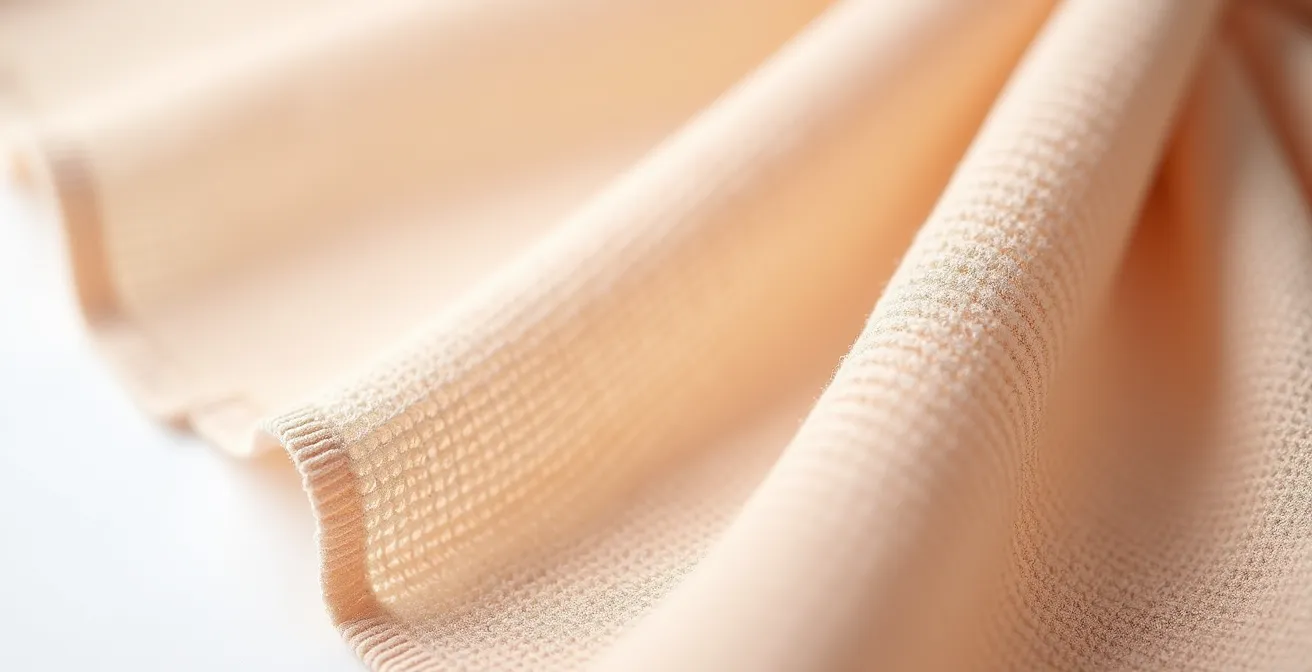
A case in point from the UK market is the brand Heist, which has become a cult favourite for its revolutionary approach. Their designs are fit-tested extensively to ensure a no-pinch, no-chafe, and truly invisible wear experience under the tightest of clothes. The technology often involves ‘feathered’ edges, where the knitting density gradually decreases towards the hem. This creates a gradient that melts into the skin, making the edge of the garment undetectable.
When shopping for seamless solutions, look for these specific features. Run your fingers over the leg and waist openings. They should feel completely flat, with no discernible ridge or thread. These are the pieces that will truly disappear under a tight jersey fabric, allowing the dress to glide over your body without interruption and giving you the confidence that comes from a perfectly smooth foundation.
How to engineer support for significant curves without relying on thick straps?
Supporting significant curves, particularly a larger bust, without resorting to thick, utilitarian straps is a masterclass in biomechanical engineering. The common assumption is that support must come from pulling upwards via the shoulders, but this creates immense pressure on a small area and limits the aesthetic possibilities of a garment. The secret lies in redistributing the load and creating a self-supporting structure around the torso.
The first principle is to use the torso as an anchor. Instead of thin bands, advanced designs incorporate wide, structured underbands that act as a cantilever system. This band is the primary source of support, taking the majority of the weight off the shoulders. To enhance this, flexible yet firm vertical boning (often modern spiral steel, not rigid plastic) can be integrated into the side seams. This prevents the band from rolling or buckling and helps to anchor the entire structure against the body’s core.
Furthermore, internal structures can provide lift without external straps. Interior slings, often made of non-stretch power-mesh, can be strategically placed to lift and shape the bust from below, holding it against the torso. Finally, to prevent any slipping, especially in strapless designs, high-friction surfaces are essential. Bands lined with dotted or wavy lines of silicone provide a gentle grip against the skin, ensuring the garment stays perfectly in place through movement. This approach shifts the engineering focus from ‘hanging’ to ‘anchoring’, liberating the shoulders and opening up a world of design possibilities. This innovation is also tied to material science; for instance, a third-party life cycle assessment confirms that modern fibres like LYCRA® EcoMade can reduce the fibre’s carbon footprint by up to 45 percent, showing that performance and sustainability can go hand in hand.
Your action plan: Verifying strap-free support
- Feel the band: Check for a wide, firm underband that feels like the primary support structure.
- Locate the boning: Gently press the side seams to identify the presence of flexible vertical boning.
- Inspect the interior: Look for hidden power-mesh slings or panels inside the cups or body.
- Test the grip: Run your finger along the inside of the top edge to feel for a silicone anti-slip band.
- Get a professional fitting: Ensure realistic expectations; good shapewear creates a sleek silhouette but won’t change your dress size.
How to walk gracefully in heels while wearing a long chemise?
Walking with grace in a long, figure-hugging chemise, especially when paired with heels, is an exercise in creating harmony between your body’s movement and the fabric’s properties. The potential pitfall is restriction: a garment that is too constricting around the knees or thighs will force you into a hobbled, unnatural gait. The key to an elegant stride lies in a fabric cut that is specifically designed to accommodate movement: the bias-cut.
Unlike standard cuts that align with the fabric’s rigid vertical and horizontal threads, a bias-cut orients the pattern diagonally across the grain. This simple shift unlocks the fabric’s inherent mechanical stretch, allowing it to drape and move with the body’s natural curves and contortions. As you walk, the fabric stretches diagonally with the extension of your leg and recovers as you bring it forward, creating a fluid, flowing motion rather than a restrictive bind. This is why a bias-cut silk chemise seems to glide with the wearer.
Your posture and gait are the other half of the equation. When wearing heels, the body’s centre of gravity is shifted forward. To walk gracefully, you must engage your core and walk from your hips, not your knees. Think of leading with your hip, allowing your leg to swing forward in a longer, smoother stride. This creates a more elegant line and allows the bias-cut fabric to move as intended. A restrictive, straight-cut chemise would fight this movement, but a well-designed one will amplify its grace.

Key takeaways
- True comfort is not about size, but about ‘recovery rate’—a fabric’s ability to snap back after stretching.
- A garment’s performance should be tested in a dynamic, real-world scenario, like sitting through a long dinner, to check for rolling and pinching.
- Modern compression uses graduated pressure to aid circulation, unlike old girdles that constricted with uniform pressure.
How does medical-grade compression in modern bodysuits differ from old-school girdles?
The evolution from the rigid, uncompromising girdles of the past to modern compression bodysuits represents a monumental shift in philosophy: from constriction to sophisticated support. The old-school girdle’s primary goal was to forcibly reshape the body using heavy, non-breathable fabrics and rigid boning, often at the expense of comfort and even health. It applied a static, uniform pressure across the torso, which could impede breathing and circulation.
Modern medical-grade compression, now integrated into high-end shapewear, operates on a completely different principle. It uses advanced, breathable power-mesh fabrics and is engineered with graduated compression. This means the pressure is strongest at the extremities (e.g., the ankle or thigh) and gradually decreases towards the core. This intelligent pressure gradient is designed to assist the body’s natural systems, specifically helping lymphatic fluid and venous blood flow back towards the heart. It’s a technology borrowed directly from medical garments used to treat conditions like lymphoedema.
The difference is scientifically measured and applied. As data from sources like Cancer Research UK shows, the pressure of these garments is quantified in mmHg (millimetres of mercury) and applied by trained specialists. This contrasts sharply with the unstandardised, purely aesthetic sizing of traditional girdles.
| Feature | Modern Medical-Grade | Old-School Girdles |
|---|---|---|
| Compression Type | Graduated to help lymph fluid drain | Static uniform pressure |
| Materials | Advanced power-mesh, breathable | Rigid, non-breathable fabrics |
| Medical Application | Used with MLD therapy by trained specialists | No medical oversight |
| Measurement Standard | mmHg (millimetres of mercury) | No standardized measurement |
This engineered approach provides a smooth silhouette while actively supporting your body’s functions, a world away from the restrictive philosophy of the past. For those with concerns or seeking therapeutic benefits, it’s vital to seek professional guidance.
Contact Manual Lymphatic Drainage UK or the British Lymphology Society directory for qualified therapists
– Macmillan Cancer Support, Lymphatic Drainage Guidelines 2024
By applying this biomechanical lens to your choices, you transform the act of buying lingerie from a game of chance into a science of support and liberation. The next step is to put this knowledge into practice, seeking out garments engineered for kinetic harmony and reclaiming your comfort without sacrificing your silhouette.
Frequently asked questions about Lingerie and Movement
What makes a figure-hugging garment move well with the body?
A garment’s ability to move well is primarily due to its elasticity. High-quality elasticated fabrics, often with a specific percentage of elastane, allow the garment to conform to the body’s shape and flex with its movements without losing its form.
How does bias-cut fabric help with movement?
Bias-cut fabric is cut diagonally across the grain, which unlocks its natural mechanical stretch. This allows the material to drape and move fluidly with the body’s curves and motions, providing freedom and an elegant flow, especially in longer garments like chemises.
Which fabrics work best for graceful movement?
Fabrics with inherent drape and some degree of elasticity, like bias-cut silk or high-quality jersey blends, are excellent for graceful movement. They are versatile enough to work with a range of footwear, from strappy sandals to sneakers, without hindering your natural stride.