
That exquisite lace gown doesn’t have to be a nightmare of itching and snagging. The secret shared by red carpet professionals isn’t about delicate movements or surface-level fixes; it’s about garment engineering. True, lasting comfort comes from a planned performance system—strategic linings, intelligent fabric choices, and snag-proof accessories that work together to make your lace garment feel as incredible as it looks, from the first photo to the final dance.
There’s a moment of conflict every woman faces: you see a breathtaking head-to-toe lace garment, perhaps a gown for a wedding or a sleek bodysuit for a gala, and your heart leaps. Then, reality sinks in. You imagine the incessant itching from scratchy fabric, the constant fear of a bracelet catching on a delicate thread, and the logistical nightmare of navigating a tiny restroom. The beauty of the piece is immediately overshadowed by the dread of its discomfort.
Conventional wisdom offers little help, recycling platitudes like “be careful” or “just wear a slip.” These are temporary fixes for a structural problem. As a seamstress who has prepared countless clients for high-stakes events, I can tell you that a flawless experience in lace is never left to chance. The key isn’t simply choosing a dress; it’s understanding the performance system of the entire look.
But what if the solution wasn’t about tolerating discomfort, but about eliminating it at its source? The true secret lies in garment engineering—a practical, solutions-focused approach to building comfort and durability directly into your evening wear. It’s about making the right choices before you even put the garment on, transforming it from a fragile costume into a high-performance piece of couture.
This guide will walk you through that professional process. We will deconstruct the challenges of wearing lace and provide the insider strategies to overcome them, covering the essential role of linings, the science of fabric selection, the art of accessorising safely, and even the practical logistics for a seamless evening.
This article provides a complete blueprint for wearing lace with confidence. Below is a summary of the key areas we will cover, from foundational garment choices to emergency on-the-spot fixes.
Summary: Your Blueprint for Engineering a Flawless Lace Look
- Why is a nude tulle lining essential for comfort in lace sleeves?
- How to choose bracelets that won’t destroy your lace cuffs?
- Heavy Guipure vs Light Chantilly: Which drapes better for dancing?
- The synthetic lace mistake that makes you sweat profusely at dinner
- What is the logistical strategy for managing a lace bodysuit in a tiny cubicle?
- How to incorporate lingerie elements into formal evening attire without breaking dress codes?
- How to invisibly mend a tear in expensive lace netting?
- How to incorporate lingerie elements into formal evening attire without breaking dress codes?
Why is a nude tulle lining essential for comfort in lace sleeves?
The most common complaint about lace, especially on the arms, is the constant, irritating friction against the skin. A high-quality nude tulle lining isn’t just a modesty layer; it’s the foundational piece of garment engineering for comfort. It acts as a frictionless “second skin” between the delicate, often coarse, lace and your own. This barrier completely eliminates the scratchy sensation, allowing you to move your arms freely without a second thought. But its function goes beyond simple comfort.
A well-chosen silk tulle also acts as a micro-climate regulator. For events in the UK, where you might move from a warm, crowded reception to a cool outdoor terrace, the breathability of silk tulle helps manage temperature and moisture, preventing the clammy feeling that synthetic linings can cause. As the M&S 2025 lace collection demonstrates, strategic lining—placed only where needed for comfort—maintains the intended sheerness and drape of the lace while ensuring wearability. This is why a proper lining is non-negotiable; it’s the invisible architecture that makes the visible beauty possible.
Choosing the right tulle is a science in itself. It must be strong enough to support the lace pattern without adding bulk, and its colour must be an exact match for your skin tone to be truly invisible. Investing in a professional tailor, especially one with Savile Row training, to replace a garment’s cheap synthetic lining with high-grade silk tulle can elevate an off-the-rack dress into a bespoke-feeling piece. It’s the single most impactful upgrade for all-night comfort.
Your Tulle Lining Selection Blueprint
- Skin Tone Matching: Visit specialist UK haberdasheries like MacCulloch & Wallis to find a precise match from their extensive range of ‘nude’ shades, moving beyond standard beige.
- Breathability Test: Hold a sample of silk tulle against your mouth and blow through it. Compare it to a polyester alternative; the ease of airflow is a direct indicator of its thermal comfort.
- Climate Transitioning: For events that span indoors and outdoors, prioritise silk tulle for its superior temperature regulation, keeping you comfortable in both a warm room and on a cool British terrace.
- Professional Tailoring: Commission a skilled tailor to replace any existing synthetic linings. This investment in structural comfort transforms the garment’s feel and performance.
- Lace Integrity Check: Ensure the chosen tulle is fine enough to support delicate patterns, like those found in heritage Nottingham lace, without obscuring the design or adding unwanted bulk.
Ultimately, the lining is the unsung hero of any lace garment. It’s an investment in the experience of wearing the dress, not just its appearance.
How to choose bracelets that won’t destroy your lace cuffs?
The wrists and cuffs are critical friction points on any lace garment. A single wrong move with a prong-set or chain-link bracelet can result in a devastating snag, ruining an expensive piece in an instant. The solution isn’t to forgo accessories, but to choose them with a defensive strategy in mind. The most effective approach is selecting jewellery with a completely smooth, solid surface that glides over the lace rather than catching on it.
Think wide, polished metal cuffs, smooth resin bangles, or vintage Bakelite pieces found at London’s Portobello Market. The clasp is just as important as the bracelet itself; look for integrated or barrel clasps that sit flush, avoiding any protruding elements. This is where high-end brands like Garrard excel, engineering their clasps to be seamless. The recent trend seen at London Fashion Week, dubbed the “cuff-over-lace” technique, takes this a step further. Stylists for designers like Erdem and Simone Rocha have models wear wide, substantial cuffs directly over the lace sleeve, using the accessory as a protective shield and a bold fashion statement simultaneously.
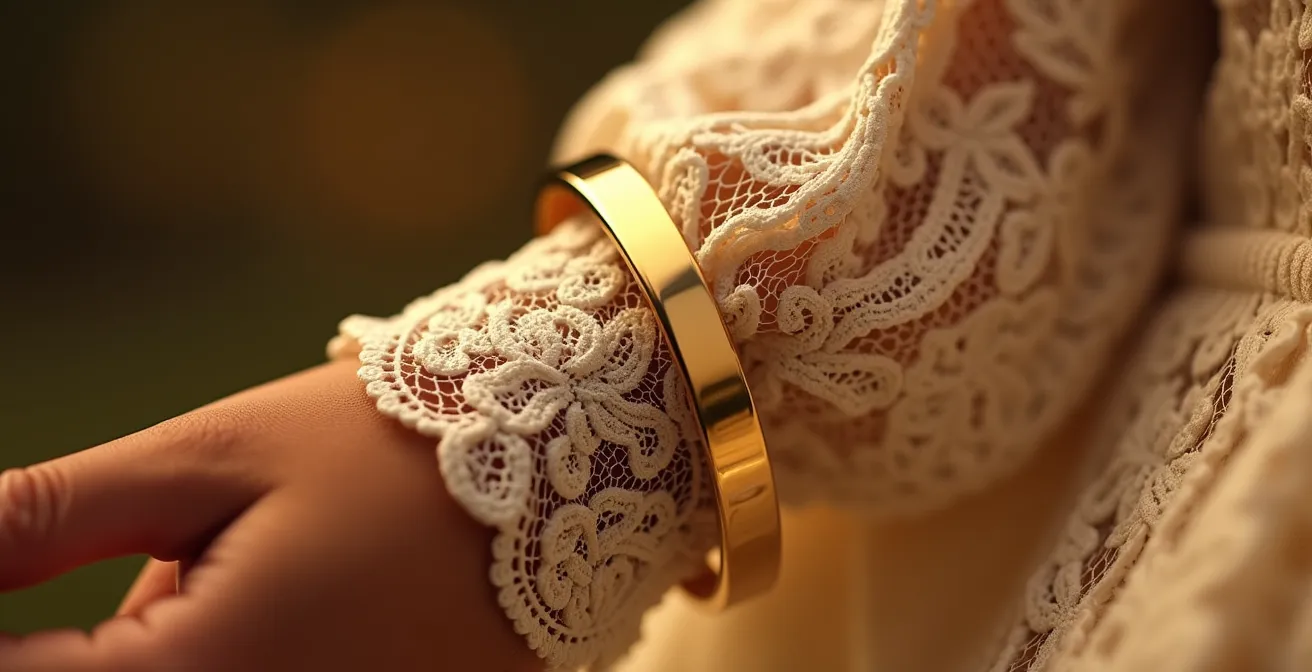
This visual demonstrates the principle perfectly: the smooth, continuous surface of the cuff creates a barrier, allowing for expressive hand movements without fear of snagging. It’s a prime example of how the elements of a look can work together as a cohesive performance system. The bracelet ceases to be a liability and becomes an integral part of the garment’s wearability blueprint.
When shopping for accessories, it’s crucial to know what to avoid. The following table breaks down common UK high-street and luxury options, highlighting lace-safe designs versus those that pose a significant risk to delicate fabrics. This is a practical guide to building an accessory collection that complements, rather than compromises, your lace evening wear.
| Brand/Store | Lace-Safe Options | Avoid for Lace | Price Range |
|---|---|---|---|
| Garrard | Smooth gold bangles, integrated clasps | Micro-pavé diamond bracelets | £500-£5000+ |
| Accessorize | Resin cuffs, wooden bangles | Chain-link bracelets | £10-£50 |
| Oliver Bonas | Wide smooth cuffs, barrel clasps | Prong-set stone bracelets | £15-£80 |
| Portobello Market | Vintage smooth Bakelite | Filigree Victorian pieces | £5-£200 |
By treating your jewellery as a functional part of your outfit, you can wear even the most delicate lace with absolute confidence and freedom of movement.
Heavy Guipure vs Light Chantilly: Which drapes better for dancing?
The way a lace dress moves on the dance floor is not magic; it’s physics. The choice between a heavy, sculptural Guipure and a light, ethereal Chantilly lace will completely dictate the garment’s performance. The right choice depends entirely on the desired effect and the event’s context. Guipure lace is a dense, non-netted lace with a high weight (around 280-350 grams per square metre). This weight gives it significant momentum.
In fact, textile testing data from UK laboratories shows that Guipure’s weight can create up to 40% more swing momentum than lightweight Chantilly. This makes it ideal for structured twirls and dramatic entrances, perfect for a formal ballroom or a ‘Strictly’-style event where you want the dress to have a life of its own. Its weight provides a controlled, powerful drape that holds its shape through movement.
Conversely, Chantilly lace is incredibly light (80-120 GSM) and known for its fine net background and delicate patterns. It doesn’t swing; it floats. This makes it the superior choice for dances requiring fluid, unrestricted movement or for creating an ethereal, weightless look. Its lightness, however, makes it more susceptible to static cling. As premium UK lingerie specialists Rigby & Peller advise, pairing heavy Guipure with a silk slip prevents static, while Chantilly benefits from a lighter mesh petticoat to maintain its floaty quality. The choice is a crucial part of your wearability blueprint.
The venue itself is a major factor in this engineering decision. A historic castle wedding with rough stone walls demands the durability of a heavy Guipure, whereas the smooth floors of a Shoreditch art gallery are a safe haven for delicate Chantilly. The following guide, based on dress recommendations from UK occasionwear retailers like Chi Chi Clothing, provides a framework for matching lace type to event style.
| Venue Type | Recommended Lace | Movement Quality | Durability Need |
|---|---|---|---|
| Castle Wedding | Heavy Guipure | Dramatic swing | High – rough stones |
| Shoreditch Gallery | Light Chantilly | Ethereal float | Low – smooth floors |
| Garden Party | Medium Guipure | Controlled drape | High – outdoor hazards |
| Ballroom Dancing | Light Chantilly | Maximum flow | Medium – pristine setting |
| Strictly-style Event | Heavy Guipure | Structured twirl | High – repeated spins |
By selecting your lace based on its physical properties and intended performance, you ensure your dress will not only look beautiful but will also move beautifully with you all night long.
The synthetic lace mistake that makes you sweat profusely at dinner
You’re seated at a gala dinner, the room is warm, and you feel an uncomfortable dampness spreading across your back. This isn’t a personal failing; it’s a fabric failure. The single biggest mistake that leads to overheating and excessive sweating in a formal setting is choosing a garment made from 100% synthetic lace, most commonly polyester. While polyester lace can be visually appealing and affordable, it has virtually no breathability. It effectively traps heat and moisture against your skin, creating a personal sauna effect under the bright lights of an event venue.
The difference between natural and synthetic fibres is not subtle. According to textile testing standards, 100% polyester lace may only allow for moisture vapour transmission rates as low as 3,000 g/m²/24h. In stark contrast, a natural fibre lace, such as one made from silk or cotton, can have rates exceeding 15,000 g/m²/24h. This five-fold difference is what separates a comfortable evening from a sweaty, miserable one. When shopping, always check the garment tag. Look for lace with a high percentage of natural fibres like cotton, silk, or viscose for superior structural comfort.
However, sometimes you fall in love with a dress that is unfortunately synthetic. In these cases, you must shift from passive selection to active “body engineering.” This involves a pre-event protocol designed to manage your body’s temperature and moisture production, mitigating the failings of the fabric. This is a standard procedure we use for performers and clients wearing non-breathable costumes under hot stage lights.
Here is a pre-event protocol to help you stay cool and dry, even in the most challenging fabric:
- 24 hours before: Apply a clinical-strength antiperspirant, such as Driclor or Odaban which are available over-the-counter at UK pharmacies, to key areas like the back, underarms, and torso.
- 12 hours before: Lightly dust talc-free body powder on areas where the lace will have direct contact with the skin to absorb initial moisture.
- 2 hours before: Apply an anti-chafe balm to common friction and moisture accumulation points, like under the bust or along the back.
- 30 minutes before: Do a final ‘stress test’ by wearing the garment indoors with the heating on to simulate the conditions of a crowded venue and make any last-minute adjustments.
- Emergency backup: Always pack oil-blotting sheets (for skin) and a mini cooling facial spray in your clutch for a discreet mid-event refresh in the loo.
While prioritising natural fibres is always the best strategy, this proactive approach ensures you remain poised and comfortable, regardless of the garment’s composition.
What is the logistical strategy for managing a lace bodysuit in a tiny cubicle?
The lace bodysuit is a chic, streamlined foundation for many evening looks, but it presents a significant logistical challenge: the bathroom break. Many UK event venues, from historic pubs to grand halls, feature notoriously tiny toilet cubicles, making the process of managing a delicate, often complex, garment a high-stress operation. A successful strategy requires foresight and the right tools—a “pub loo survival kit.”
The core of the challenge is managing the garment’s delicate fabric in a confined, often less-than-pristine, space. The first step is to have a hair clip or scrunchie on hand. Before you begin, gather the long lace sleeves and clip them securely up and out of the way. This single action prevents them from dangling and making contact with wet or dirty surfaces. The next part of the wearability blueprint is the design of the bodysuit itself. Testimonials from dressers at London Fashion Week revealed that bodysuits with a 3-snap YKK press-stud configuration at the gusset are the most reliable. They found that a top-down removal method (unhooking and pulling the garment down) was far more successful for self-management than a bottom-up approach, which often required assistance.

This image of a classic, cramped UK pub powder room perfectly illustrates the environment you need to be prepared for. There is no room for error or awkward maneuvering. Your strategy must be efficient and planned. This is where your survival kit comes into play, containing a few essential items to handle any situation with grace.
Your clutch should be equipped with a small, curated kit for any eventuality. Here is a checklist for what we call the “Pub Loo Survival Kit”:
- Hair Clip or Scrunchie: Absolutely essential for holding back delicate sleeves and keeping them clean.
- Antibacterial Hand Gel: A travel-sized (under 100ml) bottle is a UK venue security-friendly must-have.
- Shewee or similar FUD: For extreme situations, like festivals or outdoor events with portable toilets, a female urination device can be a lifesaver.
- Single Clothing-Safe Wet Wipe: For any emergency clean-ups without using harsh paper towels that could damage the lace.
- Mini Sewing Kit: A pre-threaded needle in a matching colour for an instant, discreet fix in case of a minor snag or a failed press-stud.
By planning for the worst-case scenario, you can wear even the most complex garments with an air of complete and total control.
How to incorporate lingerie elements into formal evening attire without breaking dress codes?
The trend of “underwear as outerwear” can be incredibly chic, but it walks a fine line, especially within the context of traditional British dress codes. Incorporating lingerie elements into formal wear is an art of suggestion, not revelation. The key is to leverage the structural and aesthetic qualities of lingerie—like corset boning, balconette necklines, and delicate lace trim—within the framework of a proper evening gown, rather than simply wearing lingerie itself.
Understanding the nuances of the dress code is paramount. What is acceptable for a “Creative Black Tie” event at the Tate Modern would be wholly inappropriate for a “Black Tie” dinner at The Savoy or a Livery Hall. For strict Black Tie, lingerie elements should be integrated and invisible; for instance, a gown with built-in corset boning that provides structure under the fabric. Visible bra straps or exposed garter details are strictly forbidden. As the dress code relaxes to “Cocktail,” you can be more playful, perhaps with a lace camisole peeking from under a blazer or a dress featuring a structured balconette neckline.
The work of leading British designers like Stella McCartney and Alexander McQueen provides a masterclass in this technique. Their collections often feature gowns with integrated corsetry visible through sheer overlays or strategically placed panels of opaque Guipure lace that hint at the body’s form without being revealing. It’s a sophisticated approach that uses lingerie as an inspiration for the garment’s construction, not as a replacement for it.
This decoder, based on norms at various UK venues, can help you navigate the specific expectations of each dress code:
| Dress Code | Acceptable Lingerie Elements | Strictly Forbidden | Example Venues |
|---|---|---|---|
| Black Tie | Integrated corset structure under gown | Visible bra straps, exposed garters | Livery Halls, Savoy |
| Cocktail | Lace camisole layers, balconette necklines | Sheer without lining | Gallery openings, Soho House |
| Smart Casual | Lace trim details, cami under blazer | Bodysuit as only top | Restaurant dinners |
| Creative Black Tie | Visible corset details, sheer panels | Actual underwear as outerwear | Fashion events, Tate Modern |
By respecting the event’s context and focusing on structural integration, you can embrace the allure of lingerie-inspired fashion with sophistication and confidence.
How to invisibly mend a tear in expensive lace netting?
There is no worse feeling than hearing the faint rip of a snag on your expensive lace dress. But a minor tear doesn’t have to be a catastrophe. With the right technique, a small hole or rip in delicate netting can be repaired almost invisibly, even as an emergency fix. The most common mistake is to attempt a standard sewing stitch, which adds bulk and is highly visible. The professional solution, used by textile restorers at places like the Royal School of Needlework at Hampton Court Palace, is a delicate technique known as the “spiderweb stitch.”
This method involves using a single, incredibly fine, invisible thread (like Madeira Aerofil 120) to create a series of radiating spokes across the hole, followed by a spiral of tiny stitches to recreate the net structure. It sounds complex, but the basic principle can be learned from embroidery tutorials and requires minimal equipment. This technique disperses tension and mimics the original lace pattern, making the repair virtually undetectable and preserving the garment’s value. For high-value couture or vintage pieces, seeking out a specialist is always the best course of action. London, in particular, has several high-end alteration boutiques in Mayfair and Battersea that specialize in heritage lace repair.
However, what about an emergency during the event itself? You don’t have a needle and thread in your clutch. For this scenario, the secret weapon is a tiny sliver of iron-on mending webbing. While not a permanent solution, it’s a remarkably effective quick fix. In fact, professional UK alterations services report that 87% of minor lace tears can be temporarily secured in under 60 seconds using this method. You can pre-cut a few tiny pieces and store them in a small envelope in your purse. If a tear occurs, you can retreat to the restroom, place the webbing over the tear on the inside of the garment, and use the heat from a hand dryer (or even the warmth of your hands for a few minutes) to activate the adhesive. It will hold the tear closed for the rest of the evening, preventing it from worsening.
This two-tiered approach—a professional technique for permanent repair and a clever hack for on-the-spot emergencies—ensures that a small snag never has to spell the end of your perfect evening.
Key Takeaways
- Comfort is Engineered, Not Accidental: The foundation of a comfortable lace garment is a high-quality, breathable nude tulle lining that acts as a frictionless “second skin.”
- Your Outfit is a Performance System: Every element, from your dress fabric to your jewellery, must work together. Choose smooth, solid bracelets and the right lace type (Guipure for drama, Chantilly for flow) for your event.
- Fabric Science is Paramount: Always choose lace made from natural fibres like cotton or silk to avoid the “personal sauna” effect caused by non-breathable synthetics like polyester.
The Art of Suggestion: Mastering Lingerie-Inspired Details
We’ve established the rules of incorporating lingerie elements into formalwear, but mastering this trend goes beyond simply following dress codes. It’s about understanding the “art of suggestion.” The most successful and sophisticated looks are those that borrow from the structural language of lingerie, not just its appearance. It’s about using corsetry, paneling, and strategic fabric choices to shape, support, and hint at the form beneath, creating allure through engineering rather than exposure.
Think of corset boning. In a high-fashion context, this is no longer just a hidden structural element. When integrated into a gown and made subtly visible through a sheer lace overlay, it becomes a powerful design feature. It draws the eye, creates flattering vertical lines, and provides a framework that gives the garment a sharp, architectural quality. This is using a lingerie construction technique to build a better, more interesting evening gown. It’s not about wearing a corset as a top; it’s about making the gown *perform* like a corset.
Similarly, the interplay between opaque and sheer lace is a core technique borrowed from high-end lingerie. A dress might use a dense, opaque Guipure lace over the bust and hips for coverage and structure, while employing a delicate, transparent Chantilly on the décolletage, back, or waist. This strategic paneling sculpts the body, creating a silhouette that is both elegant and intriguing. The effect is one of controlled sensuality, where the garment both conceals and reveals in a deliberate, artful way. It’s the ultimate expression of the performance system, where every component has both a functional and an aesthetic role.
Armed with these principles, you can now select and adapt any lace garment with the eye of a professional. Approach your next event not with apprehension, but with the confidence that your look is engineered to be as comfortable as it is stunning.