Contrary to popular belief, luxury lingerie is not a frivolous expense but a calculated asset for the savvy consumer.
- The higher initial cost is offset by a dramatically lower “Cost Per Wear” due to superior materials and construction.
- Proper care, especially in UK hard water areas, is non-negotiable to protect the asset and extend its lifespan significantly.
Recommendation: Shift your mindset from “cost” to “investment value.” Analyse the Cost Per Wear before any purchase and commit to a strict care routine to maximise your return.
For many, the idea of spending over £150 on a single bra, especially when the UK median annual salary for full-time employees is £37,430, seems like the peak of financial indulgence. The high-street offers alternatives for a fraction of the price, making the luxury price tag feel not just extravagant, but irresponsible. The common justifications often revolve around vague notions of feeling good or the allure of premium materials like silk and French lace. While these points have merit, they fail to address the core question for a budget-conscious fashion enthusiast: is it a genuinely viable purchase?
This analysis moves beyond the emotional appeal. We will treat high-end lingerie not as a fleeting treat, but as a durable wardrobe asset. The key, often overlooked, is to reframe the debate from initial outlay to long-term value. The true measure of an item’s worth isn’t its price tag, but its Cost Per Wear (CPW). By dissecting this metric, understanding the engineering behind the price, and adopting a preservation-focused mindset, a different picture emerges.
The argument is simple: the depreciation of a cheap, mass-produced garment is rapid and severe. A premium piece, however, is an investment in your wardrobe’s core infrastructure. This guide will provide a rational, economic framework for evaluating luxury lingerie. We will break down the real cost, provide actionable strategies for protecting your investment in the specific conditions of the UK, and navigate the post-Brexit market to make the smartest financial decision for your style.
This article will guide you through the economic and practical realities of investing in high-end lingerie. From calculating the true value to mastering care and shopping smart, you’ll gain the tools to make an informed, value-oriented decision.
Summary: Is luxury lingerie a viable investment for a median UK salary earner?
- Why does a £150 bra actually cost less per wear than a £30 supermarket alternative?
- How to hand-wash silk lingerie in a hard water area like London?
- Bespoke vs Mass-Luxury: Which offers better value for money?
- The storage mistake that destroys elastic fibers within 6 months
- How to restore the whiteness of lace that has greyed over time?
- Why is a 19-momme silk count the minimum for durable nightwear?
- Why have European lingerie brands become 20% more expensive in the UK?
- How to plan the ultimate luxury lingerie shopping day in London?
Why does a £150 bra actually cost less per wear than a £30 supermarket alternative?
The most significant barrier to purchasing luxury lingerie is “sticker shock.” A £150 price tag feels inherently expensive compared to a £30 high-street option. However, this initial-cost focus is a classic consumer fallacy. The true economic measure of a garment’s value is its Cost Per Wear (CPW), calculated by dividing the initial price by the number of times you’ll wear it. When viewed through this lens, the entire economic argument flips.
A premium bra is engineered for longevity. It uses high-grade elastic that retains its modulus (stretch and recovery) for years, not months. The fabrics are more resilient, the stitching is reinforced, and the design accounts for subtle body changes. A budget bra is built for rapid turnover. Its elastic fatigues quickly, losing support within months. The fabric pills, the underwire can distort, and the fit degrades. This leads to a much shorter lifespan and a higher replacement frequency, which stealthily inflates its true cost over time.
This table breaks down the long-term financial reality. While the initial investment is five times higher, the extended lifespan of the premium piece makes it the more economical choice in the long run.
| Factor | £150 Premium Bra | £30 Supermarket Bra |
|---|---|---|
| Initial cost | £150 | £30 |
| Average lifespan | 3-4 years | 6-8 months |
| Wears per week | 2-3 times | 2-3 times |
| Total wears over lifetime | 416-624 | 52-104 |
| Cost per wear | £0.24 – £0.36 | £0.29 – £0.58 |
| Replacement frequency | Every 3-4 years | 2-3 times annually |
Furthermore, superior fit offers indirect value. UK brand Edge o’ Beyond, for example, exemplifies this investment value. Their extensive fit testing across diverse body types and use of adjustable features mean their pieces maintain a perfect fit through minor body fluctuations. This drastically reduces the need for replacements due to poor fit, a primary cause of ‘wardrobe obsolescence’ for cheaper alternatives. A better fit also means more versatility under clothing, increasing the number of potential wears and further driving down the CPW. Ultimately, the numbers show that paying more upfront for quality is a more frugal decision.
How to hand-wash silk lingerie in a hard water area like London?
Owning a luxury asset is one thing; protecting it from value erosion is another. For UK residents, particularly in London and the South East, one of the biggest threats to delicate fabrics like silk and lace is hard water. The high concentration of calcium and magnesium carbonates leaves mineral deposits on fibres, making silk feel stiff and causing colours, especially white, to appear dull and grey. Machine washing, even on a delicate cycle, is too aggressive and accelerates this damage. Hand-washing is non-negotiable, and a specific protocol is required to neutralise hard water effects.
The goal is to prevent mineral build-up from ever occurring. This requires treating the water itself before it even touches the fabric. Using a specialist silk wash is essential, as standard detergents are too alkaline and will strip the natural proteins (fibroin) from the silk, leaving it brittle. Likewise, the rinsing process is as crucial as the washing. A final rinse with deionised water acts as a ‘reset’, removing any final mineral traces left from the tap water, ensuring the fabric dries soft and lustrous.
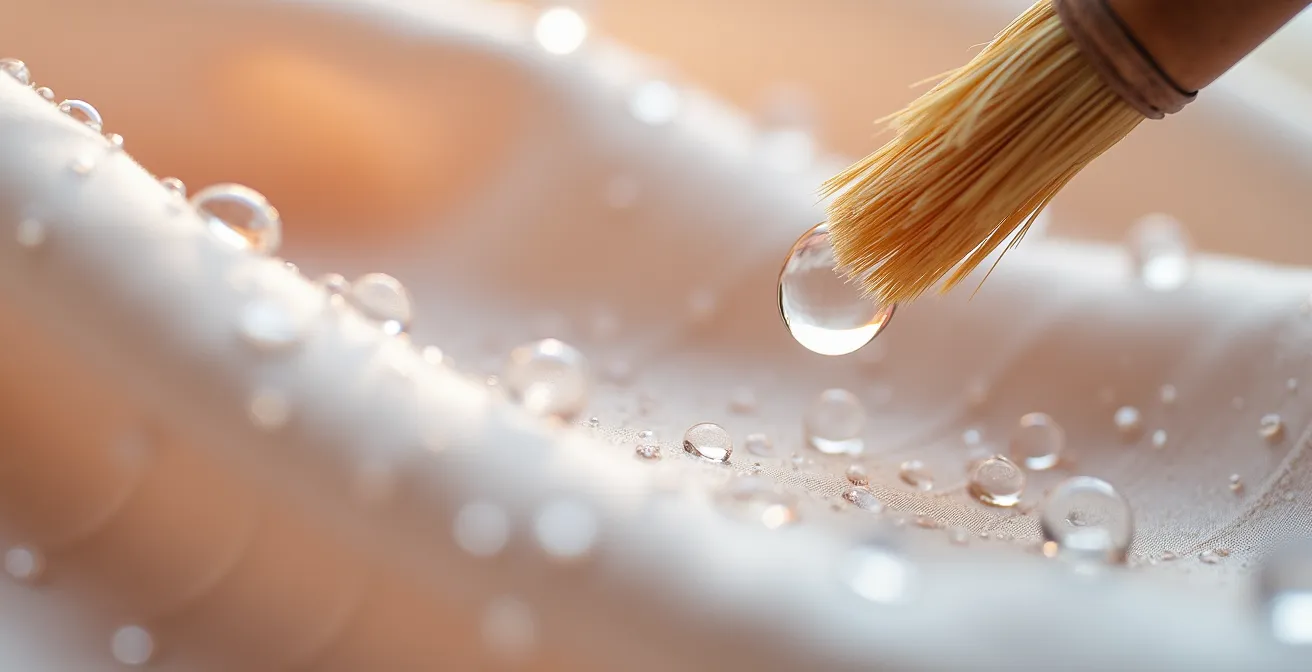
This process might seem laborious, but it is the single most effective action you can take to preserve the texture, colour, and lifespan of your investment. Ignoring it can halve the life of a garment, completely negating the economic advantage of a low Cost Per Wear. Think of it as essential maintenance for a high-performance asset.
Your Action Plan: Silk Care in Hard Water
- Pre-treat water with a water softener tablet (available at Boots or Superdrug) to neutralize minerals before the garment is submerged.
- Use lukewarm water (30°C max) with a pH-neutral, specialist silk wash from a retailer like John Lewis or Selfridges.
- Gently agitate the garment for 3-5 minutes. Never twist or wring the fabric, as this breaks the delicate silk fibres.
- Rinse twice: first in a basin of softened tap water, then a final, quick rinse with deionised water (from Halfords) to remove all mineral residue.
- Gently roll the item in a clean, thick towel to blot excess moisture, then lay it flat to dry on a mesh rack, away from direct sunlight or radiators.
Bespoke vs Mass-Luxury: Which offers better value for money?
Once you’ve committed to investing in high-end lingerie, a new choice emerges: established ‘mass-luxury’ brands (like Agent Provocateur or La Perla) versus smaller, bespoke or made-to-order artisans (like Studio Pia or Evgenia). The definition of “value” here becomes more nuanced. It’s not just about Cost Per Wear; it’s about fit, uniqueness, and long-term satisfaction. As Cora Harrington of The Lingerie Addict has noted regarding artisanal brands:
These are investment pieces, but they’re also awareness pieces. Lingerie fused with fine art.
– Cora Harrington, Studio Pia testimonial
Mass-luxury brands offer brand recognition, consistent availability, and often, a physical retail presence. Their value is in their proven reputation and the aspirational status they confer. However, their sizing is standardised. For anyone with a non-standard body shape (e.g., small band/large cup or vice-versa), achieving a perfect fit can still be a compromise, potentially reducing the garment’s wearability and thus, its value.
Bespoke or custom-fit brands offer the ultimate in value through a perfected fit. By crafting a piece to your exact measurements, they eliminate all fit-related issues. This not only provides superior comfort and support but also ensures the garment works flawlessly under your entire wardrobe, maximising its utility. While the initial cost may be higher and the lead time longer, the resulting product is a true “second skin” that you are more likely to wear frequently and for many years. For individuals who have struggled with standard sizing, bespoke offers unparalleled value for money by delivering a 100% effective product.
Interestingly, market data shows that older consumers intuitively grasp this concept of long-term value. According to Statista, UK consumers aged 50-64 invest the highest weekly amount on women’s underwear. This suggests a learned behaviour: prioritising the longevity and superior fit that comes with a higher initial investment. For a younger, budget-conscious enthusiast, adopting this mindset early is a financially savvy move.
The storage mistake that destroys elastic fibers within 6 months
Even the most expensive lingerie can be ruined not by wear, but by improper storage. The single most destructive element for a bra’s structure is the mishandling of its elastic fibres and moulded cups. The common mistake is folding one cup into the other to save space. This action permanently creases the foam of the moulded cup and puts the elastic band under constant, uneven tension. Over a period of just a few months, this can cause the elastic to lose its recovery, leading to a band that is permanently stretched and unsupportive.
A second, more insidious threat in the UK is humidity. The UK’s average humidity often exceeds 70%, creating an environment where mould can grow and elastic can degrade. Storing lingerie in a bathroom or a damp, unventilated drawer is a recipe for disaster. The moisture accelerates the breakdown of elastane and can cause discolouration. Proper storage is not about neatness; it’s about creating a controlled micro-environment that preserves the materials.
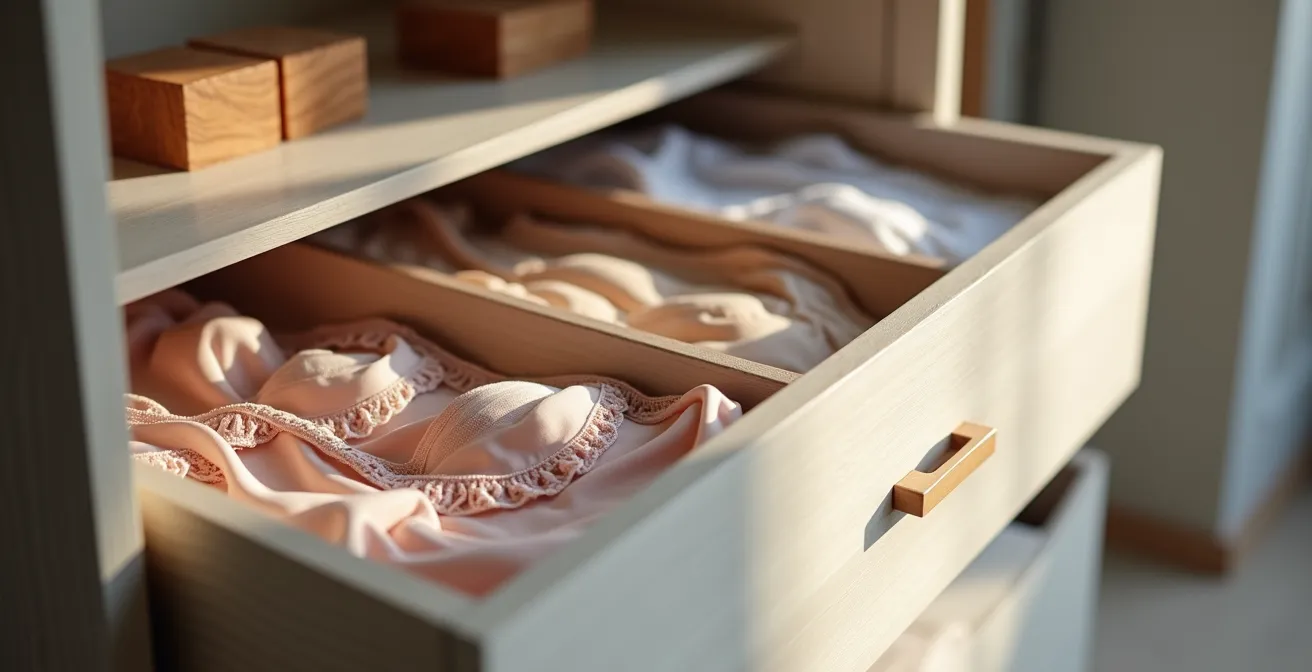
The correct method is to store bras flat or nested loosely behind one another in a drawer, allowing the bands and cups to rest in their natural shape. Using drawer dividers or velvet-lined trays helps prevent snagging from other items. To combat the UK’s damp climate, deploying wardrobe dehumidifiers is a small but crucial investment. These simple measures ensure the garment’s structural integrity is maintained between wears, directly protecting its value and extending its functional life to its maximum potential.
Here are the essential guidelines for creating a preservation-focused storage system:
- Install wardrobe dehumidifier pots (like the Unibond Aero 360 from B&Q) and replace them regularly to combat the UK’s ambient humidity.
- Line drawers with acid-free tissue paper (from art supply shops like Cass Art) rather than scented liners, which can degrade delicate fabrics.
- Store bras laid flat without folding the cups. Use shallow, velvet-lined trays to keep them separated and prevent snagging.
- Implement a strict rotation schedule, allowing at least 48 hours between wears for the elastic fibres to fully recover their shape.
- Never store lingerie in a bathroom. The constant fluctuations in heat and moisture are incredibly damaging to elastic and silk.
How to restore the whiteness of lace that has greyed over time?
Despite the most diligent care, white or ivory lace lingerie can sometimes lose its brilliance, taking on a grey or yellowish cast. This is often due to a combination of factors: mineral deposits from hard water, residue from body oils, or colour transfer from other garments. Before you consider the piece a loss, there are several restoration techniques you can try. However, it is crucial to understand that chlorine bleach is the enemy; it will dissolve delicate fibres like silk and elastane, destroying the garment completely.
The key is to use gentle, oxygen-based whitening agents. A long soak is the most effective method. Fill a basin with cool water and a scoop of a reputable oxygen-based bleaching agent (like Vanish Oxi Action Crystal White). Submerge the garment completely and allow it to soak for at least six hours, or even overnight. This gives the oxygen ions time to gently break down the stains and discolouration without damaging the fabric’s structure. For more targeted yellowing, such as at the underarms, a paste of baking soda and a few drops of water can be applied directly to the area and left for an hour before soaking.
After the soak, proceed with the standard hand-washing protocol as detailed previously. It may take two or three soaking cycles to restore heavily discoloured items, but this patient approach can often bring a piece back from the brink. It’s important to view this as an emergency restoration measure. The best strategy is always prevention: washing whites separately, treating stains immediately, and using the correct water and detergents from the outset. This ensures the pristine condition of the asset is maintained, rather than having to be recovered.
Why is a 19-momme silk count the minimum for durable nightwear?
When investing in silk nightwear, the term you will frequently encounter is “momme” (pronounced ‘mom-mee’). This is not a measure of softness, but of weight and density. One momme is equivalent to 4.34 grams per square meter of fabric. A higher momme count signifies a denser weave, using more silk per square meter. This is the single most important indicator of a silk garment’s durability and opacity—its “Durability Quotient.”
Silk below 19 momme is often very sheer and fragile. While it may feel light and airy, it is susceptible to snagging, pulling, and tearing, especially at the seams. It offers a poor return on investment because its lifespan is inherently short. A momme count of 19 is widely considered the entry-point for high-quality, durable silk apparel. At this density, the fabric has enough substance to withstand regular wear and careful washing while still retaining a beautiful drape. Silks in the 22-30 momme range are the gold standard for luxury, offering an almost opaque finish and exceptional longevity.
Investing in a piece with a high momme count is a direct investment in a lower Cost Per Wear. The garment will resist friction, maintain its structure after washing, and feel more substantial against the skin. Cheaper silk nightwear often uses 12-16 momme silk, which may look appealing initially but will quickly show signs of wear, making it a poor economic choice.
Case Study: Fleur of England’s Commitment to Quality
British brand Fleur of England, founded by Fleur Christacos with over 30 years of industry experience, perfectly demonstrates the value of high-momme silk. The brand exclusively uses high-grade silks for its nightwear collections. This commitment ensures their pieces maintain their structural integrity, lustre, and feel for years, not just seasons. For a UK consumer seeking a long-term wardrobe asset, this focus on foundational material quality is what justifies the initial investment, as it guarantees a product engineered for longevity and sustained value.
Why have European lingerie brands become 20% more expensive in the UK?
For decades, UK consumers have had easy access to the finest European lingerie houses. However, since the UK’s departure from the European Union, shoppers have noticed a significant price increase, often around 20%, on brands from France, Italy, and Belgium. This “Brexit tax” is not an arbitrary price hike by brands, but a direct result of new economic realities: import tariffs, increased administrative costs (customs declarations), and more complex shipping logistics are now priced into the final product.
This has shifted the landscape for the value-conscious buyer. While the UK women’s underwear market remains the 7th largest worldwide, indicating robust demand, getting the best value now requires a more strategic approach. Ordering directly from a small EU boutique, once a savvy move, can now incur unexpected customs charges and VAT upon delivery, wiping out any perceived savings. The savvy investor must adapt their purchasing strategy to mitigate these new costs.
The most effective strategy is to leverage the buying power of large UK-based retailers. Department stores like Selfridges and Harrods negotiate these import costs at a commercial scale and present a final, all-inclusive price. This eliminates the risk of surprise charges for the consumer. Furthermore, this new economic climate makes a strong case for exploring high-end British-made brands. Brands like Studio Pia, Edge o’ Beyond, and Fleur of England are not subject to these import tariffs, and their price-to-quality ratio has become significantly more competitive for the domestic market.
Here are some smart shopping strategies to navigate the post-Brexit market:
- Prioritise shopping at major UK department stores like Selfridges, Fenwick, or Harrods, where all import costs and duties are already factored into the sticker price.
- Actively explore and invest in British-made luxury brands such as Studio Pia, Edge o’ Beyond, or Emma Harris to completely bypass international import tariffs.
- Wait for seasonal sales at UK-based retailers rather than ordering directly from EU brand websites, as the discount will be applied to the final UK price.
- Before purchasing from a UK stockist, check if they offer a price-match guarantee against EU retailers, which some occasionally do to remain competitive.
- Join the loyalty programmes of UK luxury retailers for early access to sales and exclusive events featuring European brands.
Key takeaways
- True value is measured by Cost Per Wear (CPW), not the initial price tag; longevity makes luxury a more economical choice.
- Protecting your asset through meticulous care (hard water neutralisation, proper storage) is as important as the purchase itself.
- The UK market has shifted; prioritise British brands or large UK retailers to avoid unpredictable post-Brexit import costs.
How to plan the ultimate luxury lingerie shopping day in London?
Transforming the theory of lingerie investment into a tangible reality can be a powerful and celebratory experience. Planning a dedicated shopping day in a city like London allows you to compare brands, receive professional advice, and make a truly informed decision. Approaching it with a strategic itinerary turns a simple shopping trip into an efficient and enjoyable investment expedition. The goal is to combine expert fitting, brand exploration, and a touch of luxury to make the experience as valuable as the pieces you acquire.
The cornerstone of any successful lingerie purchase is a professional fitting. Brands and bodies change, so starting your day at a location renowned for its expertise, like Rigby & Peller, is a non-negotiable first step. This provides you with your precise, up-to-date measurements, which are the foundation for every subsequent choice. From there, you can explore a wide variety of brands under one roof at a world-class department store before visiting a curated independent boutique for a more personal experience. As one customer noted after a one-on-one appointment:
I’ve never felt quite as wonderful and confident as I did when I had a one-on-one appointment with an expert at Agent Provocateur.
– Anonymous customer, Who What Wear UK
Ending the day with a celebratory drink or meal reframes the purchase not as an expense, but as the successful acquisition of a valuable asset. It marks the shift from a fast-fashion mindset to one of considered, long-term investment in yourself and your wardrobe’s infrastructure.
Here is a strategic itinerary for an unforgettable and effective day in London:
- 10:00 AM: Start with a professional bra fitting at Rigby & Peller in Knightsbridge. This is essential. Book your appointment at least two weeks in advance.
- 12:00 PM: Take the Piccadilly Line to Oxford Circus and explore the vast Selfridges Body Studio. This allows you to see a huge range of brands and styles in one place.
- 2:00 PM: Enjoy a well-deserved lunch break at a nearby spot like The Ivy Collection to relax and review your options.
- 3:30 PM: Head to an appointment at a smaller, independent boutique in a neighbourhood like Marylebone to experience a more curated selection and personalised service.
- 5:00 PM: Conclude your successful investment day with a celebratory glass of prosecco at a stylish venue like Sketch or a classic afternoon tea at Fortnum & Mason.
By applying this analytical, value-oriented approach, you can confidently invest in luxury lingerie not as a guilty pleasure, but as a smart, calculated addition to your personal assets. Assess your next purchase through the lens of Cost Per Wear and commit to the maintenance required to protect its value.