
The secret to flattering lingerie isn’t creating illusion, but achieving architectural harmony with your body’s natural geometry.
- An hourglass figure is best complemented by cuts that trace its existing curves, like high-waisted briefs.
- An athletic build benefits from cuts that introduce new lines and create curves, such as high-leg thongs or sculpted Brazilians.
Recommendation: Stop chasing trends and start using the “sit-down test” to determine if a cut is truly working with your body, not against it.
For twenty years, I’ve seen the same confusion in the fitting room. Women, armed with magazine clippings of the latest “must-have” lingerie, feel defeated when that trendy quarter-cup bra or strappy bodysuit doesn’t look the same on them. The industry bombards you with terms like “high-apex” and “plunge” but rarely explains the engineering behind them. The common advice is to either “enhance” an athletic frame or “cinch” an hourglass waist, reducing beautiful, unique bodies to a set of problems to be solved.
This approach is fundamentally flawed. We’ve been taught to think about lingerie in terms of hiding and revealing, of illusion and disguise. But what if the true key to a perfect fit isn’t about changing your shape, but about understanding it? What if we approached lingerie not as decoration, but as architecture for the body?
This guide will shift your perspective. We will move beyond the simplistic “wear this, not that” rules. Instead, we’ll explore the principles of silhouette engineering—how a specific cut interacts with the lines and volumes of different body shapes. You will learn to decode the function behind the fashion, to measure yourself accurately, and to identify the subtle signs that a cut is distorting, not flattering. By the end, you’ll be equipped to choose pieces that offer true structural harmony, comfort, and confidence, regardless of your body type.
To help you navigate this new approach, this article breaks down the core principles of lingerie architecture. From understanding the geometry of a cut to decoding industry sizing, here is your complete guide to finding a truly perfect fit.
Summary: The Architectural Guide to Lingerie and Body Shape
- Why is a “high-leg” cut essential for elongating the silhouette?
- How to measure your torso length for a bodysuit accurately?
- Thong vs Brazilian knicker: Which creates a better shape under tight clothing?
- The sign that a “trendy” cut is actually distorting your natural shape
- How to adjust your silhouette choice after pregnancy?
- How to “swoop and scoop” correctly into a push-up balconette?
- Why does your cup size change when you alter the band size?
- How is the luxury lingerie industry redefining “sexy” for diverse body shapes?
Why is a “high-leg” cut essential for elongating the silhouette?
The high-leg cut is one of the most powerful tools in silhouette engineering, but its function is often misunderstood. It’s not about revealing more skin; it’s about altering the perceived proportions of the body. By raising the point where the leg opening sits on the hip, it creates a longer, unbroken visual line from the thigh upwards. This has a universally elongating effect, making the legs appear longer and the torso more streamlined. However, its application differs dramatically based on your body’s geometry.
For an athletic build, which is often characterised by straighter lines through the hip, a high-leg cut is transformative. It introduces a curve where there might be a straight line, creating the illusion of a higher hip and a more defined waist-to-hip ratio. A high-leg thong, for instance, can offer support while visually sculpting a more curved lower body. Conversely, for an hourglass figure, the goal is not to create curves but to honour them. A high-waisted, high-leg brief works with the body’s natural lines, sitting at the narrowest part of the waist and following the curve of the hip without interruption. It mimics the body’s shape rather than fighting it.
The key is to recognise that the “high-leg” isn’t a one-size-fits-all solution. It’s a design principle that can be used to either introduce a curve or accentuate an existing one. Understanding this distinction is the first step toward choosing lingerie that creates architectural harmony with your unique shape.
Ultimately, whether you’re creating a line or following one, the high-leg cut offers a lesson in proportion that is fundamental to a flattering fit.
How to measure your torso length for a bodysuit accurately?
A bodysuit is the ultimate test of lingerie architecture. A poor fit in the torso is unforgiving, leading to pulling, sagging, or discomfort. The most common mistake is assuming torso length is a simple, straight measurement. True accuracy requires acknowledging your body’s unique three-dimensional shape. UK sizing for bodysuits varies wildly between brands, making a precise personal measurement absolutely essential before you even look at a size chart.
The method of measurement must adapt to your body type. For an athletic or straighter frame, the ‘I-Curve’ method is most effective. This involves a relatively straight measurement from the top of your shoulder, down over the flattest part of your bust, to your crotch. For an hourglass figure with a fuller bust and more defined spinal curve, the ‘C-Curve’ method is non-negotiable. You must use a flexible tape measure and follow the natural curve of your body, going over the fullest point of your bust and along the curve of your lower back. Ignoring these curves will result in a measurement that is too short, causing the bodysuit to pull uncomfortably.
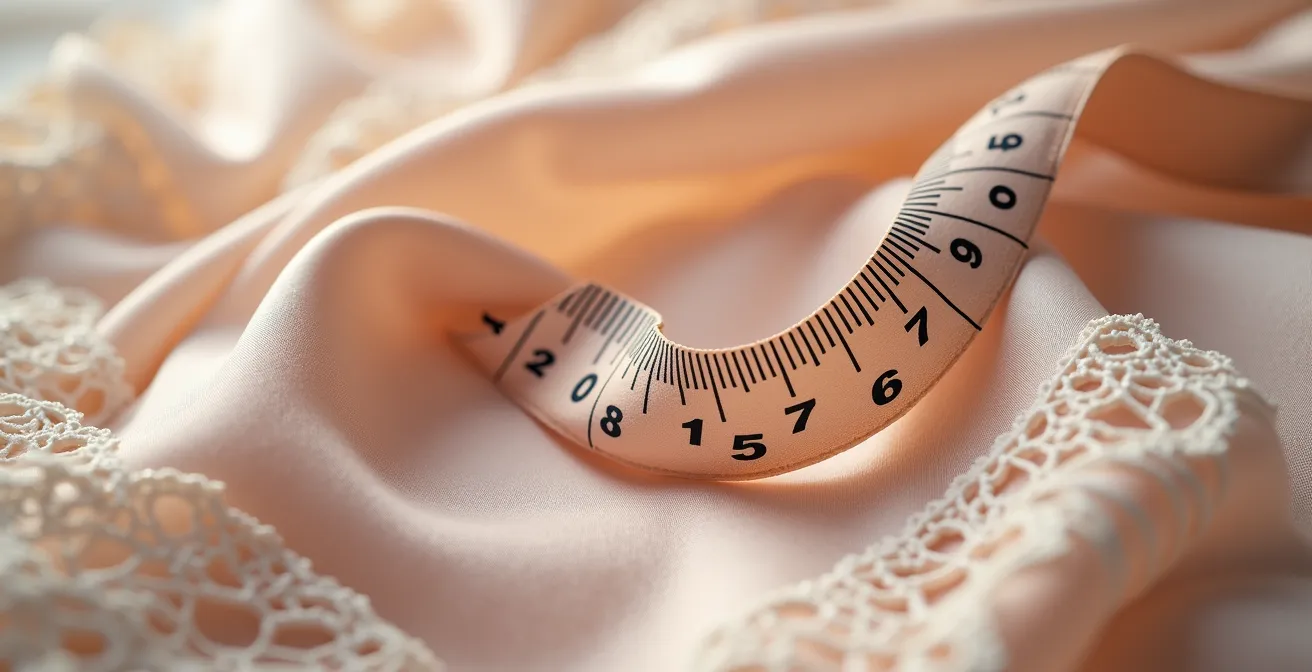
As the image above suggests, the focus should be on how the tape interacts with the fabric of your body. It must trace your contours, not bridge them. Once you have your core measurement, always add a little room for movement—about one to two finger-widths—to ensure the garment moves with you. This simple, tailored approach to measuring is the difference between a bodysuit that feels like a second skin and one you can’t wait to take off.
Your Action Plan: Perfect Bodysuit Measurement
- Posture Alignment: Stand straight with your back against a wall to ensure your spine is in a neutral position before starting.
- Select Your Method: For athletic builds, use the ‘I-Curve’ method (straight line from shoulder to crotch). For hourglass figures, use the ‘C-Curve’ method (follow the bust and spine curves with a flexible tape).
- Allow for Movement: Once you have your measurement, add 1-2 finger widths to the total length to ensure comfort and prevent pulling.
- Cross-Reference Charts: Compare your final measurement against brand-specific size charts, as UK sizing is not standardised.
- Record Both: If you’re between sizes, it can be helpful to have both your ‘I-Curve’ and ‘C-Curve’ measurements to understand why some brand cuts might fit better than others.
By treating your torso measurement as a unique topographical map of your body, you empower yourself to bypass sizing guesswork and invest in pieces that are truly engineered for your shape.
Thong vs Brazilian knicker: Which creates a better shape under tight clothing?
The debate between the thong and the Brazilian knicker is often reduced to a simple question of coverage. This misses the point entirely. From an architectural perspective, these two cuts perform vastly different functions in shaping and sculpting the glutes, especially under form-fitting fabrics. Choosing the right one depends less on personal preference and more on the interaction between the cut, the fabric, and your body’s natural shape. As noted by fashion editor Maxine Eggenberger for Who What Wear UK, the choice is highly dependent on body type.
Brazilian knickers are flattering for pear, apple and hourglass shapes, or anyone who considers their bottom half to be bigger than that of their top.
– Maxine Eggenberger, Who What Wear UK
A thong is essentially about erasure; its primary function is to eliminate the risk of a Visible Panty Line (VPL) by removing fabric altogether. For an hourglass figure, this can be ideal as it allows the body’s natural curve to be displayed without interruption. However, for an athletic build, a standard thong may offer very little shaping, simply disappearing without adding any definition. A Brazilian knicker, by contrast, is a master of subtle sculpting. It provides more coverage than a thong but less than a brief, with a cut that typically comes high over the hips and across the top of the glutes. For an athletic shape, a Brazilian made from a firm power mesh can cup and lift the glutes, creating a rounder, more defined shape. For an hourglass, however, the edge of a Brazilian cut can sometimes “bite” into the flesh, interrupting the natural curve and creating a line where none should exist.
The table below breaks down these considerations, moving beyond simple coverage to look at fabric and shape enhancement for both body types.
| Feature | Thong for Hourglass | Thong for Athletic | Brazilian for Hourglass | Brazilian for Athletic |
|---|---|---|---|---|
| Coverage | Minimal – lets natural curves show | Minimal – may lack shaping | Moderate – may interrupt curves | Moderate – provides sculpting |
| VPL Risk | None | None | Low with scalloped edges | Low with seamless design |
| Shape Enhancement | Natural curve display | Limited shaping | Can compress curves | Cups and lifts glutes |
| Best Fabric | Soft stretch lace | Firm non-stretch | Lightweight mesh | Power mesh with seaming |
Therefore, the question isn’t which is “better,” but which engineering solution best serves your specific silhouette and desired outcome under clothing.
The sign that a “trendy” cut is actually distorting your natural shape
In an industry driven by trends, it’s easy to be seduced by a visually striking cut—intricate straps, daring cut-outs, or extreme shapes. But the ultimate measure of a good fit isn’t how it looks on a mannequin or even how it looks while you’re standing perfectly still in front of a mirror. The true test is how it coexists with your body in motion. A cut that is fighting your natural shape will reveal its flaws the moment you move.
This is where I teach all my clients about the “sit-down test.” It’s the simplest, most effective way to determine if a piece of lingerie is in architectural harmony with your body. If a pair of knickers or a bodysuit looks perfect while standing but creates bulging, digging, or red marks the moment you sit down, it is fundamentally the wrong shape for you. This simple action mimics the natural compression and expansion of your torso and hips during everyday life. A well-engineered garment will accommodate this movement seamlessly; a poorly designed or ill-fitting one will resist it, causing discomfort and distorting your silhouette.
Case Study: The ‘Sit-Down Test’
Fashion experts emphasize the ‘sit-down test’ as the crucial arbiter of true fit. An undergarment that looks flawless when you are standing might create unflattering bulging or dig into your skin the moment you are seated. This is a clear sign that the cut is fighting your body’s natural shape rather than working with it. This test is particularly revealing for trendy, strappy designs, quickly showing whether they genuinely suit your body’s geometry or are simply a fleeting fashion statement that compromises on comfort and fit.
This discomfort is a sign of structural conflict. It’s proof that the garment’s rigid lines are working against your body’s soft, dynamic form. This shift in consumer mindset—valuing authentic comfort over forced shaping—is reflected in market data. This shift is reflected in hard data, with the UK shapewear market now worth £42 million and seeing a significant increase in spending from Gen Z, who view such garments as tools for enhancement, not disguise.
So, before you commit to that trendy piece, take a seat. Your body will give you an honest, immediate answer about whether the design is a true partner to your shape or just a fleeting trend.
How to adjust your silhouette choice after pregnancy?
The postpartum body is not a “problem” to be hidden; it’s a body that has performed an incredible feat and requires a new kind of architectural support. The focus must shift from aesthetics to healing and comfort. Many women experience significant changes in their torso and abdominal area, and choosing the right lingerie is crucial for both physical support and mental well-being. A common and significant condition is diastasis recti, or the separation of the abdominal muscles. Research indicates that up to 60% of women experience diastasis recti during or after pregnancy, making supportive garments a medical consideration, not just a cosmetic one.
This is where the lingerie industry’s focus on body positivity and functional design becomes paramount. The goal is no longer to “snap back” but to support and stabilise. Look for high-waisted briefs made from soft, breathable fabrics with integrated compression panels. These provide gentle support to recovering abdominal muscles without the rigidity of traditional shapewear. Wireless, soft-cup bras with wide, comfortable bands are essential, especially for those who are nursing, as they provide support without constricting sensitive breast tissue or milk ducts. Brands like Belly Bandit, a leader in the UK postnatal market, exemplify this shift by offering medical-grade compression designed to aid muscle recovery while ensuring flexibility for daily activities.

The aesthetic should reflect this new priority, favouring serene, soft materials that feel good against the skin. This period is about choosing pieces that honour your body’s journey. Forget underwires, restrictive fabrics, and complex straps. Your lingerie wardrobe should be a source of comfort and gentle reinforcement, a collection of pieces that help you heal and feel secure in your powerful, changed body.
Embracing this new approach is an act of self-care, choosing engineering and comfort to support you through a new chapter.
How to “swoop and scoop” correctly into a push-up balconette?
The “swoop and scoop” is the single most important technique I teach in a bra fitting, yet it’s the one most women have never heard of. Without it, you will never know if a bra truly fits. Its purpose is to ensure all of your breast tissue is correctly positioned within the cup, particularly in a structured style like a push-up or balconette. Doing it correctly can instantly reveal that a bra you thought was too big is actually too small, or vice versa. The technique varies slightly depending on your body’s structure.
The process is a deliberate, two-part manoeuvre. First, lean forward from the waist, letting gravity help your breast tissue fall naturally forward. As you fasten the bra on the loosest hook, “swoop” your opposite hand into the cup and gently guide all the tissue from under your arm and your back forward into the cup. Then, “scoop” the breast tissue upwards from the base of the underwire to ensure it’s fully seated. The specifics of the “swoop” are key:
- For athletic builds, the focus is on bringing tissue in from the sides. You’ll need to reach quite far back towards your shoulder blade to ensure all the tissue is brought forward and centred.
- For hourglass figures with softer tissue, the focus is more on the “scoop” from the bottom. The main goal is to lift the tissue fully into the cup to prevent the dreaded “quad-boob” spillage at the top of the balconette.
Once you stand up straight, the underwire should sit flat against your ribcage, with no gap underneath. Your breasts should be fully contained within the cups with no bulging at the top or side. If you have to perform this manoeuvre every time you put a bra on, you’re doing it right. It’s not a one-time fix but a daily ritual for a perfect fit.
By taking these extra ten seconds, you ensure the bra’s architecture is working for you, providing the support and shape it was designed to deliver.
Why does your cup size change when you alter the band size?
This is the great mystery of bra fitting that, once understood, unlocks the ability to shop with confidence across different brands. The simple answer is: a bra’s cup size is not a fixed volume. It is relative to the band size. When you go up in the band size, the cups become wider and shallower to accommodate a larger torso. When you go down in the band, they become narrower and deeper. This is why simply grabbing a ‘DD’ cup in three different band sizes will result in three completely different fits.
This concept is called “sister sizing.” It refers to a family of sizes that have the exact same cup volume. For example, a 32DD, a 34D, and a 36C all hold roughly the same amount of breast tissue. The key is knowing how to navigate these sister sizes. The rule is simple: if you go up one size in the band, you must go down one size in the cup to maintain the same volume. If you go down in the band, you go up in the cup. This knowledge is your secret weapon against the notorious sizing inconsistencies in the UK market. As industry data shows, the UK bra market generated £1.45 billion in 2024, yet the average woman still struggles with fit due to these variations.
Understanding sister sizing means you are no longer limited to a single size. If a 34E fits you perfectly in the cup but is too loose in the band, you know to try its sister size, a 32F. This will give you the same cup volume on a smaller, more supportive band. The chart below provides a quick reference for some common UK sister sizes.
| Original Size | Sister Size (Band Up) | Sister Size (Band Down) | Cup Volume |
|---|---|---|---|
| 32DD | 34D | 30E | Same volume |
| 34E | 36DD | 32F | Same volume |
| 36F | 38E | 34FF | Same volume |
| 38FF | 40F | 36G | Same volume |
By mastering this concept, you are no longer a victim of inconsistent sizing; you are an informed consumer who can find the perfect architectural fit, no matter what the label says.
Key takeaways
- Lingerie fitting is about architectural harmony, not illusion. The goal is to work with your body’s geometry.
- Practical tests, like the “sit-down test,” are more telling than how a garment looks when you are standing still.
- Sizing is not absolute. Understanding concepts like sister sizing is crucial for navigating inconsistencies between UK brands.
How is the luxury lingerie industry redefining “sexy” for diverse body shapes?
For decades, the definition of “sexy” in the luxury lingerie world was incredibly narrow, centred on a single, slender body type. Today, that definition is being dismantled and rebuilt from the ground up. The shift is monumental, driven by a powerful combination of consumer demand, social media advocacy, and a growing recognition that inclusivity is not just ethical, but profitable. The luxury market is finally understanding that true sexiness lies in confidence, and confidence comes from a perfect, comfortable fit for every body.
This redefinition is visible everywhere, from marketing campaigns to product design. We’re seeing a move away from heavily padded, transformative styles towards pieces that celebrate the body’s natural form. Sheer fabrics, intricate lacework, and soft, unstructured bralettes are taking centre stage, designed to highlight, not hide. This is backed by a tangible shift shown by the number of plus-size models, which increased from 50 to 86 at a single season’s Fashion Week events, normalising a wider range of body types in high-fashion contexts.
The industry is embracing the idea that “sexy” is not a single look but a feeling. It’s the confidence of an athletic woman in a minimalist, architectural set that complements her strong lines. It’s the allure of an hourglass woman in a luxurious silk brief that honours her curves. As the UK lingerie market, valued at £4.28 billion in 2023, continues to grow, it’s clear this inclusive approach is resonating with consumers who are tired of being told their bodies are wrong. As one global market report summarises:
The market is increasingly making efforts to be inclusive of all body types and center its advertising on body positivity.
– Statista Research Department, Global Lingerie Market Report 2024
By choosing lingerie based on architectural harmony rather than outdated ideals, you are not just finding a better fit—you are participating in this exciting redefinition of what it means to be sexy.