Styles of women’s lingerie
Choosing lingerie has evolved far beyond simple aesthetics or basic function. Today’s intimate apparel represents a sophisticated intersection of structural engineering, textile science, and personal expression. Whether you’re seeking the confidence boost of a perfectly engineered push-up balconette or the effortless comfort of an unstructured bralette, understanding the mechanics behind different lingerie styles empowers you to make informed decisions that enhance both comfort and fit.
The UK lingerie market offers remarkable diversity, from high-street accessibility to luxury investment pieces in pure silk satin. Yet many people struggle to navigate this variety, often wearing ill-fitting pieces simply because the technical aspects—wire width, suspension systems, fabric properties—remain mysteries. This article demystifies the construction principles, support mechanisms, and care requirements across the spectrum of women’s lingerie styles, giving you the foundation to build a wardrobe that genuinely works for your body and lifestyle.
Engineering and Construction: The Foundation of Lingerie Design
The difference between lingerie that transforms your silhouette and pieces that disappoint lies in structural engineering. Like a well-designed building, quality lingerie distributes weight, manages stress points, and maintains its shape under dynamic conditions. Understanding these fundamentals helps you identify construction quality and predict how a piece will perform.
Understanding Structural Support Systems
Support in lingerie operates on principles similar to suspension bridges: distributing load across multiple anchor points rather than concentrating stress in one area. A well-engineered bra transfers approximately 80% of support from the band and only 20% from the straps, preventing the shoulder grooves that plague poorly fitted pieces. The underband acts as the foundation, requiring sufficient tension to stay horizontal across your back without riding up. When examining any structured piece, check whether the engineering respects this weight distribution—if straps bear too much load, discomfort and slippage become inevitable.
Material Selection and Performance
Different lingerie styles demand specific material properties. Structured pieces requiring lift rely on low-stretch power mesh in the band and wings, while cups may incorporate memory foam that maintains shape without adding bulk. Consider these functional requirements:
- Breathability: Cotton-lined gussets and moisture-wicking synthetics prevent irritation during extended wear
- Recovery: Quality elastics return to their original shape after stretching, maintaining consistent support across dozens of washes
- Edge finishing: Bonded edges and silicone grips prevent visible lines under clothing while staying in place
- Directional stretch: Strategic placement of two-way versus four-way stretch fabrics controls where the garment yields and where it holds firm
The material choices become particularly critical in open-cup or strappy designs, where less fabric coverage means each component must perform multiple functions simultaneously.
Fitting and Adjustment Fundamentals
Even expertly engineered lingerie requires proper adjustment to function as intended. Most pieces incorporate multiple adjustment points: hook-and-eye closures with three positions, adjustable strap lengths, and sometimes convertible configurations. Start with the loosest hook setting when a piece is new—this allows you to tighten the band as elastics relax over time, extending the garment’s functional life. For complex pieces with multiple straps or suspension elements, adjust symmetrically and incrementally, checking alignment after each modification. Preventing chafing in daring designs often requires strategic use of fashion tape or silicone-backed edges at high-friction points, particularly where straps cross bare skin or hardware sits against the body.
Structured Support Styles: Balconettes and Underwired Designs
Underwired lingerie represents the pinnacle of supportive engineering, offering lift, separation, and shaping through carefully calibrated structural elements. These styles prove particularly valuable for fuller busts or occasions demanding a specific silhouette, but only when fitted according to biomechanical principles rather than arbitrary sizing conventions.
The Push-Up Balconette Mechanics
The push-up balconette achieves its distinctive lifted, rounded profile through a combination of angled cup construction and strategically placed padding. Unlike full-coverage styles, the balconette cuts horizontally across the breast tissue, typically covering only the lower half to three-quarters. This creates a natural upward angle that works with gravity rather than against it. Padding levels range from minimal (thin foam for modesty and shape) to dramatic (graduated padding that’s thicker at the bottom, creating significant lift). The key to avoiding the dreaded “quad-boob” effect lies in selecting a cup size where your breast tissue fills the cup without spilling over the top edge when you raise your arms or lean forward. The underwire should trace your natural breast root—the line where breast tissue meets your ribcage—without sitting on top of tissue or poking into your underarm.
Health Benefits and Proper Lift
Properly fitted underwired support offers genuine health advantages, particularly for those experiencing back pain or postural issues. By repositioning the breast’s centre of gravity closer to your body’s midline, a well-engineered bra reduces the forward pull on your spine and shoulders. Wire width matters enormously here: wires that are too narrow concentrate pressure and can restrict lymphatic flow, while excessively wide wires dig into your underarm or chest wall. Check that the wire sits flat against your sternum at the centre front—any gapping indicates the cup is too small or the wrong shape for your breast profile. Recent recommendations from British physiotherapists suggest replacing everyday bras every six to eight months, as fatigued elastics lose their supportive capacity and force your body to compensate through muscular tension.
Common Fitting Pitfalls to Avoid
Even experienced lingerie wearers fall into predictable fitting traps. The most common include:
- Wearing bands too loose and cups too small: If your straps leave grooves, your band likely isn’t providing adequate support, forcing straps to compensate
- Ignoring strap tension asymmetry: Most people require slightly different strap lengths on each side due to natural body asymmetry—adjust independently
- Overlooking wire distortion: Once wires bend or twist, the entire support structure fails; this signals immediate replacement regardless of the garment’s age
- Misjudging padding requirements: More padding doesn’t automatically mean more lift—it can actually reduce support by creating distance between your tissue and the supportive cup structure
Unstructured and Soft-Cup Alternatives
The surge in popularity of bralettes and soft-cup styles reflects a broader cultural shift toward comfort and natural silhouettes. However, “unstructured” doesn’t mean unsupportive—these pieces simply achieve stability through different engineering approaches, often relying on compressive fabrics and strategic seaming rather than rigid components.
Debunking the Support Myth
The persistent belief that bralettes offer no support stems from early iterations that were essentially decorative triangles of lace. Modern soft-cup designs incorporate power mesh underlays, wide underbands with silicone grips, and careful pattern engineering that provides genuine stability for cup sizes well into the DD+ range. The support mechanism differs from underwired styles: rather than lifting and separating, quality bralettes use encapsulation and compression to minimize movement. Think of it as the difference between a suspension bridge (underwired) and a compression bandage (soft-cup)—both prevent movement, but through different physical principles. For low-impact activities or relaxed settings, this approach often proves more comfortable while maintaining a smooth silhouette under clothing.
Styling for Different Occasions
Soft-cup pieces demonstrate remarkable versatility across contexts that would challenge traditional structured lingerie. At music festivals, where comfort during extended wear matters more than dramatic shaping, a well-fitted bralette in moisture-wicking fabric outperforms padding and underwires that become uncomfortable in heat and crowds. The “under-blazer” look—pairing a decorative bralette with tailored suiting—has gained traction in creative UK workplaces, offering a fresh alternative to traditional camisoles. For this styling approach, select bralettes with substantial fabric coverage and minimal transparency, avoiding styles where lace patterns or sheer panels might read as too intimate for your workplace culture. Longline bralettes that extend to your natural waist create particularly clean lines under structured jackets.
Fabric and Lace Considerations
Lace quality varies dramatically, affecting both aesthetics and function. Examine the following characteristics:
- Lace density: Tighter, more intricate patterns provide better coverage and opacity than large, open designs
- Lining strategy: Quality pieces line strategic areas while leaving decorative sections sheer, balancing coverage with visual interest
- Edge finishing: Scalloped lace edges should lie flat without puckering; loose threads or unfinished edges indicate poor construction
- Stretch recovery: Lace should stretch with the base fabric and return to shape, not remain distorted
For those concerned about nipple visibility in unlined styles, consider pieces with textured lace or strategically placed appliqués that provide visual camouflage without obvious padding.
Versatile Pieces: Chemises and Bodysuits
Certain lingerie styles transcend single-function categorization, serving equally well as sleepwear, loungewear, or foundational pieces under clothing. Understanding how to select and style these versatile investments maximizes their value in your wardrobe.
The Multi-Purpose Chemise
The chemise occupies a unique position between nightwear and intimate apparel, traditionally designed as a slip-style garment in fluid fabrics like silk, satin, or modal. The appeal lies in the movement of fabric against skin—a sensory experience that distinguishes chemises from more structured pieces. When selecting length, consider your height and intended use: mid-thigh lengths suit most people for sleepwear, while longer styles approaching knee-length work better if you’re lounging in shared spaces. Static electricity poses a genuine challenge with synthetic satin chemises, particularly in winter when central heating reduces humidity. Combat this by using fabric softener in the wash cycle, or opt for natural silk which generates less static. The transition from sleepwear to outerwear becomes possible with substantial silk or thick jersey chemises worn under cardigans or oversized shirts, creating layered looks popular in UK fashion.
The Bodysuit as a Wardrobe Staple
Bodysuits have surged in popularity across British wardrobes as solutions to the perpetual problem of tops becoming untucked and creating bulk at the waistline. The seamless torso they create under trousers and skirts proves invaluable in professional settings. However, gusset accessibility becomes a practical concern—press-stud fastenings should operate smoothly with one hand, and the gusset should provide adequate coverage without feeling restrictive. When layering for work, assess fabric opacity by testing under bright lighting: many bodysuits that appear opaque in store lighting become somewhat sheer under office fluorescents, particularly in lighter colours. For professional contexts, seek double-layered construction in the body or wear a coordinating camisole underneath. Preventing ride-up requires a body length that suits your torso proportions—those with longer torsos may need to size up or seek brands offering “long” variations.
Transitioning Between Settings
The true value of versatile pieces emerges when you can style them across multiple contexts without appearing costume-like. A quality bodysuit in opaque black jersey transitions seamlessly from a professional base layer to an evening piece when paired with tailored trousers or a sleek skirt. Similarly, a silk chemise in a subdued colour becomes outerwear-appropriate with structured layering. Consider these transition strategies:
- Coverage assessment: Evaluate which areas require additional coverage in professional settings and plan layering accordingly
- Texture mixing: Pair the fluidity of silk or satin pieces with structured fabrics like wool or cotton to balance the overall impression
- Proportion management: If wearing a fitted bodysuit, balance with looser trousers; if your chemise is flowing, ground it with tailored layers
Luxury Fabrics: Caring for Silk and Satin Investment Pieces
Investment lingerie in premium materials like pure silk satin requires specialized care knowledge to justify its higher cost. Properly maintained, these pieces can provide years of wear while retaining their lustrous appearance and structural integrity.
Understanding Quality Indicators
When evaluating silk lingerie, the momme weight provides crucial information about durability and opacity. Momme (mm) measures silk density: lighter weights (12-16mm) create delicate, drapey pieces suitable for warm weather, while heavier weights (19-22mm) offer better opacity and longevity for frequently worn items. Beyond weight, examine the weave type: charmeuse satin features a lustrous face and matte back, providing the classic “satin” appearance; habotai offers a lighter, more subtle sheen; and crepe de chine presents a slightly textured, less reflective surface. Each weave interacts differently with light and drapes distinctly on the body, affecting both aesthetics and practical concerns like visible texture through clothing.
Maintenance and Longevity
Silk’s protein-based fibres require gentle handling but prove remarkably resilient when cared for properly. Oil stains present the most common challenge, whether from skincare products, body oils, or cooking mishaps. Address these immediately by sprinkling cornstarch or talcum powder on the affected area to absorb the oil before it sets, leaving it for several hours before gently brushing away. For washing, hand-washing in cool water with specialized silk detergent preserves fibres better than machine washing, though many modern silk pieces tolerate gentle machine cycles in mesh bags. The greater threat comes from sun exposure: UV radiation degrades silk fibres and causes colours to fade, particularly in pieces stored near windows or dried in direct sunlight. Always air-dry silk lingerie in shade, and store it in a cool, dark drawer rather than on display.
Building a Rotation Strategy

How to style a lingerie bodysuit as outerwear for a London night out?
In summary: Mastering the bodysuit as outerwear in London is about ‘wardrobe engineering’—choosing pieces for both style and practicality. Fabric is key: breathable cotton blends are ideal for all-day wear, from a warm Tube commute to a cool evening. The…
Read more
What distinguishes high-grade mulberry silk satin from cheaper blends?
The true value of a silk garment lies not in its superficial shine, but in its technical specifications which dictate its longevity as a wardrobe asset. A momme count of 19 or higher is the non-negotiable baseline for durability in…
Read more
How does a well-fitted uplifting balconette improve posture and reduce back pain?
Chronic upper back and neck pain in women with larger busts is often a direct result of improper biomechanical load, not just the weight itself. The common advice to simply “find a supportive bra” is insufficient. From a clinical perspective,…
Read more
How to achieve a supportive fit with a sheer lace bralette for larger cup sizes?
The secret to a supportive bralette for D+ cups isn’t wider straps; it’s a complete engineered support system that works without wires. The band provides 80% of the support, and its structural integrity is more critical than the straps. Fabric…
Read more
How to style a flowing silk chemise for elegant home lounging?
In summary: Focus on the “bias cut” as the non-negotiable foundation for a fluid, flattering drape that moves with you. Embrace intentional layering with contrasting textures like fine-gauge wool to create a chic, contemporary silhouette. Select the right length for…
Read more
How does a push-up balconette differ from a standard plunge in creating cleavage?
Creating the perfect cleavage isn’t about just ‘pushing up’; it’s about applying the right structural engineering for your desired silhouette. Balconettes provide vertical lift for a rounded ‘shelf’, while plunges use angular compression for a ‘V’ shape. Material choice (gel…
Read more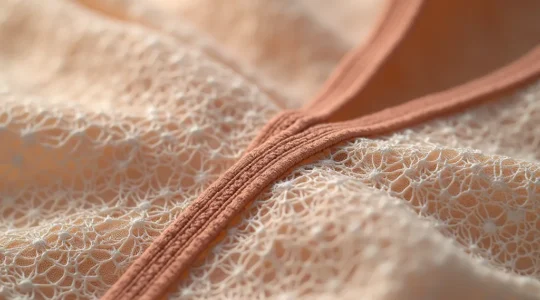
How is provocative lingerie engineered to stay in place without compromising comfort?
The secret to daring lingerie isn’t magic or body tape; it’s a precise system of soft-body engineering designed for complete security. Garments rely on calculated tension vectors and structural anchors to distribute load, preventing slippage and discomfort. Material science, including…
Read more