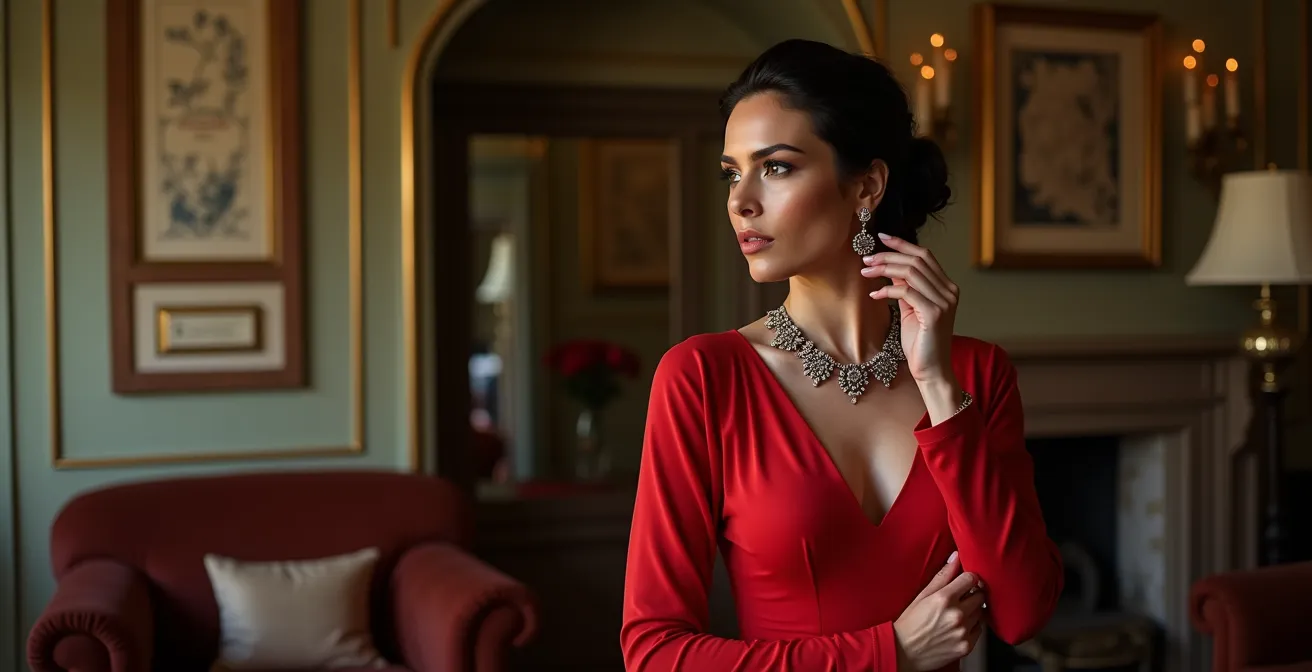
An outfit’s power to attract isn’t about fleeting style trends, but about its ability to send precise, hardwired biological signals.
- Colour is not an aesthetic choice; it’s a primal broadcast that can trigger deep-seated neurological responses.
- The strategic balance of what is concealed versus what is revealed is a powerful tool for creating psychological intrigue.
- Your physical movements must be congruent with the signals your clothes are sending to create a believable, holistic message of attraction.
Recommendation: To maximise allure, consciously align your clothing choices and non-verbal cues with a specific psychological archetype, thereby broadcasting a coherent and compelling message to the observer’s subconscious.
Have you ever observed someone walk into a room and command attention without saying a word? It’s a common experience, yet the mechanics of this silent charisma often feel mysterious. We are told the keys to being attractive are to “be confident” or to follow simple rules like “wear a flattering colour.” While well-intentioned, this advice barely scratches the surface of a deeply complex and primal process. The external perception of allure is not governed by the latest issue of a fashion magazine, but by ancient rules written into our evolutionary code. Other factors, such as scent or the timbre of one’s voice, certainly play a role in the complete picture of attraction, but the visual signals sent by clothing form the critical first impression.
But what if the true secret to an irresistible outfit has less to do with modern fashion and more to do with evolutionary biology? The fundamental shift in perspective is to stop seeing clothing as a mere covering and start understanding it as a broadcast system. Every choice, from colour to fabric to silhouette, sends a constant stream of non-verbal cues about your health, status, and genetic fitness. This is the core of Signalling Theory applied to human attraction: your outfit is a deliberate (or unconscious) advertisement of your underlying qualities. It’s a language understood by the most primitive parts of the human brain, the parts that are still scanning the environment for the best potential mates.
This article moves beyond the platitudes to provide a scientific framework for understanding attraction. We will dissect the specific visual signals that make an outfit compelling from an evolutionary psychologist’s perspective. We will explore why certain colours have a visceral effect, how the interplay of concealment and reveal manipulates an observer’s brain, and why the way you move in your clothes can either amplify or nullify their power. By understanding these mechanisms, you can transform your wardrobe from a collection of garments into a sophisticated toolkit for non-verbal communication.
This guide will explore the specific mechanisms that turn an ordinary outfit into a powerful tool of attraction. The following sections break down the key psychological and biological triggers that you can leverage.
Summary: The Science of Non-Verbal Allure in Clothing
- Why does wearing red trigger a primal attraction response?
- How to use the “70/30 rule” of coverage to increase intrigue?
- Femme Fatale vs Ingenue: Which archetype aligns with your natural personality?
- The over-grooming mistake that signals insecurity rather than confidence
- How to coordinate eye contact with your outfit’s focal point?
- Contrast vs Concealment: Which visual cue stimulates the male brain more effectively?
- How to walk gracefully in heels while wearing a long chemise?
- What biological signals does lingerie amplify to trigger attraction in the brain?
Why does wearing red trigger a primal attraction response?
The potent effect of the colour red on human attraction is one of the most well-documented phenomena in evolutionary psychology. This response is not a modern cultural construct; it is a deeply ingrained, primal reaction rooted in biology. Across the animal kingdom, the colour red is a powerful signal associated with health, dominance, and fertility. In many primate species, for instance, red appears on the body during periods of peak fertility, acting as an unmistakable biological advertisement of readiness to mate. The human brain, particularly the male brain, has retained this ancient neural wiring. When it perceives the colour red on a woman, it can subconsciously trigger associations with sexual arousal and receptivity.
This isn’t just theory; it’s backed by empirical data. Research confirms that the colour actively changes both perception and behaviour. For example, a study from the University of Potsdam found that women may intuitively leverage this effect; their findings showed that 57% of women chose to wear red or pink when expecting to meet attractive men, compared to just 16% when they expected to meet unattractive men. This suggests an unconscious understanding that red operates as a powerful fitness indicator. The colour can create a “halo effect,” where a woman wearing red is not only perceived as more sexually receptive but also as more attractive overall.
Therefore, wearing red is not simply a fashion choice but a deliberate act of biological signalling. It taps into a non-verbal language that predates spoken words, communicating vitality and openness on a subconscious level. It’s a prime example of how a single visual cue can bypass conscious thought and directly stimulate the brain’s most primitive reward and attraction centres.
How to use the “70/30 rule” of coverage to increase intrigue?
The “70/30 Rule” is a concept adapted from minimalist wardrobe theory, but its most potent application is in the psychology of visual intrigue. In this context, it refers not to classic versus trendy items, but to the strategic ratio of concealment to reveal. The core principle is that showing too much skin can signal desperation and removes all mystery, while being completely covered can appear staid or unapproachable. The sweet spot for stimulating psychological attraction lies in covering approximately 70% of the body while strategically revealing the other 30%. This balance creates a powerful dynamic of suggestion and curiosity.
The human brain is wired to solve puzzles and fill in missing information. By concealing the majority of the form, you create a visual “problem” for the observer’s mind to solve. The 30% that is revealed—perhaps the curve of a shoulder, a length of the neck, or the ankles—acts as a clue. This strategic reveal focuses attention and invites the brain to imagine the rest, making the overall impression far more compelling than full disclosure. This is a form of perceptual manipulation, guiding the observer’s gaze and engaging their cognitive resources, which intensifies their interest.
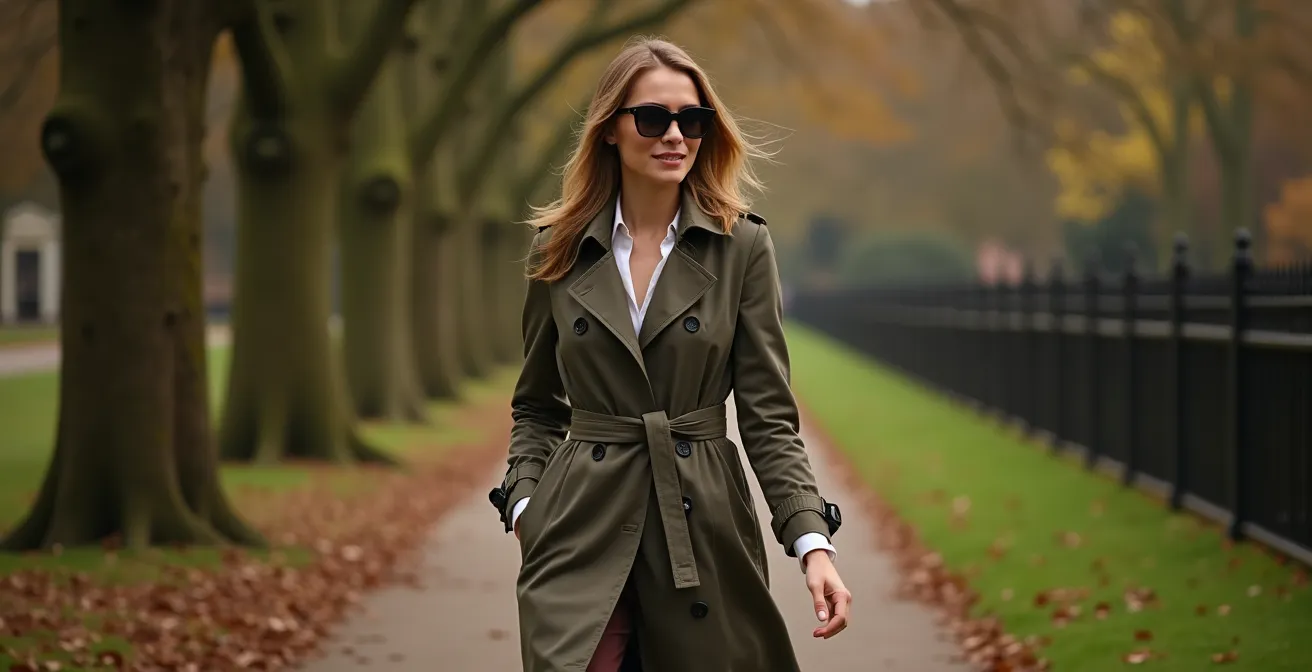
As the image demonstrates, a classic trench coat, perhaps seen on a stylish woman in a London park, can perfectly embody this rule. The coat itself provides the 70% coverage, creating a clean, elegant silhouette. However, the glimpses of a delicate silk blouse at the collar and wrists (the 30% reveal) provide a tantalising contrast in texture and form. This creates an allure built on sophistication and mystery, rather than overt display. The effect is one of confident self-possession, signalling that the wearer understands the power of subtlety.
Femme Fatale vs Ingenue: Which archetype aligns with your natural personality?
Beyond individual clothing choices, the most powerful non-verbal message is a coherent one. This is where psychological archetypes come into play. An archetype acts as a complete “signalling package,” a consistent narrative that informs your style, body language, and overall energy. The two most potent archetypes in the realm of seduction are the Femme Fatale and the Ingenue. Choosing the one that aligns with your natural personality is crucial, as inauthenticity is the fastest way to break the spell of attraction. The Femme Fatale operates on mystery and challenge, while the Ingenue leverages vulnerability and innocence.
The Femme Fatale archetype is strategic and intentional. Her power comes from her perceived control and mystery. She suggests a depth of experience that is both intimidating and intriguing. Her body language is deliberate and measured, her gaze is direct, and her style often involves form-fitting silhouettes and dark, powerful colours like black, accented with a flash of primal red. She appeals to the desire for a challenge, signalling high status and selectivity.
In contrast, the Ingenue archetype taps into the psychological principle of neoteny—the retention of juvenile traits. Her power comes from apparent innocence and vulnerability, which activates protective instincts in an observer. Her body language might seem less controlled—a giggle, a seemingly spontaneous gesture—but it is often just as calculated. Her style may involve lighter colours, playful textures, and a contrast between childlike elements and mature sophistication. She appeals to the desire to protect and cherish. The following table breaks down their core differences:
| Aspect | Femme Fatale | Ingenue |
|---|---|---|
| Core Energy | Mysterious, strategic, intentional | Innocent, spontaneous, vulnerable |
| Fashion Style | Form-fitting dark clothing, bold red lips | Playful contrasts, childlike with mature touches |
| Body Language | Controlled, deliberate movements | Giggly, seemingly clumsy, carefully constructed nervousness |
| Psychological Appeal | Challenges and intrigues through mystery | Activates protective instincts through vulnerability |
| Power Source | Uses perception and human psychology | Strategic ‘cluelessness’ to assess and build trust |
Understanding these archetypes is not about adopting a costume, but about identifying which set of signals you can broadcast most authentically. The choice should be based on your innate demeanour, as described in this detailed breakdown of their psychological underpinnings. A successful archetype is an amplification of your true self, not a fabrication.
The over-grooming mistake that signals insecurity rather than confidence
In the language of non-verbal cues, “effort” is a double-edged sword. While a complete lack of grooming signals low self-worth, an excessive, hyper-polished appearance—or over-grooming—can be just as detrimental to attraction. From an evolutionary standpoint, the most desirable traits are those that appear natural and effortless. An appearance that screams of hours of meticulous preparation can paradoxically signal high anxiety and a deep-seated insecurity. It communicates that the individual is trying too hard to compensate for perceived shortcomings, which undermines the very confidence they are trying to project.
True confidence is demonstrated through an air of “sprezzatura”—a distinctly European concept of studied carelessness. It’s the art of making the difficult look easy. This applies directly to grooming and style. The goal is to look perfectly put-together, but as if it happened by chance. This could mean a hairstyle that is perfectly styled but has a few “unintentional” strands loose, or an outfit that is impeccably tailored but worn with a relaxed posture. This subtle imperfection signals that your inherent value is so high that you don’t need to strive for a fragile, manufactured perfection. It broadcasts a sense of ease and self-acceptance, which are universally attractive qualities.
The psychological impact of our clothing choices is a well-established field of study. As fashion psychologist Karen Pine notes in her research, the relationship between attire and mindset is profound. This principle of effortlessness extends to the entire presentation.
The clothing we choose is not just about personal identity but also has the power to influence our thinking and feelings
– Karen Pine, Fashion psychologist research
An outfit that feels natural and congruent with your personality will, in turn, make you feel more confident, leading to more authentic and attractive body language. The mistake is not in the grooming itself, but in the visible anxiety of the effort. The most irresistible signal is that of a person who is comfortable and at home in their own skin, and by extension, in their clothes.
How to coordinate eye contact with your outfit’s focal point?
An outfit’s power is not static; it is activated and directed by the wearer’s body language, most notably their eye contact. A well-chosen outfit should have a clear focal point—a piece of jewellery, a unique neckline, a splash of colour—that serves to capture initial attention. However, its ultimate purpose is not to be the star of the show, but to act as a visual stepping stone, guiding the observer’s gaze upward towards your face and, specifically, your eyes. This coordination is a critical component of perceptual manipulation, turning a passive observer into an engaged participant in a non-verbal dialogue.
The goal is to create a “gaze loop.” The observer is first drawn to the outfit’s focal point, and you then use direct eye contact to acknowledge and “catch” their gaze at that moment. This transforms a potentially intrusive stare into a shared moment of connection. From there, the dance of social engagement begins. The rhythm of this dance has been studied; for instance, research at Michigan State University found the optimal ratio for building attraction is to maintain approximately 50% eye contact while you are talking and 70% while you are listening. This ratio signals confidence and genuine interest without becoming an intimidating, unbroken stare.
Failing to coordinate your gaze with your outfit renders the focal point useless. If you wear a stunning necklace but avoid eye contact, the observer’s gaze will simply stop at the object, objectifying you and disconnecting from you as a person. By meeting their eyes, you redirect that attention, assert your presence, and open the door for communication. Your outfit becomes the introduction, but your eye contact is the handshake. This technique requires practice to feel natural, but mastering it is essential for converting visual appreciation into genuine human connection.
Your action plan: Coordinating focal points with eye contact
- Use bright accessories (earrings, necklaces) as ‘beacons’ to anchor initial eye contact from a distance.
- Position focal points like brooches or pocket squares on the lapel to draw eyes upward toward your face.
- For social events, use statement pieces that create a playful loop: glance down at your own outfit, then immediately back to their eyes to create a shared moment.
- Break through reserve by using bold shoes as a conversation starter; when you notice them looking, acknowledge the shared glance with direct eye contact and a slight smile.
- Regulate your eye contact to avoid forcing it; a mutual gaze should feel natural and engaging, not intimidating or confrontational.
Contrast vs Concealment: Which visual cue stimulates the male brain more effectively?
When it comes to visual stimulation, contrast and concealment are two distinct but equally powerful tools that trigger different parts of the brain. Neither is universally “more effective”; their power depends entirely on the specific psychological response one wishes to elicit. Contrast is a direct, assertive signal of confidence, while concealment is a subtle, passive invitation to discovery. Understanding the neurological basis for each allows for their deliberate and strategic deployment.
High contrast—such as pairing black and white, or a bright colour against a neutral background—leverages a principle known as cognitive fluency. The brain finds it easier and more pleasurable to process simple, clear, and unambiguous information. A high-contrast outfit is visually striking and easy to “read,” which the brain interprets as a signal of confidence, decisiveness, and boldness. It’s a “what you see is what you get” message that communicates directness and strength. This is often seen in the sharp, geometric patterns of British subcultures like Mod or Punk, where contrast is used to project a strong, unapologetic identity.
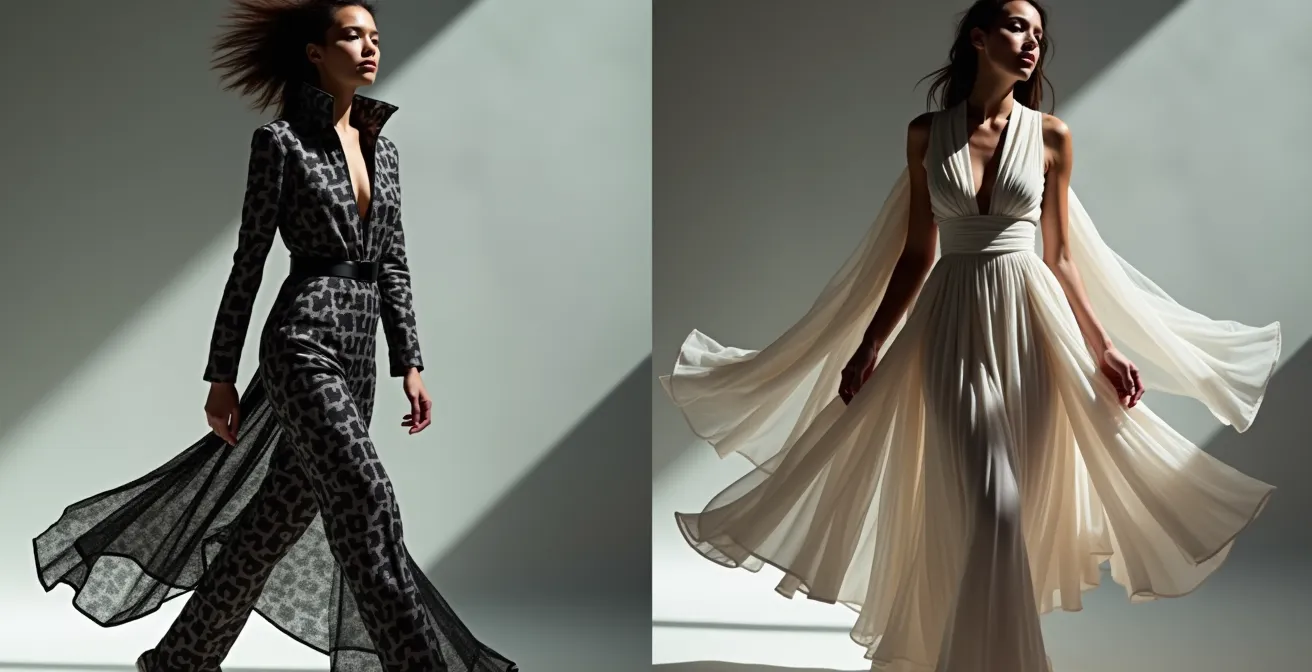
Concealment, on the other hand, works on an entirely different neural pathway. It involves the use of flowing fabrics, layering, or silhouettes that hint at the form beneath without explicitly defining it. This tactic stimulates the brain’s curiosity and problem-solving centres. It creates an information gap, a mystery that the observer is subconsciously compelled to investigate. This is not about being “frumpy”; it’s about strategic ambiguity. The gentle movement of silk or the soft draping of cashmere suggests a body in motion, activating the imagination in a way that a static, form-fitting outfit cannot. It is an invitation to look closer, to invest more cognitive energy, and therefore, to become more psychologically invested.
How to walk gracefully in heels while wearing a long chemise?
The most masterfully constructed outfit can be completely undermined by incongruent movement. An ensemble designed to signal elegance, grace, and sensuality—such as a long chemise paired with heels—requires a specific type of gait to complete its message. A clumsy, hesitant, or rigid walk sends a conflicting signal of discomfort and insecurity, shattering the illusion of effortless allure. Therefore, mastering graceful movement is not an accessory to the outfit; it is an integral part of its successful deployment.
The first principle of a graceful walk, especially in heels, is achieving a relaxed yet upright posture. Tension in the shoulders or a rigid spine creates a stilted, awkward movement. Before even taking a step, it is beneficial to practice power poses, such as standing tall with hands on hips for two minutes. This simple exercise has been shown to increase feelings of confidence, which translates into a more relaxed and fluid physical presence. The walk itself should originate from the hips, allowing for a natural, flowing stride rather than a staccato march. The body should be loose and friendly, not stiff and defensive.
The fabric of the garment must also inform your movement. A silk chemise is designed to “swish” and flow, and your gait should allow it to do so, creating a mesmerising ripple effect. A satin garment, which tends to cling, requires a more controlled and deliberate movement to maintain an elegant line. Navigating challenging terrain, such as the historic cobblestone streets found in many UK cities, demands particular attention. The key is to slow down, focus on deliberate foot placement (landing on the ball of the foot first), and maintain a strong core to keep the upper body stable and poised. When descending stairs, a subtle lift of the hem with one hand is not a sign of weakness, but a practical and elegant manoeuvre to prevent tripping while maintaining composure. The walk becomes the final, dynamic brushstroke that brings the art of the outfit to life.
Key Takeaways
- Red is not just a colour; it is a primal biological signal that can increase perceived receptivity and health.
- True allure often lies not in what is shown, but in the 70/30 balance of concealment and reveal, which sparks psychological curiosity.
- Your physical movements must be congruent with your outfit’s message to create a believable, holistic, and attractive impression.
What biological signals does lingerie amplify to trigger attraction in the brain?
Lingerie is perhaps the most direct and potent tool in the arsenal of non-verbal attraction, designed specifically to amplify key biological signals of youth, health, and fertility. Its power does not reside merely in its association with intimacy, but in its masterful ability to sculpt and frame the female form to highlight specific fitness indicators that are hardwired into the human brain as signs of reproductive viability. It is a piece of bio-architectural engineering disguised as clothing.
One of the primary signals lingerie amplifies is the waist-to-hip ratio (WHR). A low WHR is a universal and powerful signal of youth and fertility. Lingerie, through corsetry, high-waisted designs, and structural elements, is explicitly engineered to visually reduce the waist and enhance the hips, creating an exaggerated and idealized hourglass silhouette that the primal brain is programmed to find highly attractive. Furthermore, the use of push-up technology and structured cups serves to mimic the appearance of youthful, symmetrical breasts, another key signal of high oestrogen levels and reproductive health.
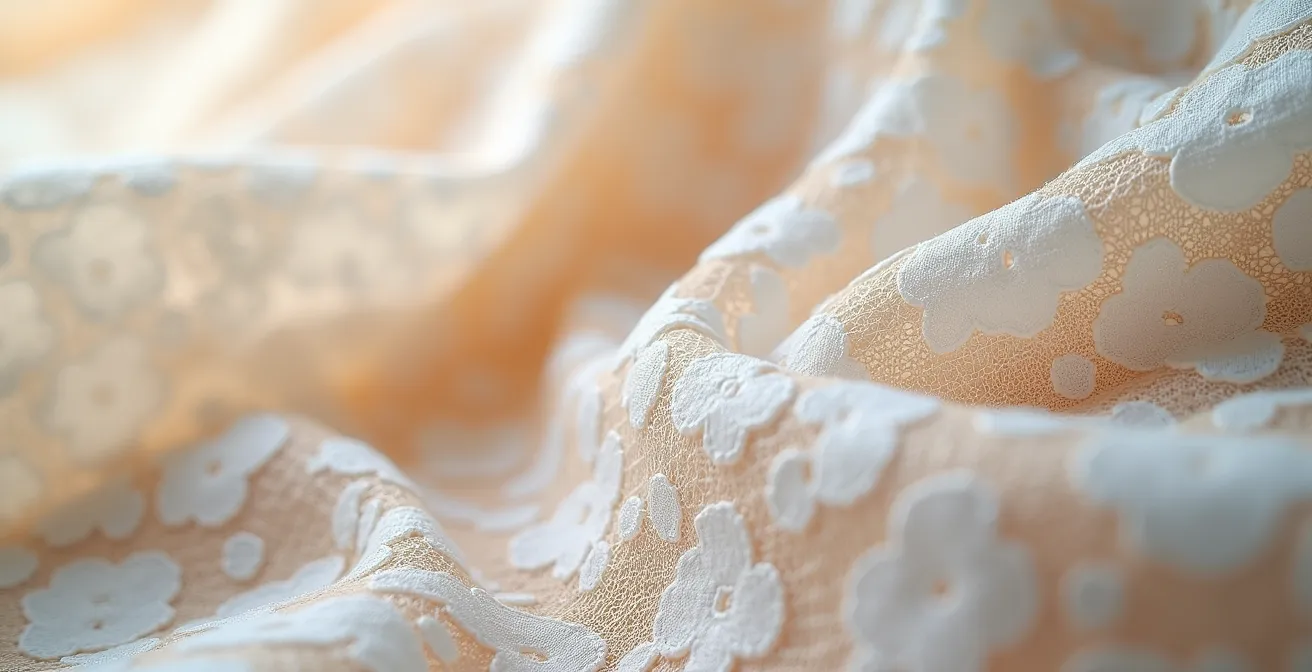
Beyond shape, the materials themselves send powerful signals. The interplay of opaque and transparent fabrics, like solid satin panels combined with sheer lace, operates on the same principle as the 70/30 rule, offering concealment and reveal in a highly concentrated form. The texture of lace and silk is also significant; it invites the sense of touch, promising a tactile reward and heightening sensory anticipation. As ethological studies have established, universal, culture-free nonverbal signs exist for negotiating sexual relationships, and lingerie leverages these by creating a visual and textural landscape that is both engaging and non-threatening, encouraging a partner’s interest.
By consciously applying these evolutionary principles—from the primal power of colour to the strategic congruence of movement and dress—you can transform your wardrobe into a powerful instrument of non-verbal communication, crafting an image that is not just fashionable, but fundamentally and irresistibly attractive.