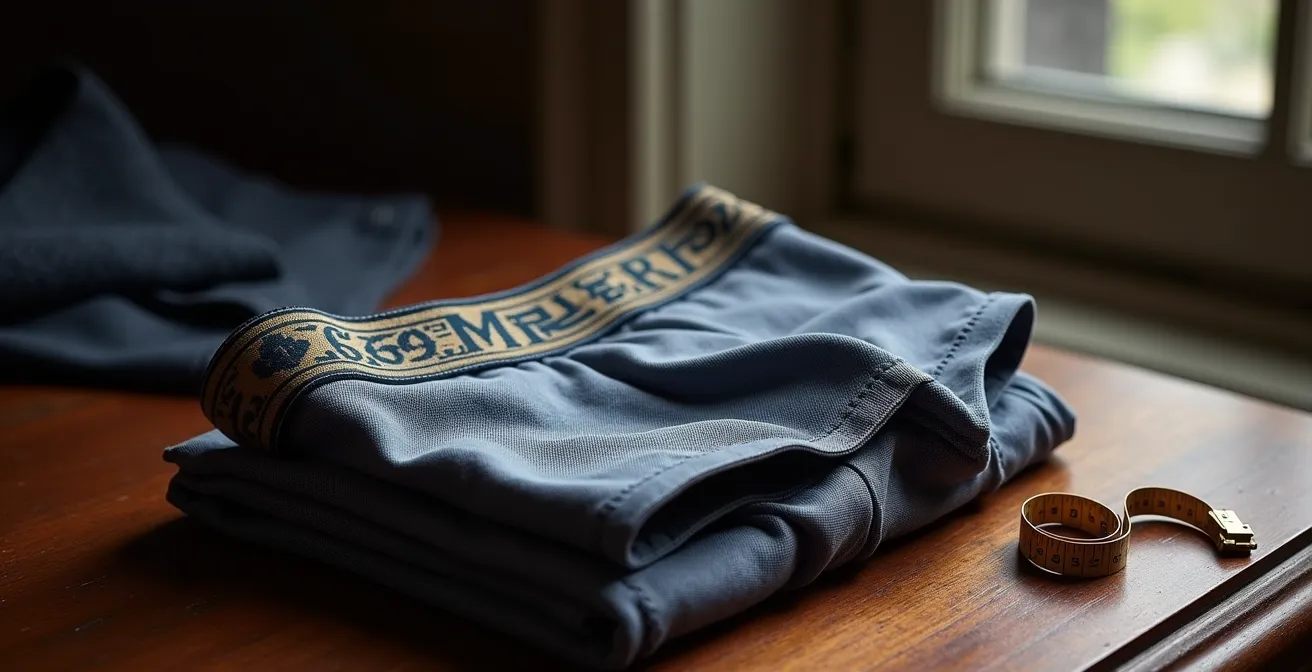
True luxury in men’s underwear is an investment in verifiable quality, not a subscription to a brand name.
- Construction integrity, like a Jacquard waistband, offers quantifiable longevity over a printed logo.
- Ethical provenance, confirmed by certifications like GOTS, provides tangible value that marketing cannot replicate.
Recommendation: Shift your focus from the brand on the label to the metrics of craftsmanship and calculate the cost-per-wear to identify genuine value.
For the discerning man, the term “luxury” has become diluted. In the world of men’s underwear, it’s often used as a synonym for a high price tag and a prominent designer logo emblazoned across an elastic band. But this is a fundamental misunderstanding of value. Many brand-conscious men are beginning to question whether they are paying for superior quality or simply funding a brand’s marketing budget. They see the familiar logos of high-end brands but are left wondering if the garment itself is any better than one at a fraction of the cost.
The common advice is to look for premium fabrics like Pima cotton or silk, and while material is important, it’s only the first chapter of a much deeper story. True luxury isn’t a logo; it’s a series of auditable qualities. It’s found in the integrity of the construction, the transparency of the supply chain, and the garment’s ability to deliver comfort and performance over years, not just seasons. But if the real indicators of quality are not in the brand name, how do you identify them?
This guide provides a framework for auditing men’s underwear like a professional. We will move beyond the surface-level appeal of a designer name to interrogate the tangible markers of exceptional quality. By adopting a critical, value-focused lens, you will learn to distinguish genuine craftsmanship from clever marketing, ensuring that your next purchase is a true investment in comfort, durability, and principled production.
For those who prefer a visual introduction, this video tour offers a glimpse into the details that matter in high-quality underwear, filmed right here in the UK.
To help you navigate this audit, this article breaks down the key areas to investigate. The following sections will equip you with the knowledge to assess everything from the packaging to the stitching, empowering you to make truly informed decisions.
Summary: Deconstructing the Elements of Genuine Underwear Luxury
- Why does premium packaging matter for the psychological perception of value?
- How to verify if your luxury cotton was harvested ethically?
- Jacquard vs Printed Elastic: Which waistband lasts longer without fraying?
- The sign that a designer brand is using cheap blanks for their their underwear line
- Bespoke vs Mass-Luxury: Which offers better value for money?
- How to find small UK lingerie makers who aren’t on the high street?
- Is silk underwear practical for the average man’s lifestyle and hygiene needs?
- When is the best time to buy luxury basics to get true value?
Why Does Premium Packaging Matter for the Psychological Perception of Value?
The experience of luxury begins before you ever touch the garment. The packaging is the first physical interaction with the brand, and it sets a powerful psychological precedent. A flimsy plastic bag signals disposability and low-cost production, undermining any claim to premium status. Conversely, a thoughtfully designed, substantial box creates an “unboxing” ritual that elevates the product within, framing it as a considered purchase. It suggests the brand cares about the entire customer journey, not just the transaction. This initial perception of care and quality is a crucial component of perceived value.
However, a discerning auditor looks beyond mere aesthetics. In the modern luxury landscape, substance must support style. The materials of the packaging itself are now a key indicator of a brand’s values. Is the box made from recycled, FSC-certified card? Are the inks vegetable-based? Today, more than 70% of shoppers are more likely to purchase from brands using eco-friendly packaging. A brand that invests in sustainable packaging demonstrates a commitment to principles beyond profit, a core tenet of contemporary luxury.
This shift is already being led by major players who understand that true luxury is responsible. For instance, LVMH Beauty has committed to replacing conventional plastics with Surlyn, a material derived from waste cooking oil. Meanwhile, pioneering fashion houses like Stella McCartney have adopted compostable TIPA ‘plastic’ that biodegrades completely, proving that a premium experience and environmental stewardship can, and should, coexist. When you assess packaging, look for these signals of sustainable innovation, not just heavy cardstock.
How to Verify if Your Luxury Cotton Was Harvested Ethically?
Any brand can claim its cotton is “premium” or “luxuriously soft.” These are subjective marketing terms. A true luxury garment provides objective, verifiable proof of its material’s quality and origin. For cotton, the gold standard for ethical and environmental assurance is the Global Organic Textile Standard (GOTS). This certification guarantees the cotton is grown without harmful pesticides and that the entire production process—from harvesting to manufacturing—adheres to strict social and environmental criteria, including fair labour practices.
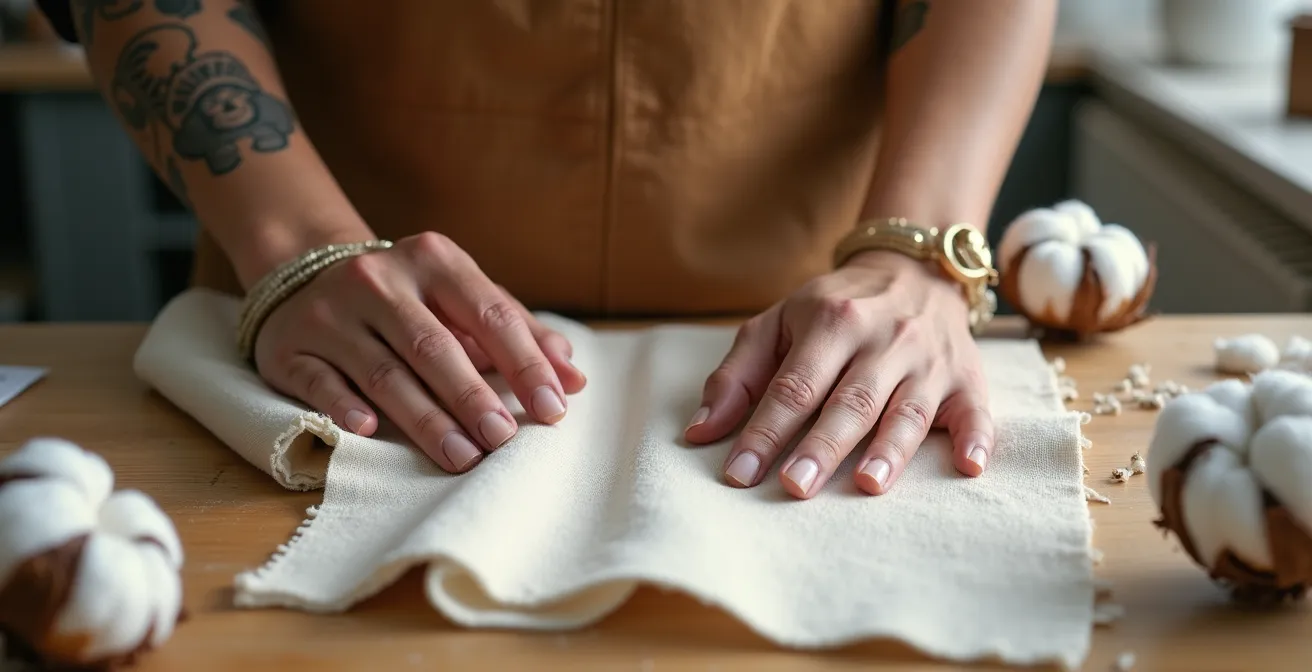
As the image above suggests, verifying authenticity involves a hands-on approach. You must become an auditor of the brand’s claims. Don’t just take the “organic” label at face value. A reputable brand will make its certifications easily accessible. Look for the GOTS logo and, ideally, a license number that can be cross-referenced on the official GOTS database. In the UK, this is often handled through the Soil Association. Furthermore, a commitment to transparency is a key indicator. Does the brand’s website offer a detailed look at its supply chain, perhaps even profiling the farms or cooperatives where its cotton is grown? This level of detail signifies genuine pride in their sourcing, not a desire to obscure it.
Beyond GOTS, other certifications add layers of trust. The OEKO-TEX Standard 100 label, for example, confirms that every component of the garment, from the thread to the buttons, has been tested for harmful substances. For larger companies operating in the UK, a quick search for their Modern Slavery Act statement can also reveal their commitment to ethical labour throughout their global supply chain. A luxury price tag demands this level of accountability; without it, you are simply buying a story, not a responsibly made product.
Jacquard vs Printed Elastic: Which Waistband Lasts Longer Without Fraying?
The waistband is the engineering core of a pair of underwear and one of the most common points of failure. It is also where the distinction between genuine quality and superficial branding is most obvious. A printed elastic waistband, where a logo is simply screen-printed onto a generic band, is a hallmark of mass production. The logo is prone to cracking, peeling, and fading with washing and wear, and the elastic itself often loses its recovery, leading to the dreaded “baconing” effect where it becomes wavy and stretched out.
In stark contrast, a Jacquard waistband is a feat of textile engineering. The brand name or pattern is not printed on top; it is woven directly into the fabric of the band itself. This method is more complex and costly, but the benefits in durability are immense. As noted in the Men’s Underwear Material Properties Study, this integrated weave is inherently superior.
Jacquard’s integrated weave inherently resists fraying and ‘baconing’ due to the different mutual friction and material density structure.
– Men’s Underwear Material Properties Study, ResearchGate Publication
The practical difference in longevity and value is not subtle. A Jacquard waistband is an investment in the structural integrity of the garment, designed to last for years, while a printed band is often a disposable fashion statement. The following table breaks down the core differences an auditor should look for.
| Feature | Jacquard Waistband | Printed Elastic |
|---|---|---|
| Durability | 5+ years with proper care | 1-2 years average |
| Stretch Recovery | Excellent – woven structure maintains elasticity | Good initially, degrades faster |
| Logo Retention | Permanent – woven into fabric | Prone to cracking/peeling |
| Price Impact | +£10-15 per garment | Standard pricing |
| Heritage Value | Traditional UK textile craftsmanship | Modern mass production |
The Sign That a Designer Brand Is Using Cheap Blanks for Their Underwear Line
One of the most cynical practices in the fashion industry is “logo-slapping”—the act of taking a generic, mass-produced garment (a “blank”) and simply adding a designer logo to justify a luxury price point. The discerning auditor must learn to spot the tell-tale signs of this value dilution. It begins with interrogating the garment’s construction. A truly designed piece will feature multi-panel construction, with seams engineered to follow the contours of the body for superior fit and comfort. A cheap blank, by contrast, will often have a simple, single back seam—a clear indicator of cost-cutting.
The branding application itself is another major red flag. As discussed, a printed logo is a warning sign, but even more so is a heat-transfer label. These are notorious for cracking, peeling, and causing irritation. A woven label, stitched into the garment, is a sign of higher quality and attention to detail. You must also scrutinize the care label. Look for the crucial distinction between “Designed in the UK” and “Made in the UK.” The former often means the garment was produced in a low-cost factory overseas, with only the design concept originating locally. True luxury often involves local or regional manufacturing where quality can be closely monitored.
Finally, trust your hands, but verify with facts. Fabric fraud is rampant in the retail industry. Indeed, independent fabric testing reveals that over 80% of retail products have improperly labeled fibre content. A garment might feel soft, but it could be a cheaper blend masquerading as 100% Pima cotton. While you can’t conduct a lab test at home, you can perform a simple stretch and recovery test on the waistband and check the stitching quality at stress points. Any loose threads or uneven seams are signs of rushed production, inconsistent with a luxury price.
Your Audit Checklist: How to Spot a Rebranded Blank
- Construction Seams: Check for a single, simple back seam versus a more ergonomic multi-panel construction.
- Logo Application: Inspect for heat transfer logos that crack or peel, a sign of cheap application versus woven labels.
- Label Provenance: Examine the care label for the “Designed in…” vs. “Made in…” distinction to understand its true origin.
- Elastic Quality: Test the waistband’s stretch and, crucially, its ability to snap back to its original shape (recovery).
- Stitching Integrity: Inspect the quality and consistency of stitching at all stress points and seams for any signs of weakness.
Bespoke vs Mass-Luxury: Which Offers Better Value for Money?
The concept of luxury exists on a spectrum. At one end is “mass-luxury”—globally recognized designer brands that produce at scale. At the other is “bespoke” or artisanal luxury—small-scale craftspeople creating items with a direct connection to the end-user. While mass-luxury offers the allure of a famous name, it often operates on a model that encourages frequent replacement, mirroring the fast-fashion cycle. The wastefulness of this model is staggering; research shows that nearly 8 million British adults wear jeans less than 10 times before replacing them. This mindset of disposability is the antithesis of true value.
Bespoke luxury, by contrast, is built on principles of longevity, transparency, and provenance. The value is not derived from a logo, but from the story of the item’s creation, the quality of the materials, and the skill of the maker. When you buy from a UK-based artisan, you are often buying a product designed to last a lifetime, with the possibility of repairs and a direct line to the person who made it. This connection itself is a form of luxury that mass-market brands cannot replicate.
As one UK bespoke craftsperson highlighted by Make it British explains, the value is in the complete transparency of the process. This is the ultimate mark of confidence in a product’s quality.
I use traditional methods and hand stitching. Making from quality veg-tanned leather. I can show you how it was made and where – the whole process.
– UK Bespoke Craftsperson, Make it British
While the upfront cost of a bespoke or artisanal garment may be higher, its extended lifespan and the quality of the ownership experience often result in superior long-term value. It’s a shift from buying a fleeting trend to investing in a lasting piece of craftsmanship. The choice between mass-luxury and bespoke is a choice between perceived status and demonstrable substance.
How to Find Small UK Lingerie Makers Who Aren’t on the High Street?
Identifying true artisanal quality requires looking beyond the familiar high street retailers. The most innovative and principled UK-based underwear makers are often small, independent businesses that rely on direct-to-consumer sales and curated online marketplaces. Finding them is part of the rewarding process of investing in authentic craftsmanship. Your audit should extend to your shopping habits, seeking out platforms that champion independent design and local production.
Start your search on curated platforms like Wolf & Badger, which is renowned for showcasing independent, sustainable, and ethical brands from the UK and beyond. Similarly, online marketplaces like Etsy and Not On The High Street can be treasure troves if you use their search filters effectively; specifically, filter by “Shop location: United Kingdom” to discover local artisans. For those interested in the next generation of talent, attending graduate shows like the New Designers exhibition in London offers a direct look at emerging creators before they hit the mainstream.
Social media, particularly Instagram, is also a powerful discovery tool. Searching for hashtags like #MadeInTheUK, #BritishDesign, and #SlowFashionUK will uncover a vibrant community of small-scale producers who are passionate about their craft. A great example is London-based Lara Intimates, a brand that embodies this ethos. Every garment is made in-house in their Soho studio, utilising deadstock luxury lingerie fabrics to minimise waste and featuring elastics produced by British manufacturers. This is the epitome of modern, responsible luxury: transparent, local, and sustainable. Following one such brand will often lead you to others within their network.
Is Silk Underwear Practical for the Average Man’s Lifestyle and Hygiene Needs?
Silk is often perceived as the ultimate luxury material, but it’s frequently dismissed as impractical for daily wear due to concerns about durability and care. This is a misconception rooted in a poor understanding of the fibre’s inherent properties. From a material science perspective, silk is remarkably robust. Contrary to its delicate appearance, high-quality silk has a tensile strength comparable to that of a steel filament of the same diameter. This means it is far more resilient to pulling and tearing than many synthetic fabrics or even lower-grade cottons.

Regarding hygiene, silk offers significant advantages. It is a natural protein fibre that is highly breathable, allowing for excellent air circulation that helps regulate body temperature in both warm and cool conditions. As the image above demonstrates with beading water droplets, it is also naturally moisture-wicking, drawing perspiration away from the skin to keep you dry and comfortable. Furthermore, silk is naturally hypoallergenic and resistant to dust mites and mildew, making it an excellent choice for those with sensitive skin.
The primary caveat is care. Silk requires more mindful laundering than cotton—typically a gentle, cool wash with a pH-neutral detergent and air-drying away from direct sunlight. However, for a garment intended as a luxury item, this level of care should be seen not as a burden, but as part of the ritual of preserving a quality investment. When properly cared for, silk underwear is not only practical but offers a superior combination of comfort, hygiene, and durability, making it a viable and valuable part of any man’s collection.
Key Takeaways
- True luxury is defined by auditable quality, not brand recognition.
- Construction details like Jacquard waistbands offer quantifiable durability over printed logos.
- Cost-Per-Wear (CPW) is the ultimate metric for assessing the true value of a premium garment.
When Is the Best Time to Buy Luxury Basics to Get True Value?
The final pillar of a luxury audit moves beyond physical attributes to a financial one: determining true value. The question is not “what should I pay?” but “what am I paying for?” The best time to buy luxury basics is when you are prepared to shift your mindset from “spending” to “investing.” This means ignoring seasonal sales, which often encourage impulse buys of lower-quality items, and instead focusing on acquiring a core piece when you have identified its long-term value proposition. The most powerful tool for this is the Cost-Per-Wear (CPW) calculation.
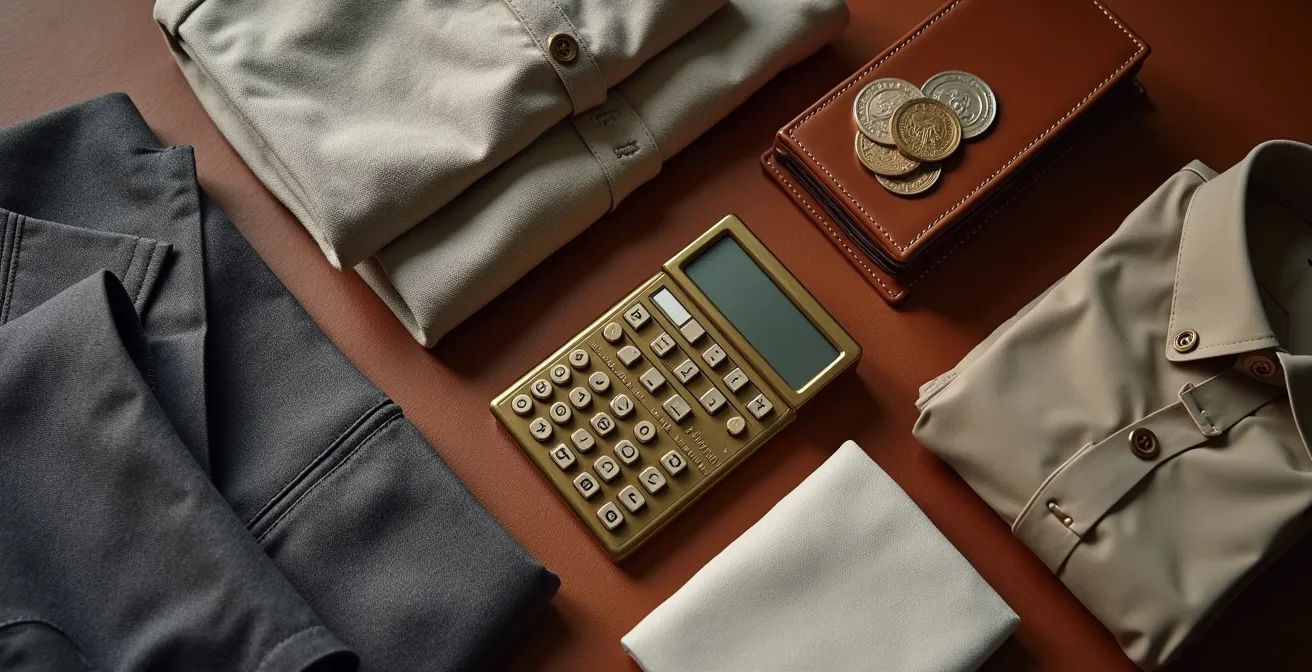
CPW reframes the price tag by dividing the initial cost of an item by the number of times you will wear it. This simple formula reveals the flawed logic of fast fashion. A cheap pair of underwear might seem like a bargain, but if it needs replacing twice a year, its long-term cost can easily exceed that of a premium, durable alternative. A case study highlighted by UK style consultant Roberta Style Lee provides a clear example: a £15 pair of underwear lasting only six months has a CPW of £0.17. In contrast, a well-made £40 pair worn for five years achieves a CPW of just £0.04.
Therefore, the “best time” to buy is not a date in the calendar but a point of personal financial clarity. It is the moment you decide to prioritise longevity and are ready to invest in a garment whose quality—from its ethical sourcing to its robust construction—justifies its upfront cost through years of reliable service. A true luxury item should see its cost-per-wear diminish over time, becoming progressively “cheaper” with every use. This is the ultimate return on investment and the final, irrefutable mark of genuine value.
To put this framework into practice, your next step is to begin auditing your own collection and future purchases with a critical eye. Use this guide to build a collection of basics that deliver demonstrable value, comfort, and longevity, moving beyond the ephemeral allure of the logo.