
The true value of a silk garment lies not in its superficial shine, but in its technical specifications which dictate its longevity as a wardrobe asset.
- A momme count of 19 or higher is the non-negotiable baseline for durability in pieces like nightwear.
- Weave structure, such as Crepe de Chine versus Charmeuse, directly determines snag resistance and suitability for regular use.
- Proper care, particularly avoiding direct sunlight when drying and using correct steaming techniques, is crucial for preserving the fabric’s integrity and colour.
Recommendation: Assess silk not as a simple purchase, but as a technical acquisition, prioritising its material science over surface-level aesthetics to ensure a lasting return on investment.
For the discerning investor in quality wardrobe staples, the allure of silk satin is undeniable. Yet, the market is saturated with garments labelled “silk” that vary dramatically in price and performance. Many are familiar with the generic advice: it’s luxurious, soft, and requires delicate handling. This often leads to frustration when a seemingly premium piece degrades quickly, or when its care feels shrouded in mystery. The common understanding that satin is a weave, not a fibre, is merely the entry point to a much deeper conversation.
The distinction between a fleeting luxury and a lasting wardrobe asset is not found in marketing language, but in material science. The real value is encoded in the fabric’s technical DNA: its weight, the specific style of its weave, and the precision of its cut. Understanding these elements transforms you from a mere consumer into an informed collector who can identify true quality and protect your investment for years to come. This is not about chasing a brand, but about recognising the engineering behind an exceptional textile.
But what if the key to a truly valuable silk collection wasn’t just buying the ‘best’, but understanding precisely how each technical characteristic serves a specific purpose? This guide moves beyond the surface-level platitudes. We will deconstruct the critical markers of high-grade mulberry silk, treating each garment as the performance-engineered asset it should be. We will analyse the minimum quality threshold for durability, compare weave structures for resilience, and provide tactical care instructions designed to preserve the fabric’s integrity against common challenges, including those specific to the UK environment.
This article provides an expert framework for evaluating and maintaining high-grade silk satin. Below is a summary of the key technical points and care protocols we will cover to empower you to build a lasting and high-performing silk collection.
Summary: The Technical Markers of Investment-Grade Silk Satin
- Why is a 19-momme silk count the minimum for durable nightwear?
- How to salvage a silk chemise stained with body oil or lotion?
- Charmeuse vs Crepe de Chine: Which silk weave is more snag-resistant?
- The drying mistake that bleaches colour from silk in 2 hours
- How many silk chemises do you need for a full weekly rotation?
- How to remove creases from satin without leaving water marks?
- Why is the “bias cut” crucial for a chemise that moves with you?
- Why does silk satin keep you warm in winter but cool in summer?
Why is a 19-momme silk count the minimum for durable nightwear?
The term ‘momme’ (mm) is the primary unit of measurement for silk density and quality, akin to thread count in cotton. It quantifies the weight of a piece of silk fabric 100 yards long and 45 inches wide. A higher momme number signifies a denser weave, thicker fibres, and consequently, a more durable and opaque fabric. While lower momme weights (below 19) can feel soft, they lack the structural integrity required for items subjected to regular wear and torsion, such as nightwear. They are prone to stress tears and premature thinning, making them a poor long-term investment.
For garments that are in close contact with the body and undergo movement during sleep, a baseline of 19 momme is essential. According to textile specialists, the range of 19–25 momme is generally ideal for sleepwear and accessories. This density provides the optimal balance of fluidity, strength, and longevity. Anything less compromises the fabric’s ability to withstand the abrasion and tension of nightly use. Lighter silks are better suited for decorative items like scarves, which are not subject to the same mechanical stresses.
Choosing the right momme is a strategic decision based on use-case and desired performance. A 19mm silk is an excellent entry point for summer wear, offering breathability and a lightweight feel. A 22mm silk provides greater versatility, suitable for year-round use in the UK’s variable climate, offering a more substantial hand-feel without being heavy. For the ultimate in luxury and resilience, 30mm silk represents the pinnacle, delivering exceptional warmth and superior resistance to wear. It is a true ‘investment-grade’ textile designed for maximum longevity.
Your 5-Point Audit for Assessing a Silk Investment
- Label Inspection: Verify the composition is 100% Mulberry Silk. Check for a specified momme count; treat any garment without this information with suspicion and aim for 19mm or higher.
- Weave & Finish Analysis: Examine the surface for uniformity. Is it a high-lustre, smooth Charmeuse or a textured, matte Crepe de Chine? The finish should be consistent without flaws.
- Construction & Seam Check: Inspect the quality of the stitching. Seams should be flat, secure, and finely executed. For chemises and slips, check if the garment is bias-cut by gently stretching the fabric diagonally.
- Light & Lustre Test: Hold the fabric up to a light source. High-grade silk possesses a deep, multi-dimensional lustre, not a cheap, flat shine. It should not be overly transparent, which indicates a low momme count.
- Tactile Assessment: Feel the fabric’s ‘hand’. It should be exceptionally smooth, but also have a degree of substance and weight. It should glide, not feel flimsy or papery.
How to salvage a silk chemise stained with body oil or lotion?
Oil-based stains from body lotions, serums, or natural skin oils are among the most common threats to a silk garment’s longevity. These stains require a targeted approach that breaks down the lipid molecules without damaging the delicate protein fibres of the silk. Aggressive rubbing or using harsh, generic stain removers will permanently damage the fabric’s lustre and structure. The key is a gentle but effective solvent action, followed by a careful rinse. Panic is the enemy; prompt and precise action is the solution.
For fresh stains, begin by blotting away any excess oil with a clean, dry cloth. Do not rub. The goal is to lift the oil, not spread it. Prepare a targeted cleaning solution. A 50/50 mixture of a pH-neutral silk detergent and cold water is the first line of defence. Apply this solution with a cotton bud, gently dabbing the stained area from the outside-in to prevent the stain from spreading. For more stubborn or set-in oil stains, a mixture of one part white vinegar to one part lukewarm water can be more effective at breaking down the grease.
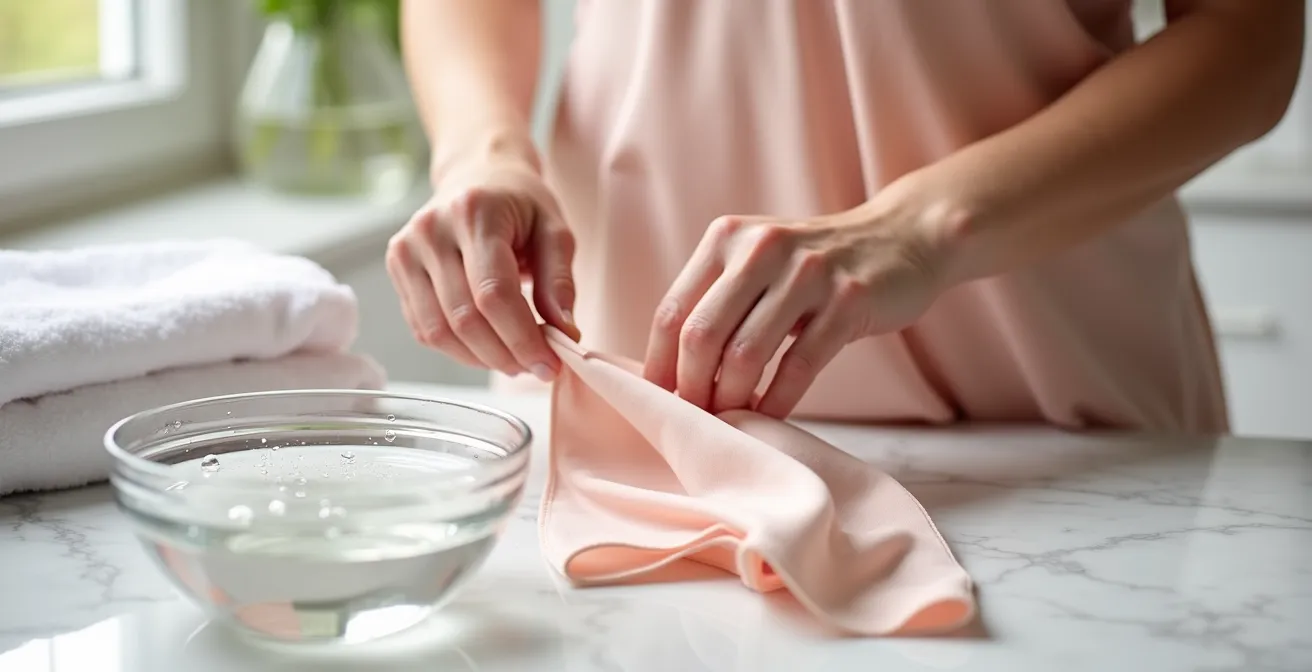
After treating the specific spot, it is often necessary to hand wash the entire garment to prevent water marks or ‘halos’ from forming around the cleaned area. Use cold water and a small amount of silk-specific detergent. Submerge the garment and gently agitate it, then rinse thoroughly with cold water until all detergent is gone. Never wring or twist the silk. This methodical process ensures the preservation of the fibre’s integrity and appearance, treating care not as a chore, but as a crucial part of maintaining a valuable asset.
Charmeuse vs Crepe de Chine: Which silk weave is more snag-resistant?
While both Charmeuse and Crepe de Chine are woven from mulberry silk fibres, their performance characteristics, particularly their resistance to snagging, are vastly different. This difference is not due to the fibre itself, but to the engineering of the weave. Understanding this distinction is critical for selecting the right silk for the right purpose—a choice between high-gloss visual impact and everyday resilience. An investor in wardrobe staples must look beyond the surface to the underlying structure.
Charmeuse is defined by its satin weave, where warp threads float over multiple weft threads, creating a surface with long, exposed fibres. This construction is responsible for its signature high lustre and fluid drape. However, as textile experts at Sino Silk note, this structure has a distinct vulnerability: “Charmeuse/satin weave produces fewer interweaving points than other weaving styles”. These long floats are susceptible to catching on jewellery, rough surfaces, or even fingernails, leading to snags and pulled threads. This makes Charmeuse an exquisite choice for special occasions but a higher-risk option for regular nightwear.
Crepe de Chine, by contrast, is a plain-weave fabric made with tightly twisted yarns. This process creates a textured, pebbly surface with a subtle, matte finish. The threads are interwoven in a simple over-under pattern, resulting in a much tighter and more integrated fabric structure. This construction offers significantly higher snag resistance, making it a far more durable and practical choice for items that will see frequent use, such as daily sleepwear or loungewear. It sacrifices the high sheen of Charmeuse for superior longevity and ease of care.
The choice between these two weaves is a strategic one, balancing aesthetic desires with practical needs. The following table breaks down their key differences, including their reaction to a common UK-specific issue: hard water. As this comparative analysis highlights, Crepe de Chine’s texture makes it more forgiving.
| Feature | Charmeuse | Crepe de Chine |
|---|---|---|
| Momme Range | 12-30 momme | 12-16 momme |
| Texture | Smooth and soft satin face | Matte, pebbly texture |
| Snag Resistance | Lower – floating threads vulnerable | Higher – tighter weave resists snags |
| Best Use | Special occasions, seductive evenings | Regular sleeping, lounging |
| UK Hard Water Impact | Shows water marks easily | More forgiving of water marks |
The drying mistake that bleaches colour from silk in 2 hours
One of the most catastrophic yet avoidable errors in silk care is improper drying. After taking meticulous care in washing, many owners unwittingly destroy their investment in the final stage. The culprit is not heat, as many assume, but ultraviolet (UV) radiation. Silk is a natural protein fibre, composed primarily of fibroin, which is highly susceptible to photodegradation. Exposing silk to direct sunlight is the fastest way to cause irreversible damage to both its colour and its structural integrity.
The UV rays in sunlight act as a powerful bleaching agent on the dyes used for silk. This is not a slow, gradual fading over months; significant and uneven bleaching can occur in as little as a couple of hours. Furthermore, fabric care guides warn that to avoid drying silk in direct sunlight for a prolonged period is crucial because it doesn’t just strip colour—it breaks down the protein fibres themselves, making the fabric brittle, weak, and prone to tearing. A garment dried in the sun will feel harsher and lose its signature lustre permanently.
The correct protocol for drying silk involves removing excess water gently and drying via air circulation, away from any direct heat or light source. The professional method is as follows: first, lay the wet garment flat on a clean, thick towel. Roll the towel up with the garment inside and press gently to absorb the majority of the water. Do not wring or twist. Then, unroll and either lay the item flat on a mesh drying rack or hang it on a padded, non-slip hanger. The location is critical: it must be indoors, away from windows, or in a shady, well-ventilated outdoor spot. This gentle, light-free drying process is non-negotiable for preserving the colour, feel, and strength of your silk investment.
How many silk chemises do you need for a full weekly rotation?
Building a functional collection of silk nightwear is not about quantity, but about strategic acquisition. The goal is to create a sustainable rotation that allows each piece adequate ‘rest’ and care time, ensuring the longevity of the entire collection. Unlike robust cottons, silk fibres benefit from time to recover their natural shape between wears. A common mistake is to either own too few pieces, leading to overwear and hasty laundering, or too many low-quality pieces that fail quickly.
From an investment perspective, the optimal number is three high-quality pieces. This ‘three-piece rotation’ is a classic wardrobe management strategy that balances use, care, and rest. The system is simple: one piece is being worn, one is in the laundry or drying, and one is resting in the closet. This cycle ensures that you are never without a fresh garment, and more importantly, it prevents the panic of needing to wear a piece that has not been properly cleaned and dried, which often leads to care-related mistakes.
The success of this strategy hinges on the quality of the garments. Investing in fewer, more durable pieces is far more cost-effective in the long run. As textile data shows, higher momme count silk is generally considered to be of better quality, as its denser weave and thicker fibres offer superior resilience. A rotation of three 22-momme chemises will vastly outlast a collection of seven 16-momme pieces. The focus should shift from ‘how many’ to ‘how well-made’. A small, curated collection of high-performance silk is the hallmark of a savvy investor, not a cluttered drawer of disposable luxury.
How to remove creases from satin without leaving water marks?
Creases are an inevitable reality of wearing and storing silk garments, but removing them incorrectly can cause more damage than the wrinkles themselves. The primary risk, especially in the UK where hard water is common, is leaving mineral deposits on the fabric, which manifest as stubborn water stains or ‘rings’. Direct ironing can be too harsh and risks scorching the delicate fibres, while a standard steam iron can spit droplets of tap water. The solution is to use humidity, not direct water contact.
The most effective and safest tool is a handheld garment steamer. The hot steam gently relaxes the silk fibres, allowing the wrinkles to fall out without direct pressure or contact. It also has the added benefits of removing odours and killing bacteria. The crucial detail for UK users is the water source: always use filtered or de-ionised water in your steamer. This prevents the mineral scale present in hard water from being deposited onto the silk, which is the primary cause of water staining.

For those without a steamer, a simple environmental technique is highly effective. Hang the silk garment on a good-quality hanger in the bathroom while taking a hot shower. The ambient humidity will work in the same way as a steamer, gently releasing the creases. Ensure the garment is not in direct contact with any water spray. This method is ideal for travel or for a quick refresh. Should a water stain occur by accident, the remedy is to dip the entire garment in lukewarm water for a few minutes, which evens out the moisture, and then dry it correctly away from sunlight.
Why is the “bias cut” crucial for a chemise that moves with you?
The secret to a silk chemise that drapes beautifully and moves with the body lies not just in the quality of the fibre, but in the engineering of its construction. The ‘bias cut’ is a dressmaking technique that is fundamental to unlocking the full potential of a woven fabric like silk satin. It refers to cutting the fabric panels at a 45-degree angle to the straight grain (the warp and weft threads), rather than parallel to it. This seemingly simple shift in orientation has a profound impact on the garment’s performance.
Woven fabrics have no natural stretch when pulled along their straight grain. However, when pulled on the bias, the weave has the flexibility to shift and expand, creating a ‘mechanical stretch’. For a garment like a chemise, which needs to flow over the body’s curves and move with the wearer during sleep, this is not a luxury—it’s a functional necessity. A garment cut on the straight grain will feel restrictive and may bind or pull, whereas a bias-cut garment offers unparalleled fluidity and comfort, adapting to your form without the need for synthetic stretch fibres like elastane.
This technique is also responsible for the iconic, figure-skimming drape associated with classic silk slips and gowns. The fabric hangs differently, falling in soft, sinuous folds that are both flattering and comfortable. It is a more wasteful and therefore more expensive way to cut fabric, as it leaves more unusable scraps. This is why it is typically reserved for higher-quality garments. When assessing a silk chemise as an investment, the presence of a bias cut is a clear indicator of superior design and a commitment to performance, not just appearance. It is the invisible engineering that creates tangible comfort.
Key takeaways
- Investment-grade silk begins at a 19-momme density; this is the minimum threshold for durability in regularly worn items.
- The weave of the silk dictates its resilience: matte Crepe de Chine is superior for snag resistance in daily wear, while high-lustre Charmeuse is best for occasional use.
- The most critical care protocols are avoiding UV light during drying and using filtered water for steaming to prevent irreversible colour and fibre damage.
Why does silk satin keep you warm in winter but cool in summer?
The most remarkable quality of mulberry silk, and a core reason for its status as a premier textile, is its ability to act as a natural thermoregulator. Users consistently report that it feels cool to the touch in summer, yet provides surprising warmth in winter. This is not a subjective feeling but a result of the unique physical structure of the silk fibre itself. This dual-action performance makes it an intelligent fabric, actively working to maintain the wearer’s comfort across a range of temperatures, a particularly valuable trait in the UK’s unpredictable climate.
The science behind this phenomenon lies in the fibre’s composition. According to textile analysis, authentic silk fibres have a special structure with a hollow center. This hollow core, along with the protein composition of the fibre, allows silk to perform two functions. Firstly, it is highly absorbent and can wick away moisture (perspiration) from the skin, which then evaporates, creating a cooling effect in warm conditions. It can absorb up to 30% of its weight in moisture without feeling damp.
Secondly, in cool conditions, the same structure works as an insulator. The air trapped within the hollow fibres and the dense weave of the fabric creates a thermal barrier that slows the loss of body heat, keeping the wearer warm. This is a level of performance engineering that synthetic fabrics like polyester satin cannot replicate. They may mimic the look of silk, but they are non-breathable and trap heat and moisture against the skin, leading to discomfort. Silk’s thermoregulating property is its ultimate functional advantage, making it a truly high-performance material for year-round wear.
To fully leverage these benefits, the next logical step is to apply this knowledge when evaluating potential additions to your wardrobe, ensuring every piece is a true, high-performing asset.