The integrity of a tailored suit’s silhouette is not determined by the cut alone, but by the unseen science of its foundational underpinnings.
- The primary error is fabric antagonism; common cotton underwear creates friction and bunching against fine wool trousers.
- A light grey, not white, undershirt is the only truly invisible option under a crisp white dress shirt.
- Modern seam technology, such as laser-cut hems, is essential for eliminating any visible lines through fitted trousers.
Recommendation: Invest in long-leg boxer briefs made from high-performance fabrics like micromodal or silk as a non-negotiable requirement for all formalwear.
A gentleman’s investment in bespoke or well-fitted formal attire is an investment in his presentation. The sharp line of a trouser, the clean drape of a jacket, the crispness of a shirt—these are the elements that craft an impression of authority and elegance. Yet, this entire structure, often costing a significant sum, can be compromised by a single, ill-considered choice made in the privacy of one’s dressing room. This is the crucial, yet often overlooked, matter of one’s underpinnings.
The common wisdom is to simply choose something “comfortable,” a platitude that woefully misunderstands the assignment. The function of underwear beneath a finely tailored suit is not merely comfort; it is a technical requirement. It is an engineering choice that directly impacts the garment’s performance. The wrong fabric can cause trousers to cling and bunch, the wrong cut can create unsightly lines that disrupt the silhouette, and the wrong colour can reveal itself ghost-like through a fine shirt, undoing the entire effect of sartorial precision.
The true key lies not in a vague notion of comfort, but in understanding the science of the foundation. It is about selecting undergarments that work in harmony with the suiting fabrics, not against them. It is about creating a seamless, invisible base layer that allows the suit to hang and move exactly as the tailor intended. This is the difference between simply wearing a suit and truly embodying its elegance.
This guide will deconstruct this foundational science. We shall examine the critical principles of fabric compatibility, silhouette preservation, and the disciplined order of dressing, ensuring your presentation remains impeccable from the first handshake to the final toast at any of Britain’s most distinguished occasions.
text
To navigate these sartorial intricacies, we will proceed methodically. The following guide details the essential considerations for selecting the correct underpinnings, ensuring your formalwear performs to the highest standard.
Summary: What is the correct underwear strategy for wearing a tuxedo or fitted suit?
- Why are long-leg boxer briefs essential under fine wool suit trousers?
- How to prevent formal trousers from sticking to your underwear?
- Grey vs White: Which undershirt is actually invisible under a white dress shirt?
- The fabric choice error that causes underwear to bunch up when sitting
- What is the correct order of dressing to ensure shirt stays work perfectly?
- How to incorporate lingerie elements into formal evening attire without breaking dress codes?
- The silhouette error caused by bulky boxer seams showing through suit trousers
- Can men’s sculpting trunks improve posture and silhouette without being uncomfortable?
Why are long-leg boxer briefs essential under fine wool suit trousers?
The primary function of an undergarment beneath formal trousers is to create a smooth, consistent buffer between a man’s skin and the fine wool of the suit. Standard boxer shorts are anathema to a good suit; their loose fabric bunches unpredictably, creating lumps that disrupt the clean line of the trouser leg. Traditional briefs, while solving the bunching issue, fail to address another problem: friction and chafing along the inner thigh, particularly during events that require extended periods of sitting and standing.
The long-leg boxer brief is the superior engineering solution. Its extended length provides full thigh coverage, which serves two purposes. Firstly, it prevents the skin-on-skin friction that leads to discomfort and chafing. Secondly, and more critically for the suit’s appearance, it creates a continuous, smooth surface down the leg. This allows the fine wool of the trouser to drape cleanly without catching or clinging to the skin, preserving the intended silhouette at all times.
Investing in this specific cut is a mark of discerning taste. Given that the UK underwear market reached a value of £5.3 billion, it is clear that a segment of the population understands the value of premium underpinnings. For the gentleman, this means selecting longer cuts designed to complement the silhouette of formal attire and opting for moisture-wicking fabrics to ensure composure during the UK’s often variable-weather events.
How to prevent formal trousers from sticking to your underwear?
The phenomenon of trousers clinging or “sticking” to one’s legs is not a matter of chance; it is a predictable outcome of fabric antagonism, specifically static friction. Fine wool, the hallmark of quality suiting, has a microscopic texture. When it rubs against a fabric with a similar or incompatible texture, like cotton, it generates static electricity. This causes the fabrics to cling to one another, resulting in the trouser leg pulling and gathering unnaturally, particularly around the thigh and calf as one walks or sits.
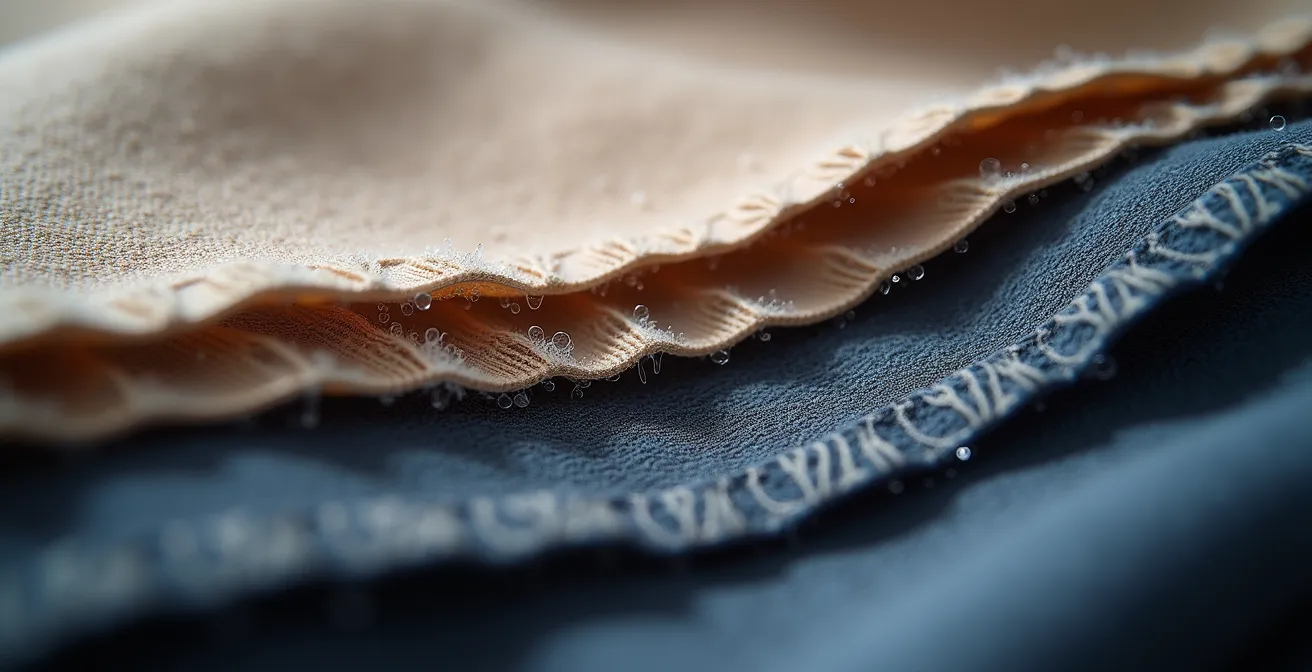
The solution is to introduce a “slip layer”—an undergarment made from a material with a fundamentally different, smoother texture. Fabrics such as micromodal and silk are exceptionally effective. Their fibres are smooth and have a very low propensity for generating static when interacting with wool. As shown in the detailed fabric analysis, this creates a buffer that allows the outer trouser fabric to glide effortlessly over the undergarment, preserving the suit’s natural drape and movement.
The technical specifications are quite clear. One must choose undergarment fabrics based on their static properties and slip factor, a choice that has a greater impact on your appearance than almost any other. The following table illustrates the science of fabric compatibility for formalwear.
| Underwear Fabric | Static Level | Recommended for Wool | Slip Factor |
|---|---|---|---|
| Cotton | High | No | Poor |
| Modal/Micromodal | Low | Yes | Excellent |
| Silk | Minimal | Yes | Superior |
| Synthetic Blends | Medium | Conditional | Good |
Grey vs White: Which undershirt is actually invisible under a white dress shirt?
It is a sartorial paradox that has confounded men for decades: wearing a white undershirt beneath a white dress shirt does not make it invisible. On the contrary, it makes it more conspicuous. The reason lies in basic colour and light theory. The white fabric of the undershirt creates a stark, high-contrast layer against one’s natural skin tone. This contrast is easily visible through the fine poplin or twill of a dress shirt, creating the tell-tale “ghost” outline of the undershirt’s sleeves and neckline.
The correct choice, counterintuitive as it may seem, is a light grey undershirt. Grey, being a neutral tone midway between white and black, has a lower contrast against most skin tones. Rather than reflecting light back through the dress shirt like white fabric does, it subtly absorbs it, effectively blending with the shadow of the body. This allows it to disappear completely, rendering it truly invisible and preserving the clean, uninterrupted white of the dress shirt.
Style experts consistently advise matching the undershirt tone closer to one’s skin than to the shirt colour. For gentlemen with fairer skin, a light heather grey is ideal. For those with darker complexions, a darker grey or even a nude tone that matches the skin is the superior choice. This is a critical detail for any professional, especially in the UK where a commute on the Underground can necessitate an undershirt to protect expensive shirts from perspiration, making its invisibility all the more crucial.
The fabric choice error that causes underwear to bunch up when sitting
The primary culprit behind underwear bunching and riding up, especially when sitting or rising, is almost always the choice of fabric: cotton. While ubiquitous and comfortable for casual wear, cotton possesses properties that make it wholly unsuitable for wearing under tailored trousers. Its fibres have a relatively rough texture and, more importantly, they absorb moisture. This combination is disastrous for maintaining a smooth line.
When you perspire, even minimally, cotton absorbs that moisture. This causes the fabric to become slightly tacky and “stick” to your skin. Simultaneously, its texture creates friction against the wool of your trousers. You are thus caught between two points of grip: the fabric clinging to your skin and the fabric dragging against your trousers. When you move—particularly the motion of sitting down—the trousers pull the underwear fabric upwards, and because it is also clinging to your skin, it does not slide back down. It bunches. This is a simple mechanical failure.
Despite these technical limitations, cotton’s dominance is pervasive; a market analysis reveals the largest market share at 68.6% being held by cotton fabric underwear. This widespread preference is the source of the most common silhouette errors. The solution is to consciously select fabrics like micromodal, which wicks moisture away instead of absorbing it and has a silky-smooth finish, eliminating both points of friction and ensuring the undergarment moves with you, not against your suit.
What is the correct order of dressing to ensure shirt stays work perfectly?
A tucked-in shirt that remains perfectly taut throughout a long day or an entire evening event is the mark of a truly polished gentleman. This is most reliably achieved with the use of shirt stays. However, their effectiveness is entirely dependent on a precise and disciplined order of dressing. Approaching this as a haphazard task will result in discomfort and failure. It is a methodical ritual, best performed in a calm and ordered environment.
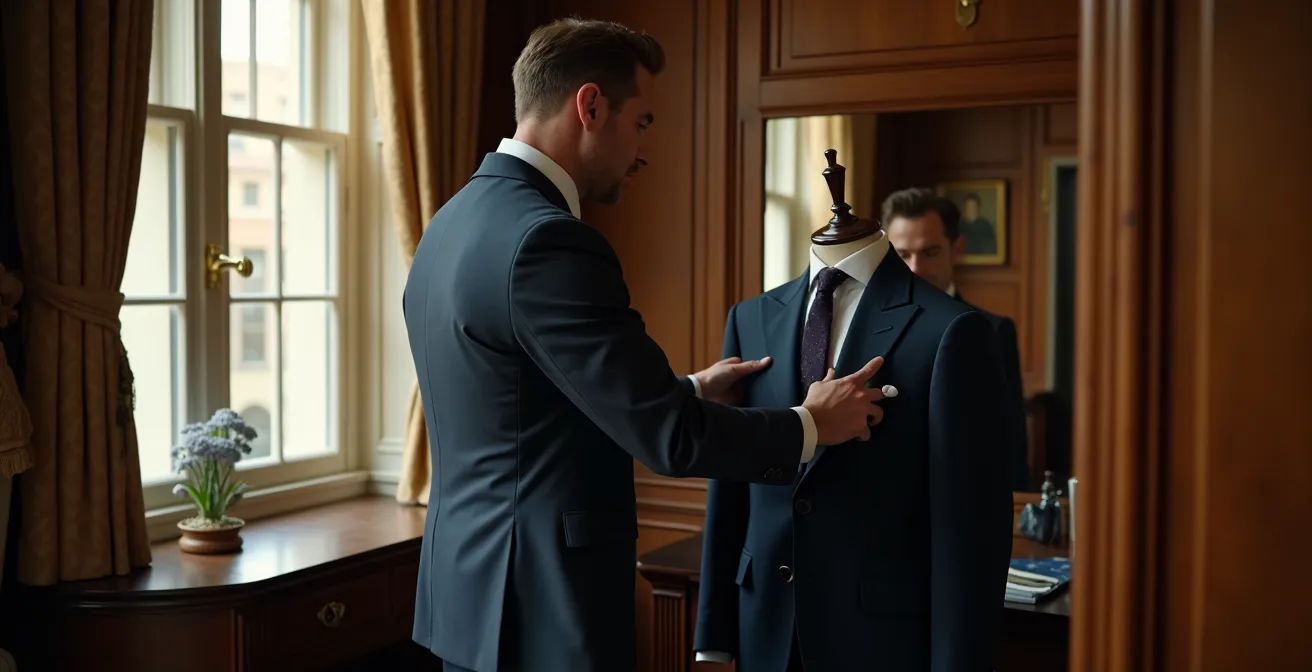
The sequence is logical and designed to create the correct tension at each stage. Any deviation compromises the system. One must proceed with the exactitude of a military officer preparing for inspection. The objective is to create a secure, downward pull on the shirt that is anchored firmly, preventing any blousing or untucking, regardless of movement. Following this procedure ensures the stays are effective, comfortable, and entirely concealed.
Your Action Plan: Military-Precision Dressing Sequence
- Step 1: Underwear First. Put on your underwear, ensuring the waistband sits correctly at the hip or natural waist. This is your foundation.
- Step 2: Socks. Put on your dress socks next. They will serve as the anchor points for the stays.
- Step 3: Dress Shirt. Don your dress shirt while standing, but do not tuck it in yet.
- Step 4: Attach Stays to Socks. While seated or with one foot on a stool, attach the lower clips of the shirt stays to the top of your socks. Ensure a secure connection.
- Step 5: Attach Stays to Shirt. Stand up straight. Pull the shirt taut and, ensuring the stays are straight, attach the upper clips to the front and back tails of your shirt.
- Step 6: Trousers. Finally, put on your trousers, carefully pulling them up and smoothing the fabric to ensure the stays lie flat against your legs and the shirt is perfectly smooth.
How to incorporate lingerie elements into formal evening attire without breaking dress codes?
The term “lingerie” for men, or “mantyhose,” may seem incongruous with the sober traditions of formal evening wear. However, the concept is not about ostentation but about personal luxury and confidence. It refers to undergarments crafted from superior, more sensual materials like silk, satin, or fine mesh, which remain entirely private and invisible but enhance the wearer’s personal sense of occasion. The guiding principle is one of absolute discretion.
As Sarah Rudge notes in the Retail Merchandiser Guide to Formal Attire, the goal is about “maintaining a level of sophistication that aligns with the tone of the event.” This means the “lingerie” element must be a secret known only to the wearer. It could be a pair of silk boxer briefs or trunks with a satin trim. The tactile pleasure of such a garment against the skin can provide a significant psychological boost, a hidden layer of luxury that enhances one’s poise and self-assurance.
It’s about maintaining a level of sophistication that aligns with the tone of the event.
– Sarah Rudge, Retail Merchandiser Guide to Formal Attire
This is a growing trend, even among the most discerning. Research shows that a surprising number of men are exploring diverse styles, with 11% preferring thongs and 7% choosing jockstraps for their support and minimal coverage under tight trousers. In the UK, specialist boutiques in London’s Soho and Shoreditch districts cater to this demand, offering aesthetically daring yet tasteful options. These pieces feature fine materials and subtle detailing that are designed to be completely invisible under formalwear while providing a unique sense of personal confidence.
The silhouette error caused by bulky boxer seams showing through suit trousers
One of the most unforgivable sartorial errors is the visible outline of an undergarment’s seams through a pair of well-fitted trousers. This immediately shatters the illusion of a smooth, clean silhouette. The cause is simple: traditional underwear construction, which utilizes thick, overlocked seams to join fabric panels. These seams create a ridge that is easily telegraphed through the fine worsted wool or flannel of a quality suit.
This detail does not go unnoticed. While a gentleman dresses for himself, it is worth noting that a significant majority of women surveyed find boxer briefs most attractive at 64.5%, and a visible seam detracts significantly from this preferred style. The solution lies in modern seam technology, which has been engineered specifically to address this problem. Choosing an undergarment with advanced construction is as important as choosing the right tie.
For the gentleman seeking an impeccable finish, there are several tiers of seam technology available. Each offers a different level of discretion and performance, and the choice should be made with the same care as selecting the suit itself. The following comparison outlines the options for achieving a truly seamless foundation.
| Seam Type | Visibility Under Suits | Durability | Comfort Level |
|---|---|---|---|
| Laser-Cut Hems | Invisible | Good | Excellent |
| Bonded Seams | Minimal | Excellent | Very Good |
| Flatlock Seams | Low | Superior | Good |
| Traditional Seams | Visible | Good | Variable |
Key Takeaways
- Fabric choice is a technical decision: Micromodal or silk must be chosen over cotton to prevent static friction and bunching under wool trousers.
- Invisibility is achieved through colour science: A light grey undershirt blends with skin tone and shadow, whereas a white undershirt creates visible contrast.
- The silhouette is preserved by construction: Undergarments with laser-cut hems or bonded seams are non-negotiable for eliminating visible lines through fitted trousers.
Can men’s sculpting trunks improve posture and silhouette without being uncomfortable?
The concept of “sculpting” or “shaping” undergarments for men is often met with scepticism, evoking images of restrictive and uncomfortable girdles. This is a misunderstanding of the modern technology involved. Today’s sculpting trunks are not about aggressive compression, but about providing light support and proprioceptive feedback. Their growing acceptance in formal settings is evident, as trunks have captured significant market share at 19.1%, many featuring these supportive properties.
These garments work by providing a gentle, consistent pressure around the core and upper thighs. This pressure acts as a subtle reminder to the wearer to engage their core muscles and maintain an upright posture—a phenomenon known as proprioceptive feedback. Over the course of a long event, this can significantly reduce slouching and fatigue, helping to maintain a strong, confident stance. The key is a modest elastane content, typically between 5-10%, which provides structure without constricting movement.
Wear tests from formal events confirm their efficacy. Testers in the UK report that light-compression trunks function as a form of “subtle armour,” enhancing the fit of a suit and providing a psychological boost of confidence. They are designed to withstand 8-plus hour events like British weddings and galas, maintaining their shape and support without becoming uncomfortable, even while dancing. Far from being restrictive, they are a functional tool for perfecting one’s posture and overall silhouette, much like a well-folded pocket square perfects a jacket.
To ensure your investment in fine tailoring is fully realised and your presentation is flawless from every angle, the next logical step is to audit and upgrade your foundational wardrobe based on these exacting principles.