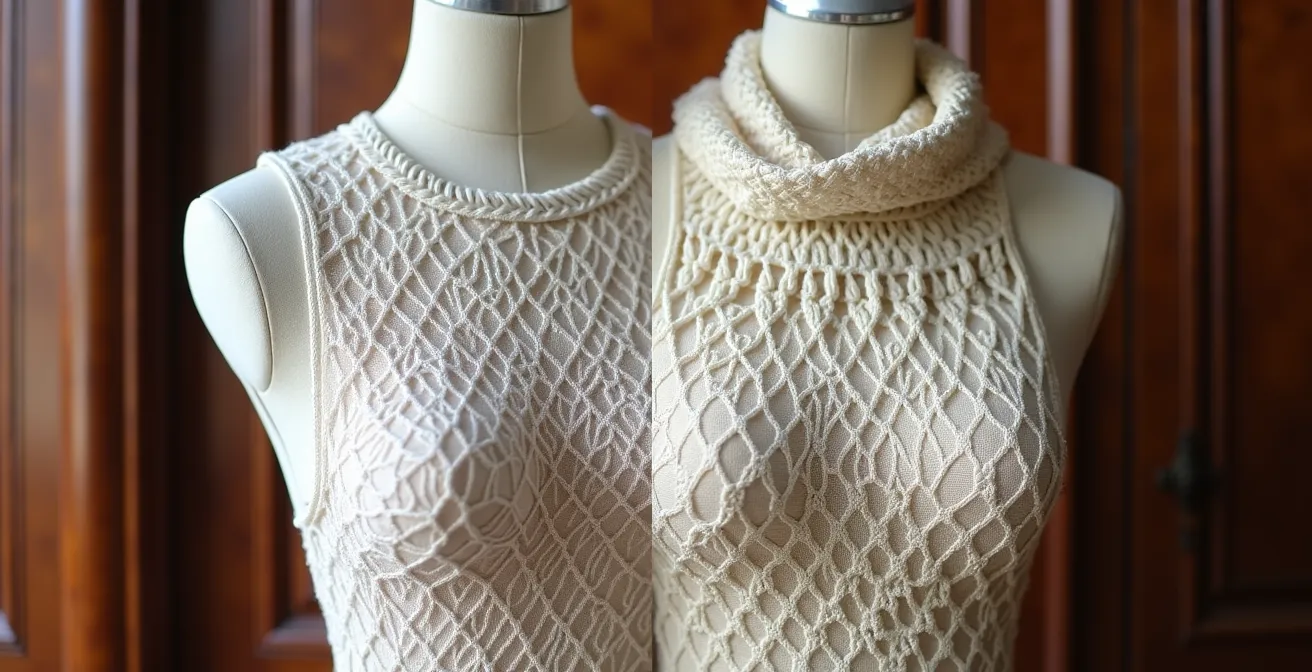
Contrary to popular belief, true lace quality isn’t about ‘old vs. new’, but understanding its underlying engineering and structural integrity.
- Leavers lace achieves its superior quality through a complex twisting method, mimicking handmade lace, which creates unparalleled pattern definition and delicacy.
- Modern knitted laces, like Jacquardtronic, are engineered for performance, integrating high elastane content for crucial support in applications like fuller-bust lingerie.
Recommendation: Learn to ‘read’ the lace’s construction—its thread finish, pattern cohesion under tension, and fibre content—to accurately judge its durability, comfort, and suitability for purpose before you buy.
For the discerning textile enthusiast, the world of lace can seem a binary choice: the revered, historic Leavers lace versus modern, functional knitted varieties. Many articles simply label one as ‘premium’ and the other as ‘commercial’. This oversimplification, however, misses the point entirely. The true measure of lace quality lies not in its age or origin story, but in its very architecture—the intricate engineering of its threads that dictates its feel, its strength, and its performance over time. Understanding this is the key to moving from a mere consumer to a true connoisseur.
The conversation often revolves around surface-level aesthetics, but the real story is woven into the structure. We might discuss the delicate appeal of Chantilly or the bold relief of Guipure, yet the fundamental difference in quality comes from the manufacturing process itself. Is the pattern created by thousands of threads twisting around each other, or by a series of interlocking knitted loops? This single distinction is the foundation of everything that follows: from how a bra supports a fuller bust to whether a dress will survive a single evening without snagging.
But what if the key wasn’t choosing Leavers *or* knitted lace, but understanding the specific structural signature of each type to select the right one for the right job? This guide moves beyond the platitudes. As a technologist steeped in Nottingham’s rich lace-making heritage, I will deconstruct these fabrics for you. We will explore the mechanical magic that makes Leavers the ‘Rolls Royce’ of textiles, compare the engineering of modern support laces, and provide you with the visual and tactile cues to identify genuine quality. You will learn to see lace not just as a decoration, but as a marvel of textile engineering.
This article will guide you through the critical distinctions that define lace quality, from its historical pinnacle to its modern applications. We will examine each type’s unique characteristics to equip you with the knowledge to make truly informed decisions.
Summary: The Definitive Guide to Discerning Lace Quality
- Why is Leavers lace considered the “Rolls Royce” of textile art?
- How to invisibly mend a tear in expensive lace netting?
- Raschel vs Jacquardtronic: Which lace holds a larger bust better?
- The visual sign that tells you a lace will be itchy before you touch it
- How to set the colour in red lace so it doesn’t bleed in the wash?
- How to wear head-to-toe lace for an evening event without itching or snagging?
- Chantilly vs Guipure: Which lace is durable enough for daily wear?
- How to wear head-to-toe lace for an evening event without itching or snagging?
Why is Leavers lace considered the “Rolls Royce” of textile art?
The designation of Leavers lace as the pinnacle of machine-made textiles is rooted in its unique manufacturing process, which most closely replicates the intricate art of handmade lace. Unlike modern methods that knit fabrics, the colossal Leavers machines, many of which are Victorian-era marvels still in operation in the UK, perform a complex dance of twisting ultra-fine threads. This method uses a vast number of threads—sometimes over 50,000—held on bobbins that move like pendulums through vertical warp threads, creating a stable, gauze-like net (known as bobbinet) and the pattern simultaneously. This twisting action gives Leavers lace its signature lightweight yet strong structure and unparalleled pattern definition.
The complexity and slowness of this process result in a fabric with a depth and subtlety that modern, faster knitting machines cannot achieve. The patterns are not merely laid upon a net; they are an integral part of its structure. This allows for incredibly fine detail, delicate shading effects, and a soft, fluid drape that is the hallmark of true luxury. The result is a textile that embodies both artistic heritage and engineering prowess, a testament to the golden age of the Nottingham lace industry.

This heritage is not merely a historical footnote; it is a living tradition. The enduring quality and prestige of this lace are why it continues to be the choice for couture fashion houses and even royal commissions, cementing its status as the undisputed “Rolls Royce” of lace.
Case Study: Cluny Lace, England’s Last Leavers Lace Manufacturer
A prime example of this living history is Cluny Lace in Derbyshire. As detailed in a report by the Derbyshire Times on England’s last lace makers, the firm has been operating since the 18th century and still uses its original Victorian machinery. This commitment to heritage production has seen their lace used in wedding dresses for Catherine, Princess of Wales and Princess Diana, and commissioned by luxury brands like Burberry and Dior. The firm’s output is regarded as the closest a machine can get to handmade lace, prized for a beauty and quality that modern, faster machines cannot replicate. This showcases how the historic Leavers process directly translates into tangible, high-value quality recognized at the highest echelons of fashion.
How to invisibly mend a tear in expensive lace netting?
Mending expensive lace, particularly heritage Leavers lace, is a delicate craft that aims for an invisible repair, preserving the value and beauty of the garment. Given that authentic Leavers lace can be up to ten times more expensive than other types, a successful mend is far more economical than replacement. The key to an invisible repair lies in meticulously recreating the original thread structure, whether it’s the twisted net of Leavers or the knitted loops of a modern lace. This is not simple sewing; it is a process of re-weaving the fabric’s very architecture.
Before beginning, the first step is a careful assessment. A clean tear along the grain of the fabric requires a different approach than a snag that has pulled threads into a pucker, or a hole where material is missing. For a clean tear, the goal is to bridge the gap by following the original path of the threads. For a hole, a donor piece of lace or intricate thread work is needed to rebuild the pattern. Success depends on two critical factors: a perfectly matched thread in both colour and weight, and using the correct stitching technique to mimic the lace’s construction.
For Leavers lace, this means using a fine needle to weave the new thread in and out, following the original twisted pattern of the bobbinet. For knitted laces, the repair must replicate the interlocking loops, a process more akin to knitting than traditional sewing. Patience and precision are paramount, as a clumsy repair can be more noticeable than the original damage.
Your Action Plan: The Professional Lace Mending Process
- Assess the Damage: Determine if the fault is a clean tear, a snag, or a section with missing threads. This dictates the appropriate repair technique.
- Match Thread Precisely: Select a repair thread that matches the original in weight, fibre content (e.g., fine cotton for Leavers, polyamide for modern laces), and colour to ensure the mend is invisible.
- Stabilize the Area: Place the lace on a padded surface or in an embroidery hoop. Use pins to hold the damaged area flat and stable without stretching or distorting the pattern.
- Use a Ladder or Weaving Stitch: For tears, use a fine ladder stitch to draw the edges together. For holes in Leavers lace, carefully weave new threads following the original pattern’s twist direction. For knitted lace, replicate the interlocking knit structure.
- Finish with Gentle Steam: Once the repair is complete, use a low-temperature steam iron on the reverse side (without touching the fabric) to help the new threads relax and blend seamlessly with the original lace.
Raschel vs Jacquardtronic: Which lace holds a larger bust better?
When it comes to lingerie for a fuller bust, the question of lace quality transcends aesthetics and becomes a matter of technical performance and engineering. While delicate Leavers lace offers beauty, modern knitted laces like Raschel and Jacquardtronic are specifically designed for support. This is a critical consideration in the UK, where research from Curvy Kate reveals that over 80% of women are wearing the wrong size bra, and the average size is a 36DD. For D+ cups, the lace on a bra is not just decorative; it’s a structural component that must provide lift, containment, and durability without stretching out over time.
The primary difference between Raschel and Jacquardtronic lies in their knitting technology and, crucially, their ability to integrate elastane. Raschel knitting is a simpler form of warp knitting that produces stable, often decorative, laces. However, Jacquardtronic machines represent a significant technological leap. They are computer-controlled warp-knitting machines that can produce highly complex, multi-layered patterns while simultaneously integrating a much higher percentage of elastane directly into the structure. This results in a lace with superior power, stretch, and recovery—qualities essential for supporting a heavier bust.
A Jacquardtronic lace will maintain its intricate pattern and supportive tension even when stretched, whereas a standard Raschel lace may distort or lose its shape under the same strain. As lingerie expert Madison Anne notes in her Good Housekeeping UK bra testing, construction is also key: “Seamed bras, like demi cups or ‘cut and sew’ cup constructions, are also a great help to lift and hold fuller busts.” When these constructions use a high-performance Jacquardtronic lace, the result is a perfect synergy of engineering and design.
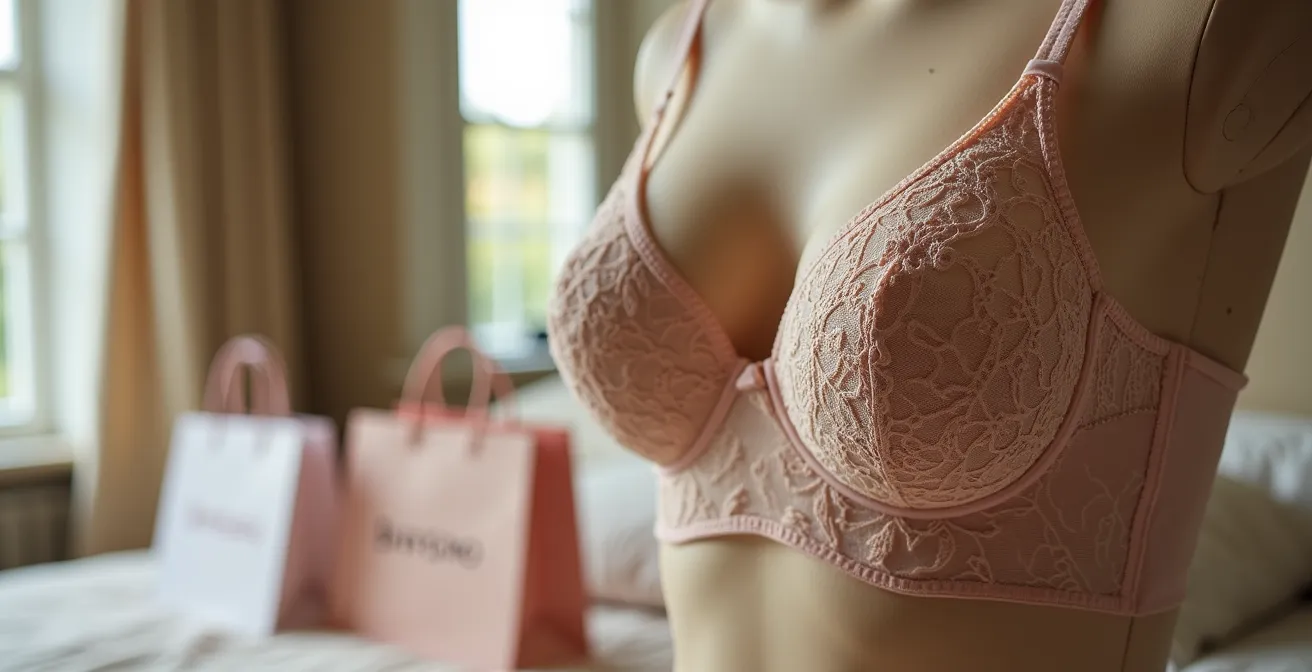
For the discerning buyer seeking support, the choice is clear. While both are knitted, Jacquardtronic lace offers the advanced structural integrity needed for high-performance fuller-bust lingerie, as demonstrated by its adoption by leading UK specialist brands.
As this technical analysis from fuller-bust specialists shows, the construction method has a direct impact on performance.
| Feature | Jacquardtronic Lace | Raschel Lace |
|---|---|---|
| Construction Method | Advanced knitting with integrated elastane | Traditional knitting, less elastic integration |
| Elastane Content | 15-25% for superior recovery | 5-10% standard content |
| Support for D+ Cups | Excellent – maintains shape under tension | Good – may stretch over time |
| Pattern Retention | Maintains intricate patterns even when stretched | Pattern may distort with heavy bust weight |
| UK Brand Usage | Freya, Panache, Curvy Kate preferred choice | More common in A-D cup ranges |
The visual sign that tells you a lace will be itchy before you touch it
One of the most common concerns when buying lace garments, especially online, is the dreaded itch factor. A beautiful piece of lingerie or a delicate top can become unwearable if it irritates the skin. While fibre content is a major culprit, you can often spot the signs of a potentially scratchy lace with a trained eye, long before you ever touch it. The most telling visual clue is an unnatural or excessive shimmer on the fabric, particularly along the scalloped edges of the pattern.
This tell-tale sheen is often indicative of stiff, low-quality synthetic threads, typically 100% polyamide or, in some cases, metallic Lurex threads woven in for sparkle. While high-quality synthetics can be soft, cheaper variants are often processed in a way that leaves them rigid and wiry. When these stiff threads are cut to form the edge of the lace pattern, they create thousands of tiny, sharp points that can feel like sandpaper against sensitive skin. In contrast, softer, higher-quality laces made from cotton, modal, or superior polyamide blends will have a more natural, matte finish. They absorb light rather than reflecting it harshly.
Beyond the shimmer, look closely at the thread itself. If you can zoom in on a high-resolution product photo, examine the fineness of the threads that form the pattern’s outline (the cordonnet). If they appear coarse, thick, and almost rope-like, the tactile signature will likely be rough. A high-quality lace, even a robust Guipure, will have a cordonnet that is smooth and clearly defined, not fuzzy or bulky. By learning to spot these visual cues, you can better predict the tactile experience and avoid the disappointment of an itchy purchase.
- Check for visible shimmer: Excessive shine, especially on scalloped edges, can indicate the presence of stiff polyamide or metallic Lurex threads that cause irritation.
- Examine thread thickness: In close-up photos, look for coarse, rope-like threads outlining the pattern. Finer, smoother threads suggest a softer texture.
- Look for a matte finish: Softer natural fibres and high-quality blends like modal and cotton have a less reflective, more matte appearance than cheaper, shiny synthetics.
- Inspect edge finishing: Raw, frayed, or loosely finished edges are more likely to be scratchy than properly heat-sealed or tightly woven scallops.
- Review fibre content: Always check the product description. Laces containing modal, viscose, or a high percentage of cotton will almost always feel softer than those made of 100% polyamide.
How to set the colour in red lace so it doesn’t bleed in the wash?
There is little more frustrating than washing a beautiful new piece of red lace lingerie, only to find it has bled its colour, staining other items and emerging a faded version of its former self. Red dyes, particularly on synthetic fibres like polyamide and nylon common in modern lace, are notoriously unstable. However, with the right preparation and products readily available in the UK, you can effectively set the colour and protect your investment. The process involves a pre-soak to fix the dye, followed by a careful first wash.
The most effective and widely accessible method involves a simple cold water pre-soak with distilled white vinegar. The acetic acid in the vinegar helps to lock the dye molecules into the fabric’s fibres, making them less likely to run. It’s crucial to use distilled white vinegar, as malt vinegar can stain or leave a lingering odour. For those living in hard water areas, like London, adding a water softener like Calgon is also a wise step, as the minerals in hard water can interfere with the dyeing process and cause colours to appear dull.
After the pre-soak, the first wash is the final line of defence. Using a colour-catching product is non-negotiable. These sheets, which are essentially super-absorbent pieces of fabric, act like a magnet for any loose dye particles in the water, trapping them before they can redeposit onto other garments. Combining these steps will give your red lace the best possible chance of retaining its vibrant, rich colour for years to come.
Your Action Plan: The UK-Specific Colour Setting Method
- Purchase Supplies: Buy Dylon Colour Catcher sheets, available at major UK supermarkets like Tesco, Sainsbury’s, or ASDA, and a bottle of distilled white vinegar.
- Pre-soak with Vinegar: In a clean basin, create a solution of cold water and approximately 100ml of distilled white vinegar. Submerge the red lace garment and let it soak for 30 minutes.
- Account for Hard Water (If Applicable): If you live in a hard water area, add a tablespoon of a water softener like Calgon to the pre-soak solution to protect the delicate dyes.
- Rinse and Test: After 30 minutes, rinse the garment thoroughly in cold water until the water runs clear. Gently blot a hidden area with a white tissue to check for any significant colour transfer.
- The First Wash: Place the lace in a delicate wash bag (available from John Lewis or M&S). Add two Colour Catcher sheets directly into the drum of the washing machine and run a cold, delicate cycle with a gentle detergent.
How to wear head-to-toe lace for an evening event without itching or snagging?
A full-lace outfit for an evening event is a bold and elegant statement. However, its success hinges on two practical considerations: preventing skin irritation (itching) and protecting the delicate fabric from damage (snagging). The key to comfort when wearing lace directly against the skin for hours is to create a barrier with a smooth, breathable underlayer. This is a secret well-known to UK stylists when dressing clients for red carpet events and formal occasions.
Rather than relying on the lining that may come with a lace dress, which can often be a staticky polyester, investing in a high-quality, separate slip is paramount. The best choices are slips made from natural silk or modal blends. These fibres are exceptionally smooth, reducing friction against the skin, and are breathable, which helps to regulate body temperature and prevent the discomfort that can exacerbate itching. Brands like the M&S Autograph collection in the UK offer excellent options in silk and modal that feel luxurious against the skin while remaining invisible under the lace, preserving the garment’s intended silhouette.
This strategic layering does more than just prevent itching. It also allows the lace to drape and move as the designer intended, without clinging to the body. It provides an opaque layer for more transparent laces and adds a feeling of security and polish to the final look. Choosing a slip in a nude tone that matches your skin will make it disappear, while a contrasting colour like black under white lace can be a deliberate and sophisticated style choice. Ultimately, this simple undergarment is the unsung hero of the head-to-toe lace ensemble, ensuring you feel as good as you look.
Chantilly vs Guipure: Which lace is durable enough for daily wear?
When selecting lace for garments intended for regular use rather than special occasions, durability becomes as important as appearance. Two popular but structurally opposite laces, Chantilly and Guipure, offer a perfect case study in this trade-off. Chantilly is known for its ethereal beauty, while Guipure is prized for its bold, substantial feel. Understanding their construction is key to choosing the right one for a lifestyle that demands longevity.
Chantilly lace is a type of bobbinet lace, characterized by fine, detailed floral or scroll patterns on a very lightweight, sheer net background. Its delicacy is its primary aesthetic appeal, making it a favourite for bridal veils and fine lingerie from brands like Bluebella. However, this same fine netting is its weakness in terms of durability. It is prone to snagging and tearing with daily wear and friction, and it almost always requires careful hand washing. It is, by its very nature, a high-maintenance, special-occasion textile.
In stark contrast, Guipure lace is a non-netted lace. Its motifs are connected by a series of braids or bars (plaits), rather than being appliquéd onto a fine mesh. This creates a much heavier, sturdier, and more textured fabric with a raised, almost three-dimensional effect. This robust structure makes Guipure far more resilient to the rigours of daily life. It’s why you often see it used for more hard-wearing applications like dress collars, cuffs, or even entire day dresses from contemporary UK brands like Whistles and Reiss. It can often withstand a gentle machine wash and will maintain its integrity for years, making it the clear winner for everyday elegance.
| Aspect | Chantilly Lace | Guipure Lace |
|---|---|---|
| Daily Office Wear | Too delicate for outer garments | Perfect for collar details (Reiss, Ted Baker) |
| Machine Washing | Hand wash only required | Gentle machine wash acceptable |
| Longevity | 2-3 years with careful handling | 5+ years with normal wear |
| Best UK Brands | Bluebella, Figleaves (lingerie) | Whistles, & Other Stories (dresses) |
| Price Range | £40-150 for quality pieces | £80-250 for designer items |
Key Takeaways
- True lace quality is determined by its structural engineering (twisted Leavers vs. knitted Raschel/Jacquardtronic), not just its age or appearance.
- For fuller bust support, Jacquardtronic lace is superior due to its high elastane content and ability to maintain pattern cohesion under tension.
- A visual inspection can often reveal a lace’s potential for itchiness: look for a matte finish (softer) versus an excessive shimmer (stiffer synthetics).
How to wear head-to-toe lace for an evening event without itching or snagging?
Having addressed the internal comfort of a full-lace outfit by using the correct underlayers, the second challenge is navigating the external world to prevent snags. A single misplaced piece of jewellery or a rough surface can instantly ruin a delicate lace garment. Proactive prevention is about being mindful of your accessories and environment, especially during a busy evening event in the UK, from a city reception to a rustic countryside wedding.
Your choice of accessories is the first line of defence. Opt for clutches and handbags made from smooth leather or satin over those embellished with sequins, beads, or sharp hardware. Brands like Accessorize or Zara offer stylish and affordable options. Similarly, examine your jewellery. A rough clasp on a bracelet or the prongs of a ring can act like tiny hooks. A clever trick is to apply a small dab of clear nail polish over any rough metal points to create a smooth, protective coating before you get dressed.
Finally, be aware of your surroundings. The charmingly rustic wooden bench at a barn wedding or a splintered railing can be disastrous for a lace dress. Carrying a pashmina or a silk scarf not only adds a layer of warmth but can also be used as a protective barrier to sit on. When choosing outerwear, favour coats with smooth linings and avoid those with velcro closures, opting for elegant buttoned or belted styles from brands like Reiss or Ted Baker. A little forethought can ensure your lace outfit remains pristine throughout the entire event.
Your Action Plan: Snag Prevention Tips for UK Evening Events
- Choose Smooth Handbags: Opt for clutches made of smooth leather or satin over those with beads, sequins, or sharp metal hardware.
- Inspect Your Jewellery: Apply a small amount of clear nail polish to any rough clasps, prongs, or watch bands to create a snag-proof surface before dressing.
- Beware of Rustic Surfaces: At countryside or rustic venues, be mindful of splintered wood on chairs or tables. Carry a pashmina or silk scarf to place on surfaces before you sit down.
- Select Lined Outerwear: Choose coats and jackets with smooth linings and avoid velcro closures. Lined wool or trench coats from brands like Reiss or Ted Baker are ideal.
- Keep Hands Moisturized: Prevent dry, rough skin on your hands from catching on delicate threads by keeping them well-moisturized throughout the event.
Armed with an understanding of thread engineering, structural integrity, and practical care, you can now approach any lace purchase with a new level of expertise. Your next step is to examine your own collection through this new lens and approach your next purchase not just as a buyer, but as a confident connoisseur of fine textiles.