
The unique identity of British lingerie is not merely a stylistic choice but a direct product of the UK’s specific industrial history, manufacturing geography, and a curatorial tension between heritage craft and subversive art school innovation.
- It is rooted in a legacy of structural corsetry and the specific provenance of materials like Nottingham lace and Birmingham hardware.
- Its aesthetic is defined by a “curated rebellion”—a dynamic dialogue between established elegance and avant-garde experimentation from institutions like Central Saint Martins.
Recommendation: To truly appreciate a piece, look beyond its design to its manufacturing DNA—verify its ‘Made in UK’ status and material origins to connect with its authentic cultural lineage.
When considering the landscape of luxury intimate apparel, the conversation often gravitates towards the assumed poles of Parisian classicism and Italian flamboyance. French design is codified by its delicate elegance, a whisper of seduction, while Italian styles are defined by opulent materials and a bold, declarative femininity. Within this established lexicon, British lingerie is frequently reduced to simplistic archetypes: the punk-inspired rebel or the quaintly comfortable practicality. Yet, this view overlooks the profound and complex identity woven into the very fabric of British design.
The truth is far more intricate and compelling. To understand what makes British lingerie distinct is to embark on a curatorial journey through industrial history, artisanal geography, and a unique cultural tension that fosters both reverence for the past and a radical vision for the future. It is an identity forged not in the abstract realm of “style,” but in the tangible realities of Nottingham’s lace mills, Birmingham’s metal workshops, and the fiercely creative corridors of London’s art schools. The distinction is not just aesthetic; it’s a matter of provenance and manufacturing DNA.
This is not merely about being “edgy.” It is about a structural integrity born from a global leadership in corsetry, a material honesty tied to local sourcing, and a spirit of “curated rebellion” that constantly challenges and redefines the boundaries of intimate apparel. This guide moves beyond the clichés to deconstruct the authentic markers of British lingerie, offering a framework for the discerning eye to identify and appreciate its true character.
To fully grasp this unique design lineage, this article will explore the historical foundations of British craftsmanship, the methods for identifying authentic production, the aesthetic tensions that define its character, and the contemporary forces shaping its future. The following sections provide a detailed map for navigating this fascinating territory.
Table of Contents: Unpacking the DNA of British Lingerie Design
- Why is the UK considered the global capital of structural corsetry?
- How to spot true British heritage manufacturing versus outsourced production?
- London Avant-Garde vs Paris Classicism: Which aesthetic suits your personality?
- The 3 signs of a fake designer set sold on online marketplaces
- Who are the top 5 emerging designers from Central Saint Martins this year?
- How to find small UK lingerie makers who aren’t on the high street?
- Bond Street vs Covent Garden: Which area suits your lingerie style?
- What are the challenges and triumphs of the UK intimate apparel market today?
Why is the UK considered the global capital of structural corsetry?
The United Kingdom’s reputation as a bastion of structural lingerie is not a recent marketing invention but a direct lineage from its dominance during the Industrial Revolution. The nation’s expertise is fundamentally rooted in engineering and material science, particularly the historic hub of lace production in Nottingham. At its zenith, this industry was a formidable economic force; Nottingham’s lace industry employed some 25,000 mostly female workers in the 1890s, creating an immense pool of specialised skill in handling complex, delicate textiles. This wasn’t merely decorative craft; it was high-precision manufacturing that laid the groundwork for complex garment construction.
This heritage of technical mastery endowed British designers with a unique ‘manufacturing DNA’. Whereas other fashion capitals may have focused on surface decoration, the British approach has often been about the architecture of the garment. This obsession with structural integrity—boning, underwiring, and pattern-cutting that sculpts and supports the body—is a direct descendant of Victorian and Edwardian corsetry. Brands that emerged in the 20th century, and even contemporary ones, inherited this engineering-first mindset. It’s a philosophy that treats the body as a form to be both celebrated and supported with precision.
This historical context explains why British brands so often lead in innovation. As Susana Lorena, founder of the luxury boutique Maison SL, observes, this foundation allows for a unique form of creativity. In her view:
British underwear designers are innovators and experimenters. They range from the overtly sexy with a dash of dominatrix to gloriously bohemian femininity and romanticism.
– Susana Lorena, Founder of Maison SL
The V&A Museum’s “Undressed” exhibition further codified this legacy, showcasing how London-founded brands like Agent Provocateur continue to evolve this tradition. By marrying provocative aesthetics with advanced construction, they demonstrate that British design is not static history but a living, breathing art form built on a foundation of unparalleled technical expertise.
How to spot true British heritage manufacturing versus outsourced production?
In an era of globalised supply chains, the “Made in UK” label has become a coveted mark of authenticity and quality, but it requires a discerning eye to verify. The first and most crucial distinction for a connoisseur to understand is the legal difference between “Designed in the UK” and “Made in the UK”. The former can simply mean the creative concept originated here, while the latter signifies that the actual cutting, sewing, and finishing of the garment took place on British soil. Post-Brexit, this distinction carries significant weight in defining true domestic production.
A second key indicator lies in the materials. True heritage manufacturing often involves sourcing from the UK’s remaining artisanal producers. The most prominent example is Nottingham lace. While the industry has contracted, a few heritage mills survive. From what were once hundreds of factories, the UK now has only one manufacturer, Cluny Lace, still producing traditional Leavers lace on original looms. A brand that explicitly names Cluny Lace as a supplier is making a powerful statement about its commitment to British craftsmanship. Similarly, high-quality metal components—clasps, rings, and sliders—are often a hallmark, with many authentic brands sourcing from artisans in Birmingham’s historic Jewellery Quarter.
Finally, transparency is a non-negotiable trait of authentic British makers. Verifying a company’s registration on the official Companies House website can provide insights into their declared operations. While not a foolproof guarantee of manufacturing location, it is a vital piece of the due diligence puzzle. An authentic heritage brand will be proud of its British roots and transparent about its production process, seeing its domestic manufacturing base not as a logistical detail, but as a core part of its identity.
Your Checklist: Verifying Authentic British Manufacturing
- Label Scrutiny: Check if the brand explicitly states ‘Made in UK’ on its products and website, not the more ambiguous ‘Designed in UK’. These have different legal meanings.
- Material Provenance: Look for mentions of heritage materials like Nottingham lace from specific mills, such as Cluny Lace, the last manufacturer of its kind on British soil.
- Corporate Transparency: Verify the company’s registration on the Companies House website to check for transparency regarding its stated business activities and location.
- Hardware Quality: Examine the metal components. Authentic British pieces often feature higher-quality, heavier-feel metal hardware, sometimes sourced from Birmingham’s historic Jewellery Quarter.
London Avant-Garde vs Paris Classicism: Which aesthetic suits your personality?
The aesthetic divergence between London and Paris in lingerie design is a fascinating reflection of their respective cultural climates. It is a tale of two cities: one celebrating timeless elegance, the other championing a “curated rebellion”. Paris Classicism is rooted in a tradition of symmetrical beauty, luxurious materials like silk and French Leavers lace, and a colour palette that favours understated nude tones and iconic black. It speaks to a personality that values timeless femininity and unwavering elegance—a style that is seductive through its perfection and restraint.
In contrast, the London Avant-Garde aesthetic is defined by experimentation and a punk-influenced spirit. This is the “Art School Pipeline” in action, where designers from institutions like Central Saint Martins deconstruct traditional forms. This approach embraces asymmetry, innovative or recycled fabrics, and a bold colour palette often featuring sharp contrasts and even neon accents. It is a style that appeals to a rebellious, artistic, and often sustainability-conscious individual who sees lingerie not just as an undergarment but as a form of personal expression and a statement of values. This is less about conforming to a classic ideal of beauty and more about creating one’s own.
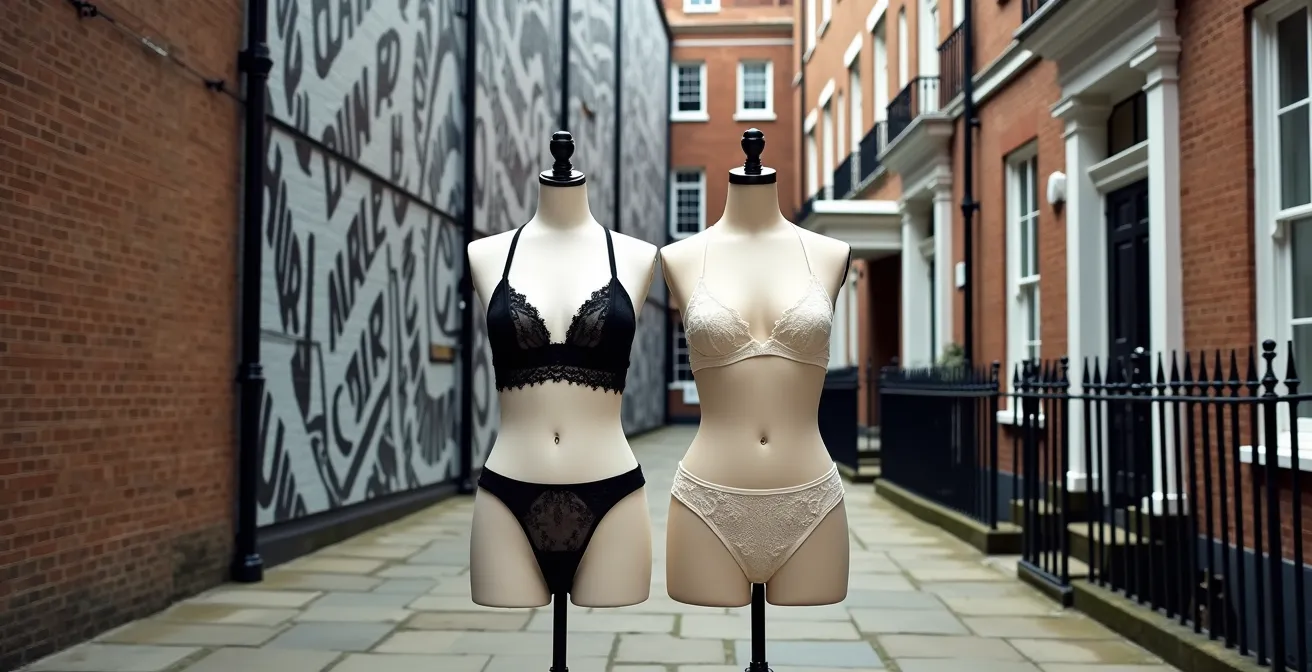
This contrast is not merely stylistic but philosophical. The Parisian aesthetic seeks to perfect a known ideal, while the London look seeks to question what that ideal can be. Choosing between them is a matter of identifying which narrative resonates most deeply with your own sense of self. Are you drawn to the harmonious poetry of a perfectly crafted silk set, or the dynamic energy of a piece that challenges convention?
To better understand this dichotomy, the following table breaks down the core tenets of each design philosophy.
| Aspect | London Avant-Garde | Paris Classicism |
|---|---|---|
| Design Philosophy | Experimental, punk-influenced, asymmetrical | Traditional elegance, symmetrical cuts |
| Materials | Recycled fabrics, innovative synthetics | Luxury silks, French lace |
| Color Palette | Bold contrasts, neon accents | Nude tones, classic black |
| Target Personality | Rebellious, artistic, sustainability-focused | Classic femininity, timeless elegance |
| Price Range | £50-200 for indie brands | £100-500 for luxury sets |
The 3 signs of a fake designer set sold on online marketplaces
The very desirability of authentic British designer lingerie makes it a prime target for counterfeiters, particularly on sprawling online marketplaces. Protecting your investment requires a curator’s eye for detail. The first and most immediate sign of a fake often lies in the branding itself. Counterfeits frequently fail to replicate logos with perfect accuracy. For instance, with a brand like Agent Provocateur, fakes often display an incorrect font weight in the cursive script, a subtle but telling flaw, especially noticeable in the loop of the letter ‘g’. A genuine item will have crisp, consistent branding, from the label sewn into the garment to the box it arrives in.
Secondly, the quality of the hardware is a powerful indicator of authenticity. True British brands, drawing on the nation’s manufacturing heritage, typically use heavyweight metal clasps, rings, and sliders, often sourced from specialist suppliers in places like Birmingham. These components feel substantial and cool to the touch. Counterfeits, produced to cut costs, will almost invariably use lightweight zinc alloys that feel hollow, cheap, and are prone to tarnishing. This difference in material integrity is often palpable before you even try the garment on.
Finally, the packaging itself can be the ultimate giveaway. Luxury brands understand that the unboxing experience is part of the product. Agent Provocateur, for example, uses very specific Pantone pink boxes with beautifully embossed, not printed, logos. Fakes often miss these nuances, using slightly incorrect shades of pink, flimsy card, or flat-printed logos that lack the tactile quality of the real thing. As 9th generation lace manufacturer Michelle Mason of Cluny Lace notes about fabric, the same principle applies to the entire product. She states, ” The fabric feel is irreplaceable – counterfeits can’t replicate the specific hand-feel of genuine Nottingham lace or the weight of high-quality British-sourced elastics.” This applies equally to every component, from fabric to clasp to box.
Your Audit Plan: Spotting Counterfeit Lingerie
- Logo Inconsistencies: Scrutinise the logo on the garment and packaging. For Agent Provocateur, for example, check for incorrect font weight in the cursive script, a common flaw in fakes.
- Hardware Quality: Test the weight and feel of the metal components. Authentic British brands often use heavyweight metal clasps, while counterfeits use lightweight, hollow-feeling zinc alloys.
- Packaging Discrepancies: Examine the packaging for errors. Check for correct Pantone colours (e.g., the specific Agent Provocateur pink), embossed versus printed logos, and overall material quality.
Who are the top 5 emerging designers from Central Saint Martins this year?
The future of British lingerie’s avant-garde identity is forged annually within the studios of Central Saint Martins (CSM). The graduate shows are not just student presentations; they are a bellwether for the entire industry, showcasing the next wave of “curated rebellion”. This year, the standout theme is undoubtedly radical sustainability, moving far beyond simple organic cotton to a deep exploration of bio-fabrication and circular design. These emerging talents are the direct inheritors of the British legacy of innovation, applying it to the most pressing issue of our time.
The 2024 CSM BA Fashion Show was a testament to this, with a cohort of designers who are redefining what lingerie can be made from and what it can represent. Among the most promising are visionaries who are not just designing garments, but pioneering entire systems of production. The official CSM BA Fashion Show 2024 spotlight highlighted several key innovators. We see talents like Thea, who is transforming discarded fishing nets into exquisite fabrics through meticulous hand-sewing and beading, and Samuel Friberg, whose “queer fairytale” aesthetic is built from recycled textiles and sequin waste. These designers prove that ethical production can fuel, rather than limit, creativity.

This focus is institutionally supported. The emphasis on sustainable practice is a core tenet of the curriculum, with the Maison/0 sustainability platform actively promoting green innovation. It’s telling that in the recent showcases, the platform recognized 60 students nominated for its Green Trail awards. Other emerging stars are pushing the boundaries of form itself, using bio-fabricated materials and 3D-printing technologies to create structural garments that would be impossible to achieve with traditional sewing methods. These are not just clothes; they are wearable sculptures, artefacts of a future where technology and nature coalesce. Keeping an eye on these names is to watch the next chapter of British design history being written.
How to find small UK lingerie makers who aren’t on the high street?
Discovering the next generation of independent British lingerie artisans—those operating beyond the reach of the high street—is a rewarding pursuit for any connoisseur. It requires moving away from mainstream retail channels and towards more curated platforms and communities. A primary resource for this is the UK Fashion and Textile Association (UKFT). Their British Brands campaign is an invaluable directory, actively showcasing a spectrum of independent labels, from the intricate strap-work of Edge o’ Beyond to the couture-level artistry of Studio Pia, all of whom pride themselves on local UK production.
Social media, when used with precision, can also be a powerful discovery tool. Instead of generic searches, the key is to use hyper-local hashtags. Combining terms like #UKlingerie or #Britishdesign with specific regional tags such as #MadeInCornwall, #ScottishDesign, or #ManchesterMakers can unearth small, localised studios that have a strong sense of place. This “geographic terroir” approach often leads to brands with a unique story and a deep connection to their community.
Beyond the digital realm, curated marketplaces and real-world events offer the most direct connection to the makers themselves. Online platforms like Wolf & Badger act as a gallery for independent British-made goods, championing craftsmanship over mass production. Furthermore, annual craft fairs are essential. Events like ‘Made London’ in the capital or ‘The Festival of Crafts’ in Farnham are not just shopping opportunities; they are chances to meet the artisans, feel the materials, and understand the philosophy behind each piece directly from the source. As the UKFT proudly states, “Contemporary UK independent brands are leading the way in terms of local production, gender and size inclusivity, and creative design.” Finding them is to find the true, beating heart of modern British lingerie.
A Connoisseur’s Guide: Discovering Independent UK Lingerie Artisans
- Explore Industry Campaigns: Utilise UKFT’s British Brands campaign to discover vetted independent labels like Edge o’ Beyond and Studio Pia, all committed to UK production.
- Use Hyper-Local Hashtags: Search Instagram with specific combinations like #MadeInCornwall, #ScottishDesign, or #ManchesterMakers alongside #UKlingerie to find regional artisans.
- Visit Curated Marketplaces: Browse UK-centric platforms such as Wolf & Badger that specifically champion and showcase independent, British-made goods.
- Attend Artisan Events: Visit annual fairs like ‘Made London’ or ‘The Festival of Crafts’ in Farnham for direct contact with the designers and their work.
Bond Street vs Covent Garden: Which area suits your lingerie style?
In London, the experience of purchasing lingerie is as much a part of the “terroir” as the design itself, and different districts cater to distinct sensibilities. The choice between shopping on Bond Street or in Covent Garden is a choice between two different philosophies of luxury. Bond Street and its surrounding Mayfair neighbourhood represent the pinnacle of discreet, establishment luxury. This is the world of private appointments, hushed tones, and unparalleled personal service. It is home to brands holding a Royal Warrant, such as Rigby & Peller, where the focus is on achieving the perfect fit and investing in timeless quality. This area suits the buyer seeking investment pieces and a classic, measured approach to luxury.
Covent Garden and the adjacent Seven Dials, by contrast, offer what could be described as the “theatre of seduction”. This is where Agent Provocateur established its flagship, transforming lingerie shopping from a discreet necessity into a playful, exploratory experience. The brand’s origin story, founded in 1994 on Soho’s Broadwick Street before expanding globally, is rooted in this spirit of playful provocation. Its Covent Garden presence, with pink-tinted changing rooms and theatrical displays, embodies London’s more rebellious and performative approach to luxury. This district is for the shopper who seeks personality and fun in their lingerie, who enjoys the thrill of discovery and the story behind the brand.
For those seeking something more exclusive, a hidden gem exists in Connaught Village. This quieter enclave offers a more intimate and personal shopping experience, home to independent boutiques that provide a curated selection of lesser-known luxury brands. It bridges the gap between the grand tradition of Mayfair and the theatricality of Covent Garden. Choosing the right area is about aligning the shopping environment with your personal style and what you value most in the luxury experience: impeccable service, playful discovery, or unique exclusivity.
| Aspect | Bond Street & Mayfair | Covent Garden & Seven Dials | Hidden Gem: Connaught Village |
|---|---|---|---|
| Shopping Experience | Private appointments, discreet service | Theatre of seduction, playful discovery | Personal, curated, intimate |
| Key Brands | Rigby & Peller (Royal Warrant) | Agent Provocateur flagship | Independent boutiques |
| Price Point | £200-1000+ investment pieces | £100-500 statement pieces | £150-600 unique finds |
| Best For | Perfect fit, timeless quality | Fun, personality, exploration | Exclusive, lesser-known luxury |
Key Takeaways
- British lingerie’s identity is defined by its manufacturing DNA, rooted in historical corsetry and the technical mastery of materials like Nottingham lace.
- Authenticity can be verified by looking for ‘Made in UK’ labels, material provenance (e.g., Cluny Lace), and the quality of hardware from places like Birmingham’s Jewellery Quarter.
- The aesthetic is a “curated rebellion,” a tension between heritage and the avant-garde innovation driven by the UK’s world-renowned art schools.
What are the challenges and triumphs of the UK intimate apparel market today?
The contemporary British intimate apparel market is a story of resilience and adaptation, defined by a dialectic between profound challenges and inspiring triumphs. The primary challenge has been the dramatic de-industrialisation of the 20th century. The decline of the nation’s textile manufacturing base was stark; as an example, the UK lace industry workforce declined dramatically from its peak in the 1890s to the 1970s. This loss of infrastructure and generational skills presents an ongoing hurdle for brands committed to domestic production, making the “Made in UK” label a hard-won badge of honour.
Yet, out of this challenge has emerged a significant triumph: the reshoring renaissance. A growing movement, championed by organisations like Make it British, is celebrating and supporting brands that have committed to manufacturing entirely within the UK. The “Make it British” campaign highlights companies like David Nieper, which has been designing and manufacturing in its Derbyshire studios for over 50 years, actively fostering local skills. This movement is not just about patriotism; it’s a strategic response to consumer demand for transparency, quality, and sustainable practices. It represents a conscious effort to rebuild and cherish the nation’s manufacturing DNA.
This spirit of resilience is perhaps the ultimate triumph. It feeds into a culture of individualism that many feel is uniquely British. As Hattie Tennant, founder of Fruity Booty lingerie, puts it:
There is something unique about the way British women dress. We have the freedom to express ourselves in ways that feel more individualistic than in some of the larger fashion capitals.
– Hattie Tennant, Founder of Fruity Booty
This freedom—to be experimental, to honour heritage, to innovate sustainably—is the enduring strength of the UK’s intimate apparel market. It is a market that has turned the challenge of its past into the triumph of its present, creating a lingerie identity that is as complex, resilient, and individualistic as the nation itself.
By understanding this rich tapestry of history, craft, and culture, one can begin to truly appreciate the distinct and compelling character of British lingerie, moving beyond simple comparisons to celebrate its unique contribution to the world of fashion.