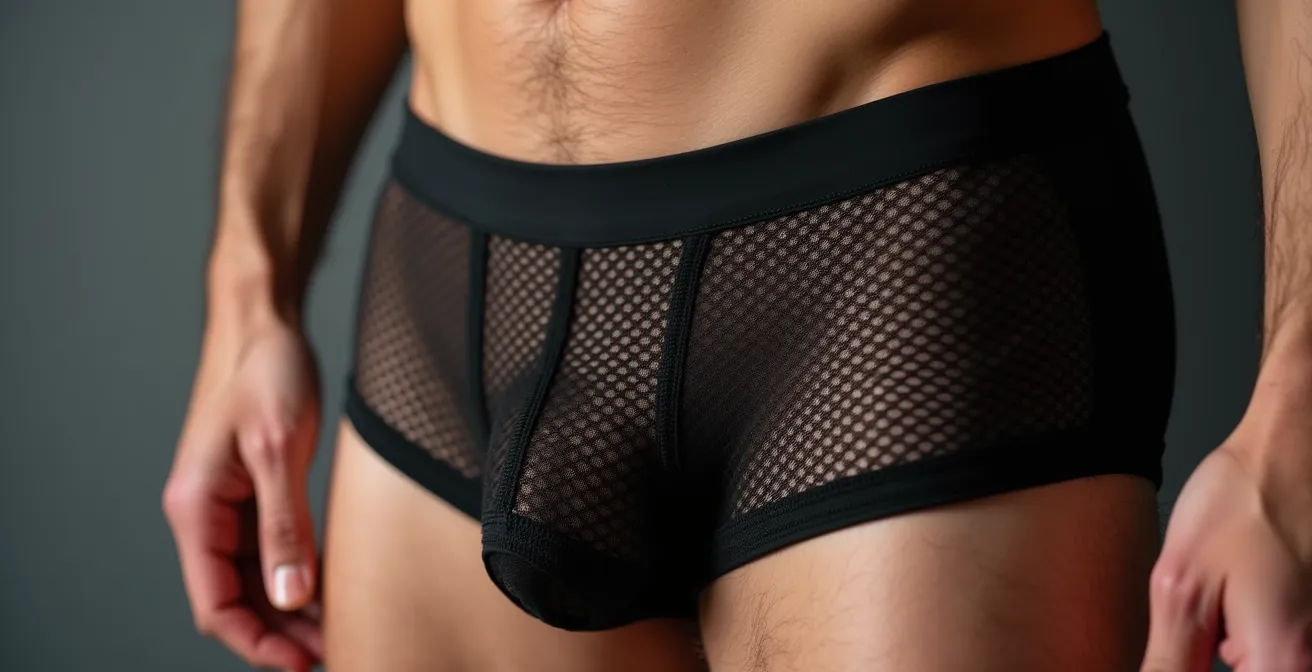
The rise of men’s mesh underwear isn’t about fashion trends; it’s a shift towards engineered performance fabric for superior everyday comfort.
- Mesh provides superior thermoregulation, actively reducing heat and moisture buildup in a way traditional fabrics cannot.
- Modern blends and advanced seam construction have eliminated the historical comfort and durability issues once associated with sheer fabrics.
- Specific mesh styles offer targeted functionality for travel, sports, and daily wear without compromising on discretion in environments like the gym.
Recommendation: Approach mesh as a technical upgrade to your base layer, focusing on fabric type (micro-mesh vs. sports-mesh) and seam design to match your specific daily activities.
The sight of mesh is ubiquitous in modern sportswear. We see it in running vests, basketball shorts, and ventilation panels on performance tops. It’s a fabric synonymous with breathability and athletic prowess. Yet, for many men, the idea of this technology extending to their most intimate apparel—their underwear—is met with a mix of curiosity and hesitation. This hesitation is often rooted in a perception of mesh as a purely aesthetic or even taboo choice, associated more with bedroom attire than boardroom comfort or gym performance. The question lingers: is it just for show, or is there a genuine functional advantage?
For too long, the conversation around men’s mesh underwear has been dominated by its appearance, overlooking the significant engineering that goes into modern sheer fabrics. The common advice to “just be confident” misses the point entirely if the product itself is uncomfortable or impractical. But what if we re-evaluated mesh not for its aesthetics, but for its raw technical performance as an advanced textile? What if the key to embracing it lies in understanding its function as a piece of high-performance gear, designed to solve common problems of heat, moisture, and weight?
This is precisely the shift happening in men’s apparel. Driven by innovations from the world of elite sports, sheer and semi-sheer fabrics are being re-engineered for everyday life. This article moves beyond the stigma to deliver a technical breakdown. We will explore the science of its cooling properties, provide a practical guide for choosing styles appropriate for any situation, dissect the material differences that affect durability, and reveal how modern manufacturing has solved the comfort equation. It’s time to treat your base layer with the same technical scrutiny as the rest of your wardrobe.
To fully understand this evolution from fashion statement to functional staple, we will deconstruct the key technical aspects and practical considerations of modern mesh underwear. The following sections provide a complete guide to making an informed choice based on performance, not just perception.
Contents: Why Mesh Underwear is a Technical Upgrade
- Why does sheer mesh reduce groin temperature by up to 2 degrees?
- How to choose a semi-sheer style that is appropriate for the gym changing room?
- Micro-mesh vs Sports-mesh: Which resists snagging in the wash?
- The seam mistake that makes mesh underwear unbearable to wear all day
- How mesh underwear saves packing weight and drying time for travelers?
- How to embrace the “naked look” trend with grace and confidence?
- How does silk wick sweat away from the body differently than sports synthetics?
- How do modern mesh blends offer the best of both worlds for the active man?
Why does sheer mesh reduce groin temperature by up to 2 degrees?
The primary performance benefit of mesh fabric is its mastery of thermoregulation. The human body constantly works to maintain a stable core temperature, and a significant part of this process involves releasing heat through the skin. In the groin area, this is particularly challenging due to restrictive clothing and lack of airflow. Traditional fabrics like cotton can trap heat and moisture, creating a “swampy” microclimate that is both uncomfortable and can lead to irritation. Mesh fabric directly counters this with a simple yet highly effective engineering principle: maximising airflow and accelerating evaporation.
The science is based on evaporative cooling. As your body produces moisture (insensible perspiration, even when not actively sweating), its evaporation from the skin’s surface has a powerful cooling effect. In fact, cutting-edge research from Oxford Academic shows that up to 20% of body heat dissipation relies on water vapor loss. Mesh fabric, with its open-weave structure, acts as a catalyst for this process. Each tiny perforation in the fabric is a vent, allowing heat and water vapor to escape directly into the atmosphere rather than being trapped against the skin. For instance, some brands engineer their fabric with over 900 micro-perforations per square inch, creating a system of constant, passive ventilation.
This constant air exchange prevents the build-up of warm, humid air, allowing the skin to breathe freely. The result is a noticeable reduction in surface temperature, often cited as being up to 2°C cooler than conventional underwear under similar conditions. This isn’t just about comfort; maintaining a lower temperature in the groin area is widely recommended for men’s health. By choosing mesh, you are essentially equipping your body with a high-efficiency cooling system, leveraging textile science to maintain optimal comfort and dryness throughout the day.
How to choose a semi-sheer style that is appropriate for the gym changing room?
One of the biggest hurdles for men curious about mesh is the “changing room anxiety”—the fear of appearing inappropriate or drawing unwanted attention. This concern is valid, but it’s based on the misconception that all mesh is completely transparent. The reality is that modern mesh comes in a wide spectrum of opacities, and choosing the right style is a matter of technical selection, not just bravery. The key is to distinguish between fashion-forward sheer styles and performance-oriented micro-mesh.
For a setting like a UK gym, discretion is paramount. The goal is to reap the thermoregulatory benefits of mesh without making a bold statement. The image below illustrates how different styles appear, from the highly discreet to the more confident.
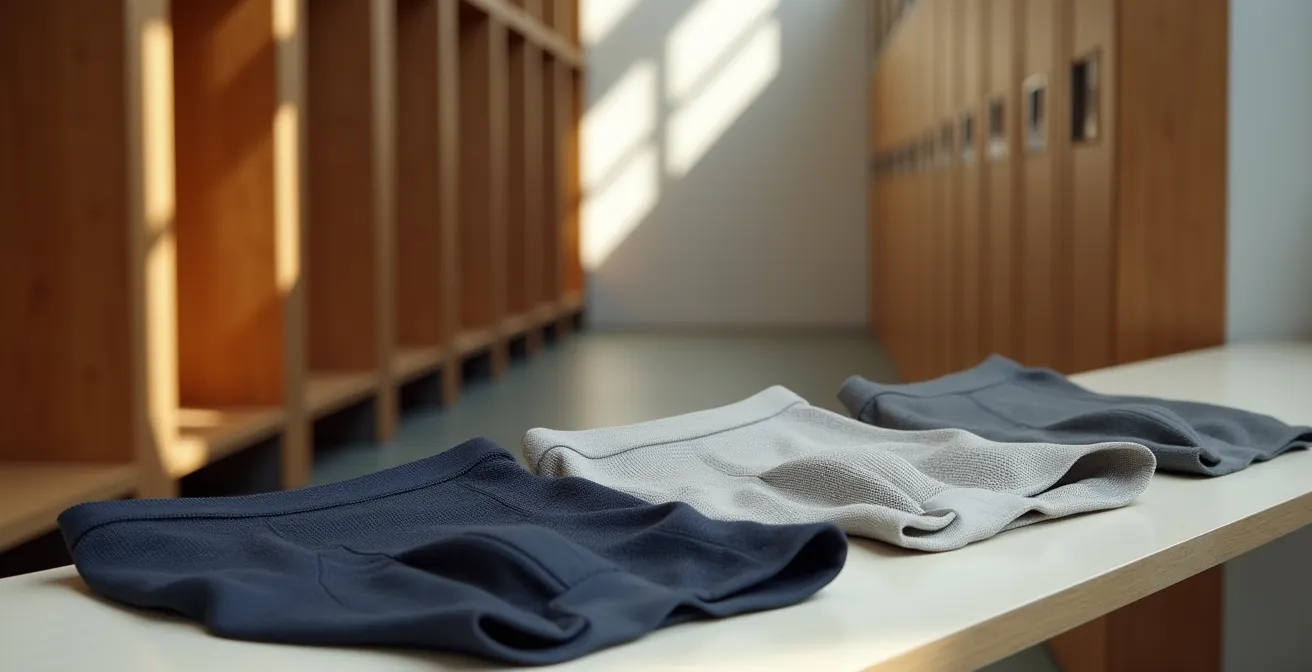
As you can see, the right choice can be almost indistinguishable from standard sportswear fabric from a distance. To ensure your choice is gym-appropriate, follow these technical guidelines:
- Prioritise Micro-Mesh: This is the most crucial factor. Micro-mesh fabric features perforations so small that they are not perceived as holes from a distance. The fabric appears as a solid, matte material. Brands like PUMP specialise in these styles specifically for athletic use because they offer maximum breathability without being see-through.
- Select Dark, Muted Colours: Navy, black, or charcoal grey micro-mesh are your safest bets. Dark colours absorb more light, which significantly reduces any perceived sheerness. From a few feet away, a pair of black micro-mesh boxer briefs will look identical to a standard pair.
- Understand Opacity Levels: Not all micro-mesh is the same. Some are polyester-based for durability, while others are softer cotton blends. Always look for descriptions that specify “micro-punch holes” or “pin-dot mesh,” often combined with Lycra for stretch, as these indicate a denser, more opaque construction.
- Apply the “Arm’s Length Rule”: A simple and effective test. If you hold the fabric at arm’s length and it appears opaque, it will certainly be appropriate in the social context of a changing room.
Micro-mesh vs Sports-mesh: Which resists snagging in the wash?
The longevity of any technical garment depends on its durability, and a common concern with mesh is its potential to snag or tear, particularly during washing. This is where understanding the difference between two primary categories—micro-mesh and sports-mesh—becomes critical. While both offer breathability, they are engineered from different materials with distinct structural properties, directly impacting their resistance to wear and tear. One is built for a soft, smooth feel, while the other is engineered for ruggedness.
The primary factor in snag resistance is the fabric’s thread structure and material composition. Micro-mesh is typically made from very fine polyamide or nylon threads, prized for their silky-smooth texture against the skin. However, these fine threads are more susceptible to catching on zippers, velcro, or even rough spots inside a washing machine drum. Sports-mesh, on the other hand, is usually constructed from more robust polyester fibres with a thicker, more durable weave. This construction is inherently more resistant to snagging and abrasion, making it a better choice for garments that will see heavy use and frequent washing. The following table breaks down the key differences, including considerations for the UK’s typically hard water.
For a direct comparison of their durability characteristics, this table, based on information from style guides like the Vocla men’s trend analysis, clarifies the trade-offs.
| Feature | Micro-mesh | Sports-mesh |
|---|---|---|
| Material | Fine polyamide/nylon | Robust polyester |
| Thread Structure | Smoother, finer threads | Thicker, more durable weave |
| Snag Resistance | Lower – prone to catching | Higher – more resistant |
| Washing Temperature | 30°C recommended | 40°C acceptable |
| UK Hard Water Impact | More affected | Less affected |
Regardless of the type, proper care is essential to maximise the lifespan of your mesh underwear. As experts in delicate fabrics advise, a gentle approach is always best. According to the care guide from specialist brand Rock & Lola:
Mesh underwear needs the bare minimum in washing terms, a short 20 minute cycle is best. Never wash your mesh lingerie in hot water, or tumble dry it.
– Rock & Lola Lingerie Care Guide, Everything you need to know about mesh lingerie
For best results, always use a laundry bag to protect mesh from other items in the wash, and always air dry. Heat from a tumble dryer is the fastest way to degrade the elastane that gives the fabric its stretch and fit.
The seam mistake that makes mesh underwear unbearable to wear all day
Even the most advanced, breathable fabric can be rendered unwearable by a single design flaw: poor seam construction. For any garment worn directly against the skin, and especially for performance underwear intended for all-day wear or physical activity, seams are the number one source of friction, chafing, and irritation. Traditional overlocked seams, with their raised, bulky profile, create pressure points that become increasingly uncomfortable over time. This is the critical mistake that many fashion-oriented brands make, prioritising cost over comfort.
True performance apparel brands, however, have invested heavily in solving this problem. The solution lies in two key engineering advancements: flatlock stitching and seamless construction. Flatlock seams, as the name suggests, are stitched in a way that creates a completely flat profile, eliminating any raised edges that could rub against the skin. This technique is a standard in high-end athletic wear, from running tights to cycling shorts, because it guarantees comfort over long durations.
The pinnacle of comfort, however, is the elimination of seams altogether. Brands like Under Armour have pioneered this approach in their performance lines. The UA Performance Tech™ Mesh, for example, is engineered with no side or back seams. By constructing the garment from a single piece of tubular fabric or using advanced bonding techniques, they remove the primary sources of friction. This results in a “second skin” feel that provides superior comfort, especially during extended wear or high-movement activities. The focus shifts entirely to the properties of the fabric itself, without the distracting and often painful interference of poorly placed stitches. When choosing mesh underwear for all-day wear, inspecting the seams should be your highest priority after the fabric itself.
How mesh underwear saves packing weight and drying time for travelers?
For the modern UK traveller, whether on a business trip to Europe or hiking in the Peak District, every gram and every square centimetre in their luggage counts. Budget airline carry-on restrictions are tighter than ever, and efficient packing is a skill. This is where mesh underwear reveals a surprising and highly practical performance benefit: its incredible efficiency in terms of weight, space, and drying time. It is, quite simply, the ultimate travel-friendly fabric.
Compared to traditional cotton, which is heavy and highly absorbent, modern micro-mesh made from polyamide or nylon is exceptionally lightweight. The open-weave structure that aids breathability also means there is simply less material, resulting in a garment that is both lighter and far more compressible. It can be rolled into a tiny, dense cylinder, taking up a fraction of the space of a bulky cotton pair.

The most significant advantage for travellers, however, is drying time. Cotton can take 8-10 hours or even longer to air dry in a humid hotel bathroom. Mesh, being a synthetic and non-absorbent fabric, dries in a fraction of that time. After a quick hand wash in the sink, it can be ready to wear again in just 2-3 hours. This means a traveller can pack fewer pairs, washing and rotating them as they go, dramatically reducing their packing load. The following checklist provides a practical guide for any UK-based traveller looking to maximise efficiency.
Your Action Plan: The UK Traveller’s Mesh Packing Audit
- Weight Audit: Replace three pairs of standard cotton underwear with three micro-mesh pairs. This can save up to 150g—more than the weight of a flagship smartphone.
- Drying Time Test: Hand-wash one pair upon arrival at your hotel. In a typical UK hotel bathroom, expect a drying time of 2-3 hours, enabling you to repack or re-wear it the same day.
- Space Optimisation: For flights from hubs like Stansted with strict carry-on limits, roll each mesh pair tightly. You’ll find that three rolled mesh pairs occupy roughly the same volume as one rolled t-shirt.
- Multi-Day Hike Prep: If you’re planning a trip to the Peak District or similar national parks, mesh is essential. Its quick-wash, quick-dry nature is invaluable when access to laundry facilities is limited.
- Consolidation Strategy: By leveraging the quick-drying properties, reduce the number of pairs you pack by a third. For a week-long trip, three pairs are often sufficient (wear one, wash one, one dry spare).
How to embrace the “naked look” trend with grace and confidence?
While the technical benefits of mesh are compelling, it’s impossible to ignore the aesthetic aspect that creates both appeal and apprehension: the “naked look.” Embracing this trend is less about having a certain body type and more about a mental shift in perspective. The key is to reframe the purpose of the sheerness. Instead of seeing it as something for an external audience, consider it a personal choice for your own comfort and confidence—a secret layer of performance that only you are aware of.
Think of it in the same way some people wear a “power suit” or a luxury watch. It’s an item that changes how you feel about yourself, projecting a confidence that comes from within. A well-chosen, comfortable pair of mesh underwear under your everyday clothes—be it office trousers or weekend jeans—can provide a subtle, personal boost. It’s a reminder of a deliberate choice you’ve made for your own comfort and style, a detail that is for you first and foremost. This internal re-framing is the most powerful tool for wearing any garment with grace.
Confidence also comes from knowledge. By understanding the technical aspects discussed in this article—choosing discreet micro-mesh, selecting dark colours, and ensuring a comfortable, seamless fit—you remove the sources of anxiety. You are no longer wearing a “revealing” garment; you are wearing a piece of technically superior apparel that happens to be lightweight and breathable. The confidence comes not from being willing to be seen, but from knowing you’ve made a smart, functional choice for your own well-being. The “naked look” is ultimately about the feeling of lightness and freedom the fabric provides, not about the visual for others.
How does silk wick sweat away from the body differently than sports synthetics?
When discussing moisture management in premium apparel, both silk and modern synthetics are often mentioned, but they function in fundamentally different ways. Understanding this distinction is crucial for choosing the right fabric for the right activity. Synthetics, like the polyester used in sports-mesh, are hydrophobic, meaning they repel water. Silk, on the other hand, is hygroscopic, meaning it absorbs water. This core difference dictates their ideal use cases.
A hydrophobic synthetic fabric doesn’t absorb sweat. Instead, it works by “wicking,” a process where the fabric’s structure pulls moisture from the skin’s surface to the outer layer of the garment, where it can evaporate. This is highly efficient for high-perspiration activities like a spin class or a run, as it actively moves large amounts of liquid away from the body. However, once the activity stops, the fabric can sometimes feel clammy as the remaining moisture sits on the surface.
Silk’s hygroscopic nature means it behaves more like a luxury sponge. It can absorb a significant amount of moisture without feeling wet to the touch. In fact, textile science research confirms that silk absorbs up to 30% of its weight in moisture while remaining dry against the skin. This makes it feel exceptionally comfortable in low-perspiration environments, like a day at the office in Canary Wharf. It manages the body’s natural, low-level moisture without the active “wicking” feel of a sports garment. The following table highlights these contextual differences.
| Property | Silk | Sports Synthetics |
|---|---|---|
| Mechanism | Hygroscopic (absorbs moisture) | Hydrophobic (wicks moisture) |
| Best Use | Low-perspiration office wear | High-intensity activities |
| Feel When Damp | Still feels dry to touch | Can feel clammy post-exercise |
| UK Context | Ideal under Canary Wharf suits | Perfect for spin classes |
While silk offers a luxurious feel and excellent moisture absorption for daily wear, it is not a performance fabric for intense exercise. It absorbs but does not dry quickly, making it unsuitable for situations where heavy sweating is expected. For true athletic performance, hydrophobic synthetics remain the superior technical choice.
Key Takeaways
- Mesh is a technical fabric engineered for superior thermoregulation, leveraging airflow to keep you cooler and drier than cotton.
- Fabric type (discreet micro-mesh vs. durable sports-mesh) and construction (flatlock or seamless) are the most critical factors for comfort and longevity.
- Beyond aesthetics, mesh offers quantifiable performance benefits for travel, including significant weight savings and drastically reduced drying times.
How do modern mesh blends offer the best of both worlds for the active man?
Historically, the choice in underwear fabric has been a series of compromises: the softness of cotton versus the moisture-wicking of polyester; the flexibility of elastane versus the structure of nylon. The modern evolution of men’s intimate apparel, however, is defined by the elimination of these compromises. Textile innovators are creating sophisticated hybrid blends that combine the best properties of multiple materials into a single, high-performance fabric. This is where mesh truly comes into its own, serving as a base platform for unprecedented comfort and functionality.
Brands at the forefront of this movement, like SAXX, demonstrate this principle perfectly. They have developed fabrics that blend the buttery-soft feel of Modal (a bio-based fibre derived from beech trees) with the cooling power of their proprietary DropTemp™ technology and the essential 4-way stretch of elastane. This creates a garment that is simultaneously soft, cooling, and completely non-restrictive. For more intense activities, they offer performance mesh made from durable nylon for muscle support, blended with elastane for flexibility. This approach signifies a move away from single-material garments and towards engineered solutions tailored to specific needs—softness for all-day wear, and structure for high-impact sports.
This trend towards intelligent blends is not a niche phenomenon; it’s a reflection of a wider market demand for performance in everyday clothing. According to industry analysis, consumers are increasingly prioritising functional benefits. In fact, a MaleBox’s 2025 fabric trend report reveals that Modal-elastane blends rank in the top 3 fabric choices for the coming year, highlighting a clear consumer shift towards fabrics that deliver both superior feel and tangible performance. Modern mesh blends are the ultimate expression of this philosophy, offering a no-compromise solution for the man who demands as much from his base layer as he does from his outerwear.
The next logical step is to re-evaluate your own daily essentials. Consider replacing a single cotton pair with an engineered mesh blend to experience the functional difference in thermoregulation and comfort firsthand.