
For those in the UK with sensitive skin, finding fabric that offers both comfort and elegance can be a constant struggle. The solution lies not just in satin’s smoothness, but in its ability to act as a personal microclimate manager. High-quality silk satin dynamically adapts to the UK’s fluctuating temperatures and humidity, offering a breathable, biocompatible layer that calms the skin, a benefit synthetic satins simply cannot replicate. This guide delves into the science of this unique interaction, empowering you to choose and care for the perfect satin garment.
For anyone navigating the challenges of sensitive skin or eczema, the search for comfortable clothing can feel like an endless compromise. The daily reality is often a trade-off between style and the risk of irritation, where even the softest-looking fabrics can hide a coarse secret. Standard advice often points towards practical but uninspiring options like cotton, leaving a desire for a touch of luxury unanswered. You might have been told that satin is a good alternative, a simple truth based on its famously smooth surface. But this only scratches the surface of a much deeper story.
The real magic of satin, particularly for those of us contending with the damp chill and dry indoor heat of the UK climate, is far more complex and rewarding. What if the key wasn’t just the fabric’s texture, but its active, intelligent relationship with your skin? The true genius of high-quality silk satin lies in its function as a ‘second skin’—a dynamic barrier that manages temperature and moisture to create a stable, soothing micro-environment. It’s a level of performance and comfort that goes far beyond simple smoothness.
This guide moves past the platitudes to explore the tangible science behind satin’s benefits. We will uncover how it regulates temperature, why not all satins are created equal, and how the right care rituals can preserve its unique properties. By understanding the distinctions in weave, quality, and material, you can finally invest in pieces that feel as good as they look, providing a sanctuary of comfort for your skin.
This article provides a comprehensive look into the world of satin, from its scientific properties to practical advice on selection and maintenance. Explore the sections below to become an expert in your own comfort.
Summary: Why Satin is the Ultimate Fabric for Sensitive Skin in the UK Climate
- Why does silk satin keep you warm in winter but cool in summer?
- How to remove creases from satin without leaving water marks?
- Polyester Satin vs Silk Satin: Which is better for sleep health?
- The laundry mistake that makes satin cling unflatteringly to your legs
- How to layer satin under wool without creating bulk?
- Why is the “bias cut” crucial for a chemise that moves with you?
- Charmeuse vs Crepe de Chine: Which silk weave is more snag-resistant?
- What distinguishes high-grade mulberry silk satin from cheaper blends?
Why does silk satin keep you warm in winter but cool in summer?
The ability of silk satin to provide comfort across seasons is perhaps its most remarkable quality, often described as ‘thermoregulation’. This isn’t just a marketing term; it’s a result of the fabric’s inherent physical properties. Silk is a protein fibre, and its structure allows it to manage the body’s microclimate with incredible efficiency. Unlike cotton, which absorbs moisture and holds it against the skin, or polyester, which traps heat, silk has exceptional hygroscopic properties. It can absorb a significant amount of moisture—up to 30% of its own weight—without feeling damp, wicking it away from the skin to keep you dry and comfortable.
In the cool, damp British winter, the cellular structure of silk fibres traps pockets of air, creating a natural insulating barrier that holds in your body heat. Conversely, during a rare British heatwave, silk’s high breathability and moisture-wicking ability release excess heat and sweat, producing a cooling effect. This active microclimate management is profoundly beneficial for sensitive skin. For the estimated 20% of children in the UK who develop eczema, maintaining a stable skin temperature and avoiding sweat build-up is critical to preventing flare-ups. Silk provides this stability, making it a soothing, non-irritating choice year-round.
This dual-action performance stems from what can be called a low thermal inertia. The fabric adapts quickly to your body’s needs, either retaining or releasing heat as required. It works in harmony with your body, rather than against it, creating a constant state of equilibrium that is the very definition of comfort for easily-stressed skin.
How to remove creases from satin without leaving water marks?
A beautifully draped satin garment can be instantly undermined by sharp creases, yet the fear of damaging the delicate fabric often prevents effective treatment. The key concern, especially in the many hard water areas across the UK, is that direct contact with water or an overly hot iron can leave permanent marks or a loss of lustre. The safest and most effective method avoids direct contact altogether, using controlled environmental moisture to gently relax the fibres.
The bathroom steam method is a time-honoured technique that works wonders. By hanging your satin garment in a steamy bathroom, the humidity penetrates the silk fibres, causing them to relax and straighten under their own weight. This process is gentle, chemical-free, and avoids the mineral deposits from hard water that can cause spotting. For this to be effective, the garment needs to hang freely on a padded or wooden hanger, away from any direct water spray, allowing the steam to circulate evenly.

As the illustration shows, the goal is to create a humid atmosphere that does the work for you. After about 15-20 minutes, the majority of wrinkles will have disappeared. For any lingering, stubborn creases, a final, careful step with an iron can be taken, but only with a pressing cloth as a barrier and the iron on its absolute lowest heat setting. This ensures the fabric is never exposed to direct, potentially damaging heat.
Your Action Plan: Emergency De-Creasing for Satin
- Atmosphere Creation: Fill your bathroom with steam from a hot shower for 10 minutes with the door closed to build humidity.
- Garment Placement: Hang the silk garment on a padded hanger, ensuring it’s away from any direct water contact.
- Gentle Smoothing: After 15 minutes of steam exposure, use clean, dry hands to gently smooth the fabric downwards.
- Stubborn Crease Tackling: For any remaining creases, use an iron on its lowest ‘silk’ setting with a pressing cloth between the iron and the fabric. Never apply the iron directly.
- Final Airing: Let the garment air-dry completely in a well-ventilated space before wearing to ensure no residual moisture remains.
Polyester Satin vs Silk Satin: Which is better for sleep health?
The term ‘satin’ refers to a specific weave, not a material. This distinction is critical when considering sleep health, as the lustrous finish can be achieved with vastly different fibres: natural silk or synthetic polyester. While both may look similar at a glance, their impact on your skin during an eight-hour sleep cycle is profoundly different. Synthetic fabrics, particularly polyester, are essentially a form of plastic. As one dermatologist notes, “Synthetic fabrics such as polyester can trap oil and sweat,” creating a warm, moist environment that is a breeding ground for bacteria and can exacerbate skin conditions.
This issue of biocompatibility is where silk satin truly excels. As a natural protein fibre, its structure is remarkably similar to human hair and skin. It is naturally hypoallergenic and breathable, allowing for the free exchange of air and moisture. This prevents the overheating and sweat build-up common with polyester, which can lead to clogged pores, irritation, and flare-ups of conditions like atopic eczema. For those with sensitive skin, choosing silk over polyester for sleepwear or bedding is not a luxury, but a health-conscious decision.
The differences extend to the potential chemical content of the fabrics. While high-quality silk can be certified as free from harmful substances, polyester production can involve a range of chemicals that may leave residues. The following comparison highlights the clear advantages of silk for anyone prioritising their skin’s health and comfort during sleep.
| Property | Silk Satin | Polyester Satin |
|---|---|---|
| Chemical Content | Natural protein fibers, OEKO-TEX certified options available | May contain formaldehyde, azo dyes, heavy metals |
| Breathability | Naturally breathable, reduces sweat buildup | Non-breathable, traps heat and moisture |
| Hypoallergenic | Naturally hypoallergenic, resists dust mites | Can trigger allergic reactions |
| Impact on UK Skin Conditions | Recommended by British dermatologists for eczema | Can worsen atopic eczema symptoms |
The laundry mistake that makes satin cling unflatteringly to your legs
There is nothing more frustrating than a beautiful satin slip or skirt that stubbornly clings to your legs, ruining its elegant drape. This phenomenon is caused by static electricity, and one common laundry mistake is the primary culprit, especially in UK homes during the autumn and winter months. The instinct is often to use a fabric softener to make the garment feel softer and reduce static. However, on a delicate fabric like silk satin, these softeners can build up, creating a residue that paradoxically attracts more lint and increases static charge.
The dry air created by central heating systems is a major contributor to static build-up. Without sufficient moisture in the air to dissipate the electrical charge, the fabric becomes a magnet for static. The solution lies in washing practices that preserve the natural properties of the silk without adding synthetic coatings.
Case Study: The UK Central Heating and Static Cling Connection
Research conducted by the UK-based silk specialist Gingerlily explored the impact of home environments on silk garments. They found a direct correlation between the use of central heating in UK homes and an increase in static cling on silk. Their recommended solution was to avoid fabric softeners entirely. Instead, they advocate for using a specialist silk washing detergent that rinses clean. As a natural static reducer, they suggest adding a small splash of white vinegar to the final rinse cycle, which helps to break down alkaline residues from detergent without damaging the delicate silk fibres, thus restoring the fabric’s natural, static-free state. This is based on findings from their guide on caring for silk garments.
Beyond the wash cycle, there are immediate fixes. A quick but effective trick is to run a metal hanger along the inside and outside of the garment. The metal discharges the static electricity, instantly releasing the cling. For a more lasting solution, a light misting with an anti-static spray specifically formulated for delicates can be applied from a distance, creating a temporary barrier against static build-up.
How to layer satin under wool without creating bulk?
Layering is an art form essential for navigating the UK’s unpredictable weather, but for those with sensitive skin, it presents a challenge. Coarse fabrics like wool, while warm, can be intensely irritating when in direct contact with the skin. The solution is to use silk satin as a protective base layer. Its genius lies in its incredibly low frictional coefficient. The ultra-smooth surface of the satin allows heavier fabrics, like a merino or cashmere jumper, to glide effortlessly over it without catching or creating friction.
This frictionless interface means you can achieve warmth without the bulk. A fine silk camisole or slip adds virtually no volume but provides a crucial barrier that protects your skin from the abrasive texture of the outer layer. The result is a sleek silhouette where fabrics work together, not against each other. This is particularly effective when the satin garment is ‘cut on the bias’, which gives it a natural elasticity that moves with your body, preventing any uncomfortable bunching or pulling under your clothes.
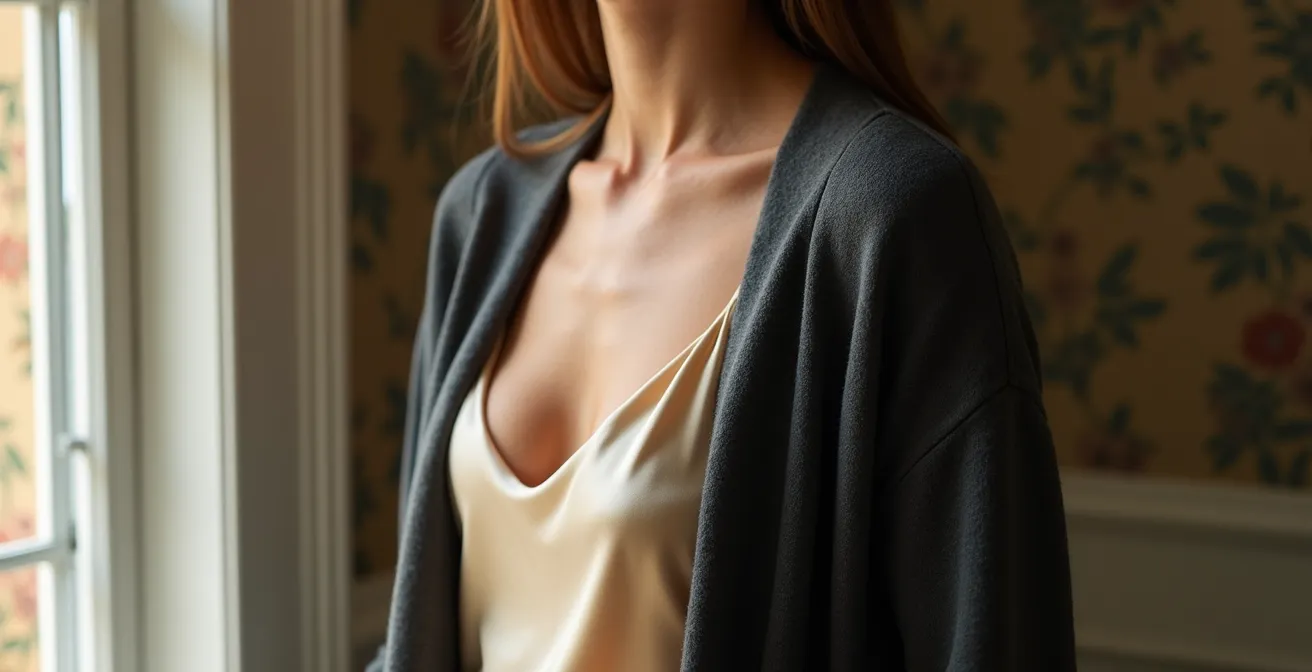
Furthermore, this layering technique offers a significant health benefit. When layering, moisture can become trapped between fabrics. For eczema-prone skin, this can increase the risk of bacterial growth and irritation. A UK study on children’s clothing highlights that silk’s anti-microbial properties reduce the risk of infection in compromised skin. By using silk as the layer closest to your body, you are not only creating a physical barrier but also a more hygienic one, making it the smartest and most comfortable choice for winter layering.
Why is the “bias cut” crucial for a chemise that moves with you?
A well-designed silk chemise should feel like a whisper against the skin, moving as you do without twisting or constricting. The secret to this fluid, body-skimming drape is a couture technique known as the bias cut. Most fabrics are woven with threads running vertically (the warp) and horizontally (the weft). When fabric is cut parallel to these threads, it has very little give. The bias cut, however, involves cutting the fabric at a 45-degree angle to the grain.
This simple change in angle unlocks the fabric’s hidden potential. It creates a ‘mechanical stretch’ that allows the garment to drape and flow in a way that is impossible with a straight cut. The fabric clings gently to curves and moves with the body, rather than resisting it. For sleepwear, this is a game-changer. As you turn in your sleep, a bias-cut chemise will stretch and adapt, preventing the fabric from pulling tight or creating points of friction against the skin. For those with sensitive or painful skin conditions, this reduction in micro-abrasion is a significant source of comfort.
Case Study: Madeleine Vionnet’s Bias Cut Revolution
The bias cut was pioneered and perfected by French couturier Madeleine Vionnet in the 1920s. She saw it as a way to liberate the female form from rigid tailoring, creating dresses that ‘poured’ over the body. By cutting silk satin on the diagonal, she harnessed its natural weight and lustre to create garments that were both incredibly glamorous and supremely comfortable. This technique is especially beneficial for sensitive skin sufferers, as it ensures the fabric maintains gentle, constant contact without any single point of pressure or friction, particularly during the movements of sleep.
When you see a chemise or slip that seems to float and follow the body’s lines perfectly, it is almost certainly the result of this intelligent design. The bias cut is not just a stylistic choice; it is the fundamental piece of engineering that transforms a simple garment into a true ‘second skin’, offering unparalleled comfort in motion.
Charmeuse vs Crepe de Chine: Which silk weave is more snag-resistant?
When investing in silk, durability is a major consideration. The heartbreak of a snag on a new garment is a real concern, and the fabric’s resistance to this depends entirely on its weave. Two of the most common silk weaves, Charmeuse and Crepe de Chine, offer very different performance profiles. Charmeuse is what most people picture when they think of satin: it has a brilliant, liquid-like lustre on one side and a dull matte finish on the other. This shine is created by ‘floating’ warp threads over several weft threads, which means long, exposed filaments lie on the surface. While beautiful, these threads are susceptible to catching on jewellery or rough surfaces, making it less ideal for everyday wear.
Crepe de Chine, by contrast, is a more resilient choice. It is woven from tightly twisted yarns, which gives it a subtly pebbled or textured surface and a more muted, sophisticated sheen. This twisted structure makes the surface much more durable and resistant to snagging. It also has the advantage of being less prone to showing water marks and wrinkles, making it an excellent, low-maintenance option for daywear, blouses, or even travel pieces. For a busy lifestyle, such as a commute in London, Crepe de Chine offers the luxury of silk with a much greater degree of practicality.
Choosing between them is a matter of matching the weave to the occasion. For intimate apparel or sleepwear where the primary goal is the ultimate smooth glide against the skin, Charmeuse is unparalleled. For items that will face the rigours of daily life, Crepe de Chine provides a far more durable and worry-free experience.
| Aspect | Charmeuse | Crepe de Chine |
|---|---|---|
| Surface Structure | Floating threads for high lustre | Tightly twisted yarns, pebbled texture |
| Snag Resistance | Lower – exposed threads catch easily | Higher – resilient twisted surface |
| Best UK Use | Sleepwear, intimate apparel | Day-to-night wear, London commute |
| Sensitive Skin Feel | Ultra-smooth glide | Subtle textured flow, less clammy |
Key Takeaways
- Silk satin’s value lies in its ability to actively manage temperature and moisture, creating a stable microclimate for sensitive skin.
- Proper care, like using steam for creases and avoiding fabric softeners, is essential to maintain silk’s natural, static-free properties.
- The “bias cut” is a crucial design feature for comfort in motion, while the weave (e.g., Charmeuse vs. Crepe de Chine) determines durability.
What distinguishes high-grade mulberry silk satin from cheaper blends?
In the world of satin, not all that shines is silk, and not all silk is created equal. The distinction between a high-grade Mulberry silk satin and a cheaper blend or a polyester imitation is not just a matter of luxury; it’s a matter of performance, comfort, and skin health. The first and most important marker of quality is the fibre itself. Mulberry silk is produced by silkworms fed exclusively on mulberry leaves. This controlled diet results in the longest, strongest, and most uniform silk fibres available. Cheaper silks or blends may use shorter fibres, which result in a less smooth, less durable fabric that is more prone to pilling.
Another key indicator of quality is the fabric’s weight, measured in ‘momme’. A higher momme weight (e.g., 19-25 momme) indicates a denser weave with more silk per square inch, resulting in a more durable and opaque fabric. While lighter weights have their place, a substantial momme weight is a sign of a premium product. However, for those with sensitive skin, the most critical distinction is chemical safety.
High-quality silk garments are often certified by independent bodies that test for harmful substances. The most respected of these is the STANDARD 100 by OEKO-TEX®. As one leading silk provider clarifies:
STANDARD 100 by OEKO-TEX® certified silk is independently tested as safe from harmful chemicals
– Mulberry Park Silks, Silk Quality Standards Guide
This certification is a guarantee that the fabric against your skin is free from irritants and allergens, a non-negotiable factor for anyone with eczema or chemical sensitivities. A cheaper blend or polyester satin will not offer this same assurance of purity and biocompatibility. Ultimately, investing in high-grade Mulberry silk is an investment in a calmer, more comfortable relationship with the clothes you wear.
To truly care for your skin, the next step is to consciously choose garments made from certified, high-quality silk. By prioritising biocompatible materials, you are investing not just in clothing, but in your daily comfort and well-being.